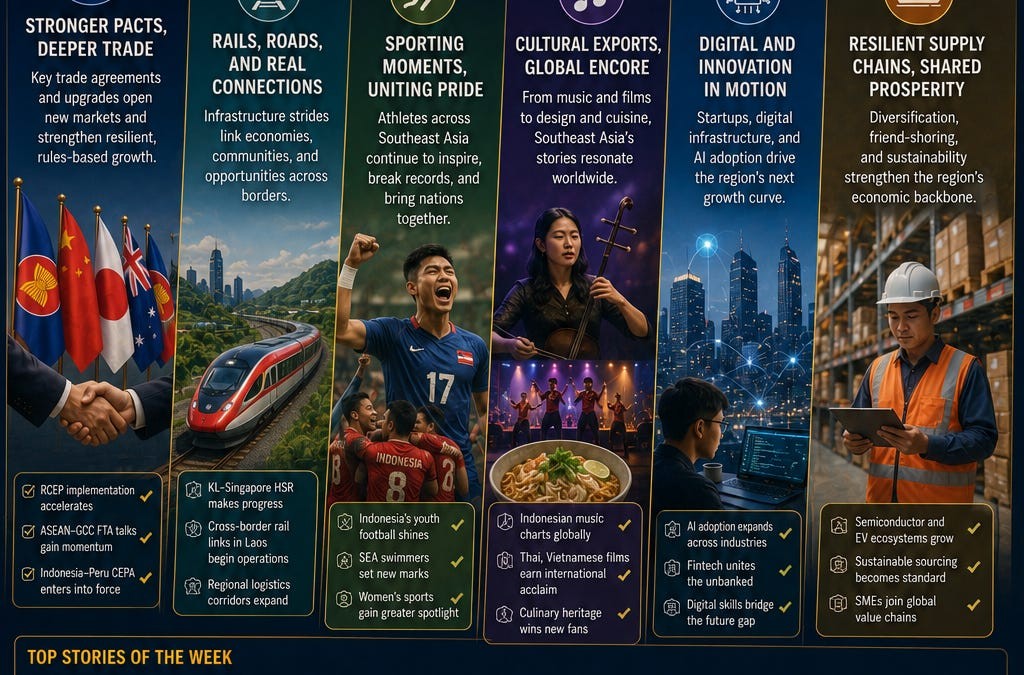
According to www.thesoutheastasiadesk.com, ASEAN and South Korea have elevated their economic partnership to prioritize supply-chain resilience over tariff reduction alone, while Indonesia’s D-8 Halal Expo closed with US$13.4 million in transaction commitments — part of a broader regional push spanning energy strategy, bilateral trade targets, sports diplomacy, and cultural exports.
ASEAN–ROK Shifts Focus to Strategic Resilience
At the 2026 ASEAN–ROK Regional Connectivity Forum held in Jakarta on 16 July, policymakers advanced plans to transform the ASEAN–Korea Free Trade Area (AKFTA) into a platform for supply-chain security — moving decisively beyond traditional trade liberalization. This strategic pivot reflects lessons drawn from recent geopolitical tensions, pandemic-era disruptions, and tightening climate regulations. According to the report, the upgraded framework aims to strengthen cross-border coordination in critical sectors including semiconductors, batteries, and medical supplies — areas where both blocs face overlapping vulnerabilities and complementary manufacturing capabilities.
Energy Security Moves Beyond Stockpiles
Southeast Asia’s dependence on fossil fuels is now widely recognized as a structural risk, prompting experts at a joint public discussion by the FPCI Climate Unit and the ISEAS – Yusof Ishak Institute to call for a fundamental reorientation: energy security must be defined not by fuel reserves but by grid reliability and clean power integration. The consensus, per the source, is that a modernized, interoperable ASEAN Power Grid is no longer merely an environmental objective — it is the foundational requirement for attracting high-value global investment. Without demonstrable progress on cross-border electricity trading and renewable integration, the region risks falling behind in next-generation manufacturing and data infrastructure deployment.
Halal Economy Gains Traction with $13.4M Commitments
Indonesia hosted its inaugural D-8 Halal Expo from 8–12 July in Jakarta, generating more than US$13.4 million in verified transaction commitments. The event spotlighted halal-certified opportunities across six verticals: food and beverages, cosmetics, fashion, pharmaceuticals, tourism, and Islamic finance. These outcomes directly support the D-8 Organization for Economic Cooperation’s stated goal of raising intra-bloc trade to US$500 billion by 2030. According to the source, Indonesia and Malaysia — both D-8 members — led participation, with over 120 exhibitors representing eight member states.
Bilateral Momentum: Indonesia–Vietnam Target $18B Trade
Indonesia and Vietnam have signed a five-year action plan to implement their comprehensive strategic partnership, reaffirming their shared target of US$18 billion in annual bilateral trade. The agreement covers coordinated efforts in digital economy development, maritime security cooperation, and joint ventures in green hydrogen and electric vehicle battery recycling. As noted in the report, this marks a deliberate shift from competitive positioning to functional complementarity — leveraging Indonesia’s mineral resources and Vietnam’s electronics assembly capacity to co-develop regional supply-chain nodes rather than replicate them.
Sports & Culture Amplify Regional Voice
The Singapore Tennis Open (STO) has been upgraded to a WTA 500 tournament — making it Southeast Asia’s sole event at that tier — scheduled for 21–27 September at the OCBC Arena. Filipino player Alexandra Eala, ranked World No. 32 and the highest-ranked Filipino in WTA history, has confirmed her participation. Concurrently, Southeast Asian developers are exporting culturally grounded horror narratives globally: titles such as Pamali (Indonesia), Home Sweet Home (Thailand), Scarred (Singapore), The Scourge (Vietnam), and Paper Ghost Stories: Third Eye Open (Malaysia) exemplify how local folklore and social anxieties are being translated into internationally competitive game design. According to the source, these titles collectively generated over 2.1 million units sold across Steam and mobile platforms in Q2 2026 — a 42% year-on-year increase.
Source: thesoutheastasiadesk.com
Compiled from international media by the SCI.AI editorial team.