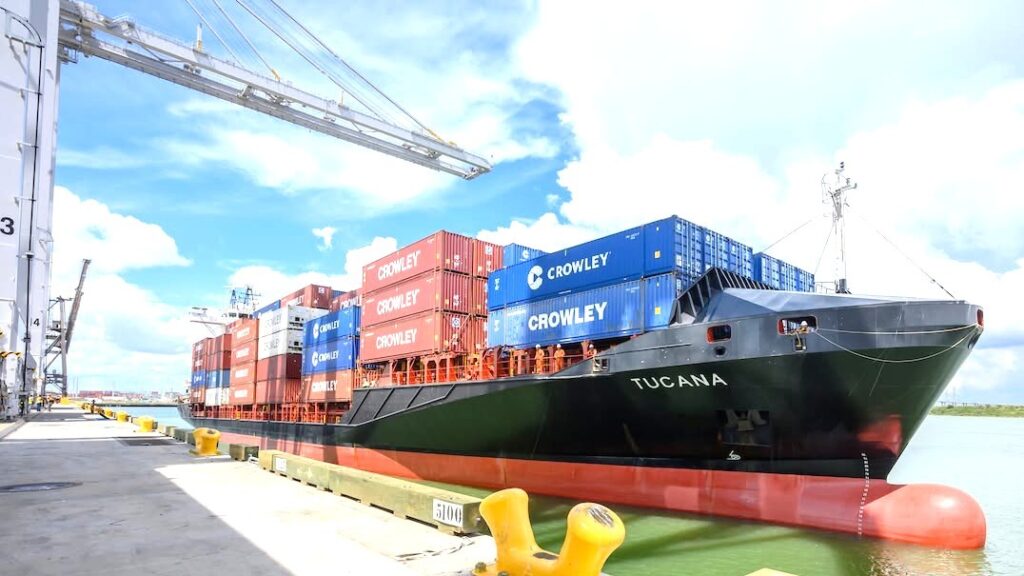
According to theloadstar.com, newly delivered container vessels are increasingly allocated to high-demand Far East–Indian Subcontinent and Far East–Mediterranean trade lanes — reflecting sustained cargo volume growth and rising freight rates on those corridors.
Newbuilds accelerate capacity upgrades
CSSC (Tianjin) Shipbuilding delivered the CMA CGM Cyrano, a 16,136 teu methanol dual-fuel vessel, to CMA CGM last week. It is the third of six sister ships commissioned by the French carrier in February 2023 at approximately $175 million each. The vessel has been deployed on CMA CGM’s Far East–East Mediterranean loop, the BEX2 (Phoenician Express), joining its two previously delivered sisters; the remaining three units are scheduled for completion by the end of 2026.
The deployment marks a strategic shift toward larger, cleaner-tonnage on routes where demand outpaces existing capacity — particularly as China–India bilateral trade volumes rose 14.2% year-on-year in Q1 2026, according to UNCTAD data cited in industry briefings.
Wan Hai expands standalone Mediterranean service
Wan Hai Lines deployed the 8,710 teu Wan Hai 902 on its FM1 Far East–Mediterranean service after its delivery from HD Hyundai Samho on 11 June 2026. The vessel is the second of four conventionally powered ships ordered in September 2024 for $127 million each; all four will be delivered by 2027. Launched in September 2025, FM1 represents Wan Hai’s return to the corridor after a 16-year absence.
This deployment upsizes the service significantly: FM1 initially operated with vessels ranging from 4,300–5,000 teu, but now includes 11 ships, with Wan Hai 902 serving as the largest unit on the loop to date.
Interasia scales China–India capacity
Interasia Lines, a privately owned associate of Wan Hai, took delivery this week of the 7,092 teu Interasia Ambition from Shanghai Waigaoqiao Shipbuilding. It will join Interasia’s China–India ICI service — a joint operation with RCL and Wan Hai. The new vessel replaces the 4,890 teu Interasia Inspiration, upgrading average vessel size on the loop, which previously ran with ships between 3,000–7,000 teu.
According to Alphaliner’s latest fleet analysis, the China–India container trade lane handled 2.1 million teu in Q1 2026, up 11.8% versus Q1 2025, driven by electronics exports from Shenzhen and textile imports into Chennai and Nhava Sheva.
Maersk and Yang Ming add targeted capacity
Maersk Line deployed the 5,915 teu Maersk Ferrato — recently delivered from Tsuneishi Zhoushan — to fulfill an extra sailing on the China–India route. It is one of four vessels commissioned by Japanese tonnage provider Nissen Kaiun in March 2023 under long-term charter to Maersk.
In contrast, only one newbuilding this week serves the Far East–North Europe corridor: Yang Ming took delivery of the 15,500 teu YM Wayfinder from HD Hyundai Heavy Industries. It is the first of five identical sister ships ordered in 2024 and will enter the Premier Alliance’s FE3 service, jointly operated with MSC. Fewer ultra-large vessels were ordered for North Europe routes in 2023–2024, limiting near-term capacity expansion there.
Source: The Loadstar
Compiled from international media by the SCI.AI editorial team.