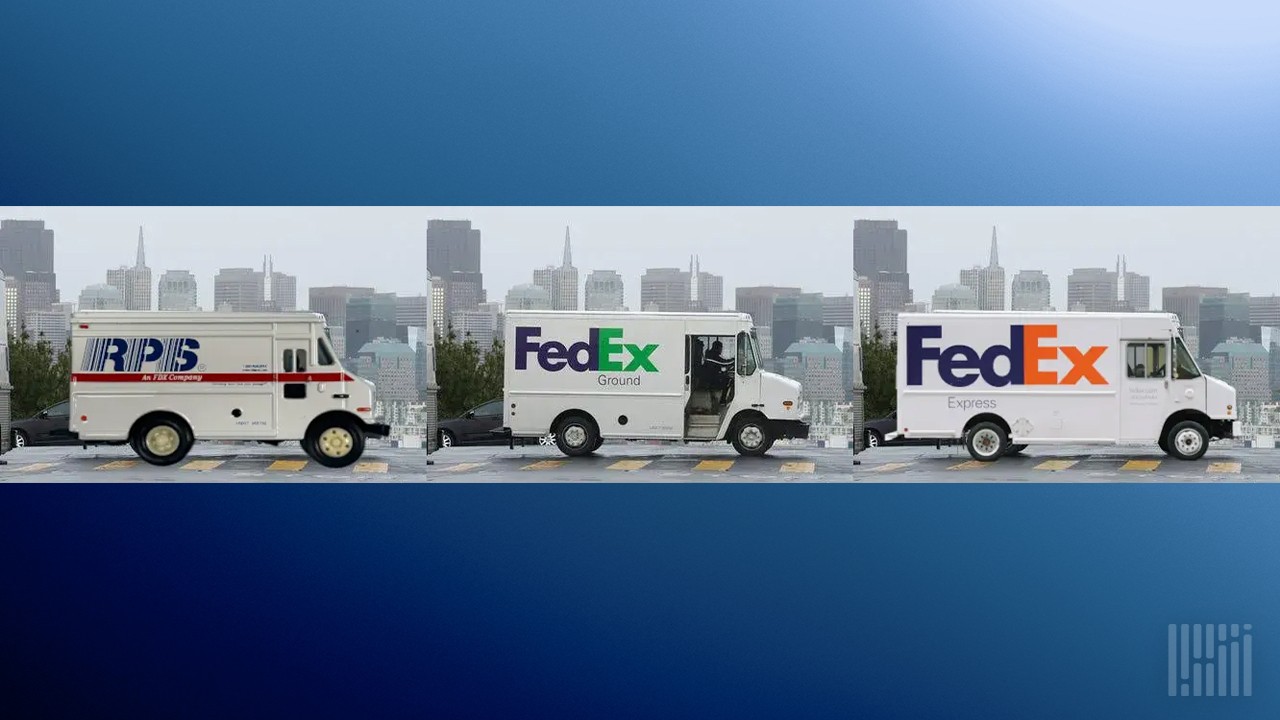
FedEx would no longer be a major player in the domestic U.S. parcel market were it not for the acquisition of RPS, which became FedEx Ground, says industry expert Satish Jindel.
Spin-off Highlights RPS’s Foundational Role
On Monday, FedEx Corp. spun-off its Freight division. What is left is the combined network of FedEx Express and FedEx Ground. It’s an opportune time to remember that FedEx (NYSE: FDX) would be a distant third-place parcel carrier in the U.S. market without the acquisition of RPS as part of the $2.4 billion deal for Caliber System in 1998. And, were it not for RPS, FedEx likely wouldn’t have acquired Caliber and its regional less-than-truckload subsidiary, Viking Freight. FedEx wasn’t looking to get into the LTL space, but had to buy Viking to get RPS. FedEx founder Fred Smith liked the Viking acquisition so much that in 2001, he acquired American Freightways to be able to offer full coverage across the lower 48 states. And now, FedEx shareholders will receive one share of FedEx Freight (NYSE: FDXF) for every two shares they hold in the parcel delivery company.
Volume & Market Shifts Since 1998
At the time of the deal in 1998, RPS handled 1.3 million parcels per day while FedEx Express was delivering 3 million. Since then, the parcel industry has undergone enormous change. Carriers began to offer guaranteed on-time performance for the ground service and e-commerce exploded to the point that segmentation in the parcel market has completely reversed from 80% B2B to 75% lightweight B2C shipments. As retailers offer more free shipping, FedEx customers need the ground service and not the expensive express delivery.
Today, FedEx express volume is just 1.8 million packages per day, while FedEx Ground (formerly RPS) volume has increased to 13 million pieces per day.
Pioneering the Low-Cost Ground Model
RPS pioneered the low-cost ground delivery operating model based on use of independent contractors with their own vans and later use of master contractors, which has been copied by Amazon (NASDAQ: AMZN) and smaller startups like Better Trucks, Jitsu, and OnTrac.
RPS, which opened for business in 1985, was very successful before its acquisition by FedEx. Founded by Daniel J. Sullivan, RPS rapidly grew from a Northeast regional carrier to a nationwide carrier serving all major markets within seven years. Beside insisting on great on time service, Dan intensely focused his team on constantly improving productivity that allowed RPS to compete with UPS. As a result, RPS was the low-cost producer in the small package delivery space.” By 1996, allowed RPS to rapidly expand service to 100% of the U.S. population and capture more than 15% of the market share. Other regional carriers at the time — Spee Dee Delivery, GPS and OnTrac — collectively controlled less than 5% of the parcel market. Thirty years later, they still remain at the same level.
Financial Performance: RPS vs. FedEx Express
RPS was a cash cow, generating double digit margins. Since RPS’s rebranding as FedEx Ground in 2000, it generated cumulative revenue of $333 billion, representing a staggering growth rate of 1,585% or CAGR of 12.49%. FedEx Ground also produced $40 billion in operating income at an average operating margin of 12.9% over the past quarter century.
- By contrast, during the same period, FedEx Express had cumulative revenues of $679 billion for a growth rate of 171% or CAGR of 4.24%, with cumulative operating income of $37 billion
- Its average operating margin over the same period is 5.6%
Technology Edge Over UPS
RPS’s success was not simply the result of excellent operational and financial execution. It deployed technology that FedEx’s main competitor, UPS, did not have at the time. RPS, for example, was able to bill customers based on true shipment attributes, track shipments in near-real time instead of waiting for days to get status from UPS, and aligned operations and contractors’ settlement to the shipping profile of thousands of customers to build density with much fewer parcels and generate high profit margin.
From Skepticism to Acclaim
Fred Smith originally was skeptical about buying RPS. At an industry event in 1996, after being told by bankers to buy RPS, Mr. Smith asked me, in the presence of CFO Alan Graf Jr., the following question: “FedEx Express is a Cadillac and RPS is a Chevy. So why do I want to buy RPS?” I responded, “Sir, what if Chevy generates a higher margin than Cadillac?” That response led to me providing a report to support the great profit generating model of RPS and the reasons to also buy Viking Freight. Using that report, in February 1997, Fred Smith called Sullivan with interest in buying Caliber System.
“the greatest transportation start-up,” adding, “I can’t imagine what FedEx would be today without RPS’s unique lost-cost operating model. . . I could not have predicted a revenue stream of $35 billion by 2023. No doubt, the best acquisition in the history of FedEx.” — Alan Graf Jr., former CFO of FedEx
“With its focus on B2B customers that were under served and overpriced, and leveraging technology, RPS brought a new value proposition to the market and helped to wake up Big Brown,” he said at the event. “Dan and company, congratulations on the incredible long-term success of the story, the vision, and the focus on the customer that inspired the whole industry.” — Kurt Kuehn, former CFO of UPS (NYSE: UPS)
Absent RPS and its low-cost operating model for ground service, FedEx would not have grown revenue as much as it has these past 28 years. It is now in position, with the integration of its two networks and using RPS’s low-cost operating mode for both express and ground services, to become the largest for-hire carrier in the domestic U.S. parcel market.
Source: FreightWaves
Compiled from international media by the SCI.AI editorial team.