Explore

  • Trending
  • Latest
  • Tools
  • Browse
  • Subscription Feed

Logistics

  • Ocean
  • Air Cargo
  • Road & Rail
  • Warehousing
  • Last Mile

Regions

  • Southeast Asia
  • South Asia
  • Central Asia
  • Japan & Korea
  • Middle East
  • Europe
  • Russia
  • Africa
  • North America
  • Latin America
  • Australia
SCI.AI
  • Supply Chain
    • Strategy & Planning
    • Logistics & Transport
    • Manufacturing
    • Inventory & Fulfillment
  • Procurement
    • Strategic Sourcing
    • Supplier Management
    • Supply Chain Finance
  • Technology
    • AI & Automation
    • Robotics
    • Digital Platforms
  • Risk & Resilience
  • Sustainability
  • Research
  • Expert Columns
  • English
    • Chinese
    • English
No Result
View All Result
  • Login
  • Register
SCI.AI
No Result
View All Result
Home Supply Chain Inventory & Fulfillment

GreyOrange CEO: AI-orchestrated warehouse automation scales in 5–10 years

2026/05/27
in Inventory & Fulfillment, Supply Chain, Warehousing
0 0
GreyOrange CEO: AI-orchestrated warehouse automation scales in 5–10 years

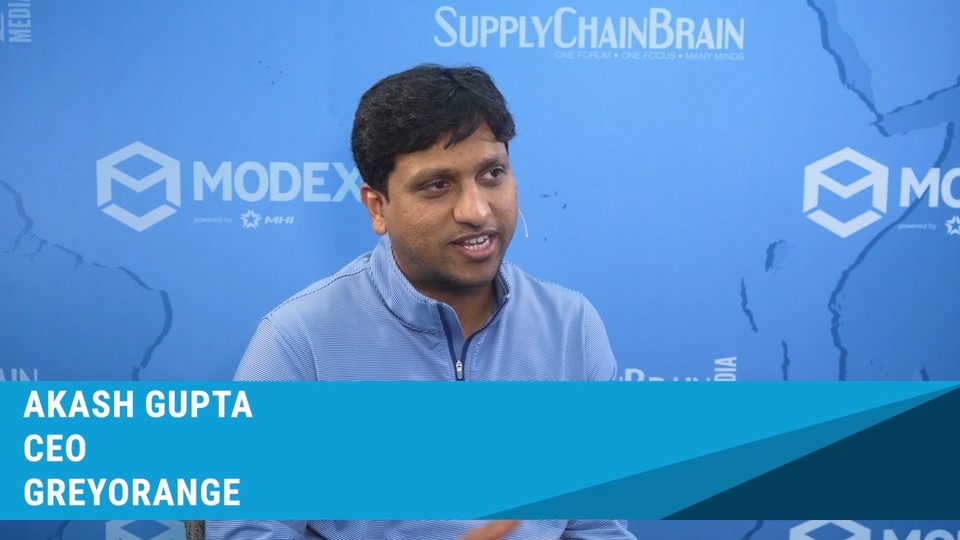
According to www.supplychainbrain.com, Akash Gupta, chief executive officer of GreyOrange, identifies orchestration—not isolated robotics—as the most critical decision in modern warehouse automation. Speaking at the CNS Conference on May 26, 2026, Gupta emphasized that facilities are now entering “stage two” of automation: shifting focus from how individual technologies function in isolation to how they deliver end-to-end value for the customer.

From Integration to Orchestration

Gupta stressed that automating only one segment of warehouse operations—such as picking or sorting—fails to resolve systemic inefficiencies. “Automating just one part of the process is just shifting the bottleneck from one place to another,” he said. What’s required, he argued, is true orchestration: the synchronized coordination of humans, robots, and underlying software systems beyond conventional IT integration. This approach ensures all components operate in harmony—responding dynamically to real-time demand shifts, labor availability, and inventory fluctuations.

The Dual-AI Architecture

While large language models (LLMs) dominate headlines, Gupta clarified they represent only a portion of the AI stack needed for robust warehouse orchestration. According to the report, success depends on combining LLMs with traditional AI, specifically machine learning, to enable more contextual decisions. For example, ML models trained on historical throughput, equipment failure logs, and seasonal SKU velocity allow predictive task allocation across autonomous mobile robots (AMRs), conveyor networks, and human workstations—whereas LLMs alone lack the precision for real-time operational control.

Timeline and Scope of Automation

Gupta projected that within the next five to 10 years, virtually every core warehouse function will be automated. He specified four foundational domains undergoing transformation: mobility (e.g., AMRs and autonomous forklifts), manipulation (e.g., robotic arms with vision-guided grasping), sensing (e.g., IoT-enabled environmental and load monitoring), and documentation (e.g., AI-powered audit trails, compliance reporting, and digital twin synchronization). This timeline aligns with industry benchmarks: ABI Research forecasts global warehouse automation spending will reach $3.5 billion by 2027, up from $1.9 billion in 2022—a compound annual growth rate of 12.8%.

Industry Context and Practitioner Implications

This shift toward orchestration reflects broader market evolution. Locus Robotics, for instance, launched its multi-robot orchestration platform LocusBot Fleet Manager in Q3 2025, enabling real-time reassignment of 500+ robots across dynamic order waves. Similarly, Honeywell Intelligrated reported in early 2026 that 72% of its new warehouse automation contracts now include embedded orchestration layers—not just hardware deployment. For supply chain professionals, this means legacy WMS upgrades are no longer sufficient; practitioners must now evaluate vendors’ interoperability frameworks, API maturity, and AI model transparency. As Gupta noted, “It’s not about buying more robots—it’s about buying intelligence that unifies them.”

“Stage two” of warehouse automation and robotics finds facilities shifting from figuring out how a particular piece of technology works in isolation, to how it creates “end-to-end value for the customer.” — Akash Gupta, chief executive officer of GreyOrange

Source: Supply Chain Brain

Compiled from international media by the SCI.AI editorial team.

More on This Topic

  • Global Warehouse Buildings Market Grows 4.8% CAGR to 2035 (May 27, 2026)
  • Quad Nations Ink Critical Mineral Pact Amid 8.3% Industrial Inflation (May 27, 2026)
  • Wärtsilä raises technical production capacity 30% with €140M hub investment (May 27, 2026)
  • Stord raises $250M at $3B valuation (May 27, 2026)
  • Yusen Logistics inks cargo.one deal for 100 branches (May 27, 2026)
ShareTweet

Related Posts

Global Warehouse Buildings Market Grows 4.8% CAGR to 2035
Strategy & Planning

Global Warehouse Buildings Market Grows 4.8% CAGR to 2035

May 27, 2026
0
Quad Nations Ink Critical Mineral Pact Amid 8.3% Industrial Inflation
Manufacturing

Quad Nations Ink Critical Mineral Pact Amid 8.3% Industrial Inflation

May 27, 2026
0
Wärtsilä raises technical production capacity 30% with €140M hub investment
Manufacturing

Wärtsilä raises technical production capacity 30% with €140M hub investment

May 27, 2026
0
Stord raises $250M at $3B valuation
Inventory & Fulfillment

Stord raises $250M at $3B valuation

May 27, 2026
0
Yusen Logistics inks cargo.one deal for 100 branches
Last Mile

Yusen Logistics inks cargo.one deal for 100 branches

May 27, 2026
0
DHL, Expeditors scale AI logistics as servers hit $3M/unit
Logistics & Transport

DHL, Expeditors scale AI logistics as servers hit $3M/unit

May 27, 2026
0

Leave a Reply Cancel reply

Your email address will not be published. Required fields are marked *

Recommended

Bank of America Appoints Chris Jameson as Global Supply Chain Finance Head #1

Bank of America Appoints Chris Jameson as Global Supply Chain Finance Head #1

8 Views
May 3, 2026
Supply Chain AI Adoption: Only 10% Trust Full Automation in 2026

Supply Chain AI Adoption: Only 10% Trust Full Automation in 2026

14 Views
March 29, 2026
红海航线重开在即:2026年全球集装箱航运业迎来「寒冬」

Red Sea Route Set to Reopen: Global Container Shipping Industry Faces a “Cold Spell” in 2026

37 Views
February 15, 2026
Economist Comments on Fed Rate Cut Impact on Freight Transportation and Logistics

Economist Comments on Fed Rate Cut Impact on Freight Transportation and Logistics

14 Views
February 16, 2026
Show More

SCI.AI

Global Supply Chain Intelligence. Delivering real-time news, analysis, and insights for supply chain professionals worldwide.

Categories

  • Supply Chain Management
  • Procurement
  • Technology


  • Risk & Resilience
  • Sustainability
  • Research

© 2026 SCI.AI. All rights reserved.

Powered by SCI.AI Intelligence Platform

Welcome Back!

Sign In with Facebook
Sign In with Google
Sign In with Linked In
OR

Login to your account below

Forgotten Password? Sign Up

Create New Account!

Sign Up with Facebook
Sign Up with Google
Sign Up with Linked In
OR

Fill the forms below to register

All fields are required. Log In

Retrieve your password

Please enter your username or email address to reset your password.

Log In

Scan to share via WeChat

Open WeChat and scan the QR code to share

QR Code

Add New Playlist

No Result
View All Result
  • Supply Chain
    • Strategy & Planning
    • Logistics & Transport
    • Manufacturing
    • Inventory & Fulfillment
  • Procurement
    • Strategic Sourcing
    • Supplier Management
    • Supply Chain Finance
  • Technology
    • AI & Automation
    • Robotics
    • Digital Platforms
  • Risk & Resilience
  • Sustainability
  • Research
  • Expert Columns
  • English
    • Chinese
    • English
  • Login
  • Sign Up

© 2026 SCI.AI