The FMCSA finally has a regulator who shows up — and the freight market is responding.
Why this administrator resonates
Barrs is the first FMCSA administrator in my career covering this industry to be recognized by name by working truck drivers. I told him so. “I have never seen any FMCSA administrator or FMCSA period have been able to accomplish” the kind of response he and Secretary Sean Duffy received walking the Louisville truck show, I said.
“You have to be engaged. And when you say that you want true partnerships, you have to go where the partners are,” Barrs said. “Things do not happen sitting behind a desk. You have to be out walking. It’s kind of like managing by walking around, if you will.”
That posture extends to the field structure. “Our division administrators, they know what’s going on in their states. They know who their partners are. They know who their association members are. They’re engaged with the people that they regulate,” Barrs said. He recounted a program from his Florida Highway Patrol days putting troopers in trucks and truck drivers in patrol cars to build mutual understanding. “I want them to respect that. But then again, I also want that driver to be in the cab or in the car of that patrol car with my trooper to understand the work that they’re doing.”
The “why” behind the work is personal. Barrs described, unprompted, his earliest 911 call as a teenage dispatcher — a log truck and a passenger car on an interstate overpass that killed a young woman. He drove to the scene after his shift. “So I took the 911 call and then I also went there and then I saw what was I was hearing.” Later, as a deputy, he pulled a man out of an overturned van in pouring rain who later died at the hospital. “I learned that he was a father, he was a son, he was a husband, and he was a member of his community. And if he’d only wore a seat belt that night, he’d still be here.”
About 60% to 70% of fatalities in commercial vehicle crashes involve someone not wearing a seat belt. “My point is, this is something we’ve been talking about forever. Put your seatbelt on,” Barrs said. “We have to do a better job.”
Enforcement, not new rules, is doing the work
When I asked Barrs what success looks like, he framed it around delivery. “What keeps me up at night is making sure that we deliver. I want to make sure that we deliver on the things that we say that we’re going to do that are number one is going to enhance safety, strengthen the market, root out the bad actors so the cream will rise to the top.”
“If we don’t enforce the rules that we have on the books, we can add all that we want to. But if we don’t enforce the rules that we have on the books, what good are we?”
The numbers tell the story. Between 20,000 and 30,000 drivers have been placed out of service for failure to meet the English language proficiency standard since enforcement was reactivated. That standard has been on the books since 1937. It was not a new rule. It was a dormant one, and the dormancy was a choice.
Barrs walked through why the standard matters operationally. “If I’m up under a truck doing an inspection, I ask a driver to apply your brake and they start cranking up the truck because there’s not understanding exactly what that means. So, that’s a safety issue.”
International Roadcheck week wrapped last week with a combined out-of-service rate around 30% — roughly 20% on vehicles and 10% on drivers. Barrs flagged that he is seeing more acute violations during investigations now than in prior years. Brake failures. Hours-of-service violations. “If we’re seeing more acute violations and we’re constantly seeing out-of-service rates at 20% and 10% for drivers and 30 combined, that’s too many. That’s too much.”
Three and a half million roadside inspections happen every year. The argument that the industry is unregulated is wrong. The argument that the wrong things have been regulated, and that genuinely dangerous operators have been allowed to compete on price against compliant carriers, is correct. Barrs is reversing that.
Killing self-certification
When I asked Barrs what he most wanted to accomplish during his tenure, his answer was unambiguous. “When I found out we had these self-certification programs, I said, ‘Well, if we could just get rid of self-certification, I will feel that we have done something.’”
The fraud problem in trucking has always traced back to the same structural failure. ELD providers self-certify that their devices meet federal standards. Entry-level driver training (ELDT) providers self-certify that they have trained a new CDL holder competently. Substance abuse providers self-certify that they have evaluated a driver appropriately. The result has been a race to the bottom, populated heavily by overseas-controlled entities operating in regulatory gray zones.
“The self-certification pieces need to go,” Barrs said. “And of course that’s ELDs, that’s entry-level driver training. We’ve talked a lot back and forth with some of the folks about substance abuse providers where that is actually taking place as well where fraud is kind of rooting in the system.”
Matt pressed on the ELDT problem specifically — the idea that a CDL mill could certify a driver as proficient in 24 hours or two days. Barrs did not flinch: “We are, and that’s a self-certification piece, and we got to reform that. And that is on the horizon for us to get through.” He continued: “Driving a commercial vehicle and having a CDL should mean something. It should mean not that I just went down and I got them pushed out like cattle or like a candy machine. It should mean you actually have to go through a rigorous training to be able to be behind the wheel of the commercial motor vehicle.”
On the ELD ecosystem, Barrs confirmed FMCSA has active investigations with federal law enforcement partners, with attention on overseas-operated platforms that enable back-door log editing. “FMCSA is a regulatory agency. It has regulatory authorities. It doesn’t have criminal authorities. We have to work closely with our office of inspector general. We have to work with other law enforcement agencies. We have to work with Department of Justice.”
“We have active investigations with our law enforcement partners on the federal level. And we will continue to go after these through investigations to determine how they’re defrauding the government, how they’re defrauding the overall industry.”
CORCA and the cargo theft problem
We spent time on cargo theft, which Barrs identified as no longer a routine cost of business but a structural threat. “This is not just a price of doing business anymore,” he said. “I think it’s way past that now.”
Matt made the legislative pitch. “There’s this thing called Combating Organized Retail Crime Act. It’s called CORCA. It’s fun to say, even more fun to explain. It has passed the House. It is in the Senate. CORCA is the single most important piece of legislation that talks about cargo theft and fraud. It creates a way for different local and state actors to collaborate on what is happening because these are criminal cartels that are doing these things.”
The bill has more than 160 bipartisan sponsors. Every major industry association supports it. As Matt put it: “From the ATA to TIA, every alphabet soup — they’re all supporting this. So that’s my pitch. Like, go do that thing.”
This is the legislation the freight industry should be calling its senators about this month.
The conditional safety rating problem
The most consistent question I received from drivers in advance of the interview was about the conditional safety rating regime. Roughly 300,000 trucks carry a conditional rating, and after the Supreme Court’s Cornejo decision opening brokers to negligent hiring liability, that rating is functioning as a scarlet letter. One driver described being assigned the rating after a single hours-of-service violation in a small fleet, and being unable to get a re-review.
Barrs acknowledged the problem directly. “We’re going to have to look at that closely. We have congressional mandates for high-risk motor carriers to have to go in and do investigations on high-risk motor carriers. And that’s what our investigators focus on.” Reviewing remediated carriers competes against that mandate for limited investigator bandwidth. “I will take that back to our team to try to figure out what that solution is going to look like.”
He also flagged a data hygiene issue underneath the headline statistic that 87% to 90% of carriers have no safety rating at all. FMCSA sent out 2.2 million letters about the MODUS registration system. “Over 400,000 letters that we sent out came back to us. So either that’s companies that are out of business, they either haven’t updated their MCS-150, they haven’t done the things that they needed to do.”
That cleanup will mechanically improve the percentage of active carriers with ratings. It does not solve the underlying problem.
Matt framed the broader implication after the Cornejo decision. “A lot of folks in the last week have said, ‘Well, the government says they’re not — they said they’re okay, they’re safe, or they don’t have a rating, therefore I should be able to book them.’ And clearly, we all know that that is not — that in itself is not a valid argument.”
There is a clear opening for private-sector audit and rating services to fill the gap that FMCSA cannot fill given its resourcing. Barrs was open to it. “We’re looking at all different ways to help us through different tools and mechanisms from the private industry to help us to identify who are our bad actors.”
Maintenance: the issue nobody is paying enough attention to
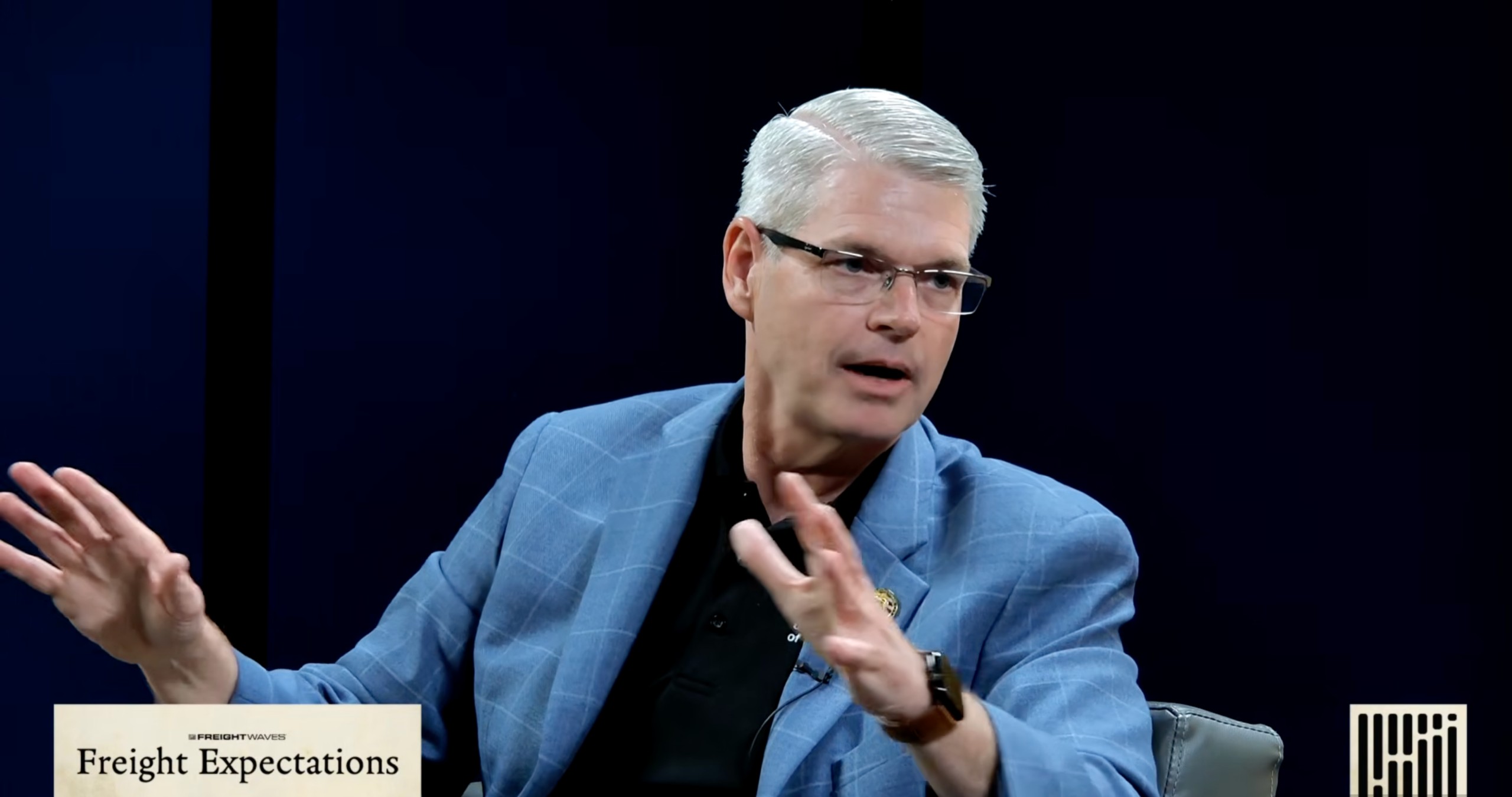
Federal Motor Carrier Safety Administration Administrator Derek Barrs sat down with me and Matt Leffler in our Chattanooga studio this week for a live taping of Freight Expectations. What I came away with — beyond the hour of substantive policy conversation — was the clearest articulation yet of why this administration is having a measurable, real-time impact on freight markets that previous ones did not.
The thesis is simple. For the first time in years, the agency tasked with regulating the trucking industry is doing the job: enforcing rules already on the books, dismantling the self-certification regimes that incentivized fraud, and showing up in person where the industry actually operates.
The market is responding accordingly. Spot rates as measured by SONAR’s National Truckload Index (NTI.USA) have moved above their COVID-era highs over the past several days. Truckload spot rates continue to surge upward, hitting a new all-time high on the daily chart. $3.73/mile +$.04/mile overnight. Today is the Friday before a major holiday, and spot rates always surge, as shippers scramble for last-minute loads set to deliver on Tuesday.…
That is not a coincidence. All time high records are a result of tight enforcement and a change in market direction at the hands of the regulators.
Source: FreightWaves
Compiled from international media by the SCI.AI editorial team.