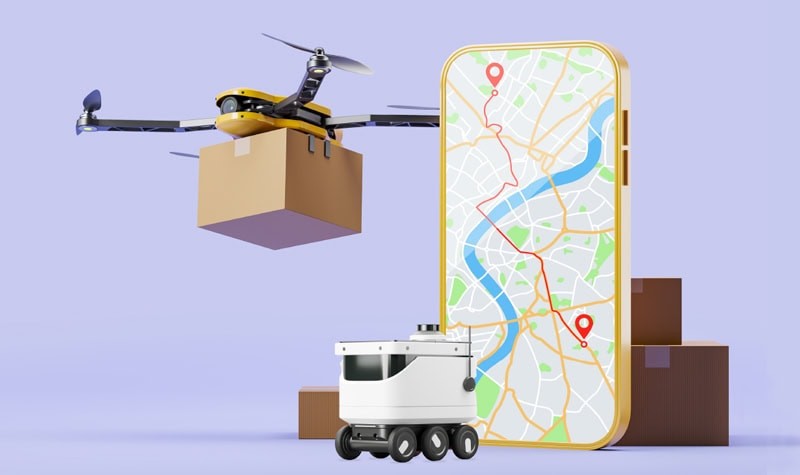
According to www.inboundlogistics.com, drone delivery is advancing rapidly as a viable last-mile solution, with industry leaders projecting 3–5 million daily drone deliveries by 2030. This growth hinges on technological maturation, regulatory progress—including the FAA’s proposed rule for Beyond Visual Line of Sight (BVLOS) operations—and infrastructure innovations to ensure airspace safety and accountability.
Cost, Regulation, and Operational Realities
The last mile accounts for more than half of total shipping expense, Statista reports. A single failed delivery costs retailers around $17, according to Gautam Kumar, co-founder and chief operating officer with FarEye. As such, reliability and visibility are no longer operational niceties but margin-critical imperatives. ‘A missed stop is no longer just an inconvenience, but a direct hit to margins,’ Kumar says.
‘Brands that get delivery right with speed, reliability, visibility, and flexibility can differentiate themselves, win customers, and increase lifetime value.’ — Gautam Kumar, co-founder and COO, FarEye
Regulatory frameworks remain uneven. Matternet—awarded both FAA Type Certificate and Production Certificate for unmanned aircraft in 2022—was the first to conduct a commercial drone delivery in the U.S. and gained early clearance via the FAA’s Integration Pilot Program in 2018. Yet BVLOS operations still require FAA approval per flight area, with proposed rules limiting flights to 400 feet above ground level and mandating pre-designated, access-controlled takeoff/landing zones.
Key Players and Pilots
- In September 2025, Uber Technologies partnered with Flytrex to launch pilot drone deliveries for Uber Eats; Flytrex has completed more than 200,000 deliveries across the U.S.
- In October 2025, Matternet partnered with Dave’s Hot Chicken to begin drone deliveries in Northridge, Los Angeles—a model requiring restaurant staff to load food into a Matternet container placed in a landing station, followed by remote-piloted flight and automated drop-off.
- Matternet’s drones carry up to 4.4 pounds over distances of up to 12.4 miles.
Scaling Constraints and Infrastructure Gaps
Despite promise, scalability faces systemic hurdles. A 2023 McKinsey report found drone deliveries currently cost more than electric vehicle deliveries—though unit costs could fall to $1.50–$2.00 per package once operators manage ~20 drones simultaneously. Tom Walker, founder and CEO of DroneUp, stresses that scaling requires verifying drone identity, linking aircraft to flight plans, and enabling real-time tracking. He notes that facilities within three miles of critical infrastructure—including power plants and hospitals—cover about three-quarters of the U.S., necessitating robust security protocols before mass deployment.
‘How do we know if it’s a good drone or a bad drone? We don’t.’ — Tom Walker, founder and CEO, DroneUp
For supply chain professionals, these developments signal both opportunity and urgency: integrating drone-capable routing platforms (e.g., Nextbillion.ai’s AI-driven mapping), auditing delivery SLAs against emerging cost benchmarks, and engaging early with local aviation authorities on BVLOS site approvals will be essential to future-proofing last-mile networks. The shift from cost center to strategic differentiator demands cross-functional alignment across logistics, IT, compliance, and customer experience teams.
Source: www.inboundlogistics.com
Compiled from international media by the SCI.AI editorial team.