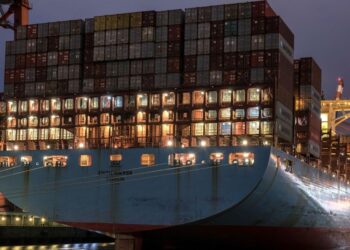
According to www.thedailystar.net, Bangladesh’s $100 billion export target for 2030 faces serious jeopardy without urgent logistics reforms, as current trade costs are one and a half times higher than Vietnam’s and, in some cases, nearly double those of India.
Export Gap and Competitiveness Deficit
Bangladesh’s exports stood at $55 billion as of the report’s publication on May 10, 2026 — less than 14% of Vietnam’s $400 billion in annual exports. Both countries had comparable export volumes in the late 1990s, yet Vietnam achieved its massive growth through sustained trade facilitation and logistics reforms. In contrast, Bangladesh continues to rank low in global competitiveness indices, logistics performance, and productivity — factors directly undermining foreign investment attraction and integration into global supply chains.
Critical Infrastructure Bottlenecks
Port dwell time remains a critical constraint: according to World Bank data cited by economist M Masrur Reaz, reducing port dwell time by just one day could increase exports by 7.4 percent. Similarly, cutting logistics costs by 25 percent could boost exports by 20 percent. Yet cargo waiting times remain prolonged, congestion is chronic, and import processing takes significantly longer in Bangladesh than in peer nations. The Dhaka-Chattogram highway has reached capacity, with limited scope for further expansion — making rail connectivity the only viable long-term solution for freight movement, per Md Habibur Rahman, former member (administration and planning) of the Chittagong Port Authority.
Policy and Investment Imperatives
Masrur Reaz, chairman of the Policy Exchange of Bangladesh (PEB), stated:
“Reaching $100 billion in exports by 2030 or even by 2033 with the current trade facilitation and logistics capacity will not be possible unless we significantly improve efficiency, reduce time and cut costs.”
He made the remarks at a DCCI-organized roundtable titled “Integrated Port and Logistics Development for a Trade-Driven Bangladesh” held in Dhaka. Reaz emphasized that developing ports solely through public funding is no longer feasible due to fiscal pressure — calling instead for public-private partnerships (PPPs) as essential for scaling infrastructure.
Systemic Planning Failures
Md Shamsul Hoque, professor of Civil Engineering at BUET, identified fragmented infrastructure planning as a root cause: roads, railways, waterways, and aviation are developed in isolation rather than as an integrated multimodal system. Even co-located facilities — such as airports and railway stations — lack seamless intermodal connectivity. Meanwhile, freight transport has been systematically neglected despite its greater economic importance compared to passenger transport. Razeev H Chowdhury, senior vice president of DCCI, added that long cargo clearance procedures, slow transport systems, and absence of modern cold-chain facilities are inflating supply chain costs and eroding competitiveness.
Industry-Wide Reform Agenda
Experts collectively endorsed three priority interventions:
- Paperless and automated port systems to accelerate customs clearance
- Public-private partnerships to finance and operate port and logistics infrastructure
- Targeted investment in cold-chain logistics to support agro-exports and pharmaceuticals
Md Salim Ullah, director general of the Bangladesh Institute of Management (BIM), confirmed that Bangladesh remains far behind regional peers in managing integrated ports and logistics — a gap that keeps the overall cost of doing business high and impedes export diversification beyond ready-made garments.
Source: www.thedailystar.net
Compiled from international media by the SCI.AI editorial team.