According to www.dcvelocity.com, supply chain organizations that replace entry-level hiring with AI deployments risk significant labor-cost penalties—up to 15% hiring premiums for early-career professionals by 2030, per a Gartner forecast.
Talent Pipeline Gaps Drive Future Cost Surge
Gartner’s analysis is based on a global survey of 509 supply chain leaders conducted from July to October 2025. The study found that 55% of respondents expect a decline in entry-level hiring due to agentic AI advancements. Crucially, the report projects that 75% of supply chain organizations which paused entry-level hiring in 2026 will face elevated pay premiums—exceeding 15%—for early-career talent by 2030.
“Many organizations are attempting to manage uncertainty today by pausing entry-level hiring, but they will face talent shortages for themselves in the near future. AI is not a ‘plug and play’ replacement for people. Organizations that stop hiring, and fail to develop early-career professionals, will soon face talent pipeline gaps, employee dissatisfaction, and elevated hiring pay premiums, especially for AI-native talent.” — Simon Bailey, VP Analyst, Gartner’s Supply Chain practice
Human-AI Collaboration Outperforms Headcount Reduction
The report emphasizes that AI’s highest-impact use cases in supply chains do not involve workforce reduction but rather augmentation. Gartner identifies three core functions enabled by human-AI collaboration: supporting, augmenting, and automating decision-making. Organizations investing in dual-skilled development—training early-career staff in both AI tools and business context—enable senior staff to shift focus toward strategic work, including building cultural readiness to scale AI initiatives.
Industry Context: AI Adoption vs. Talent Development
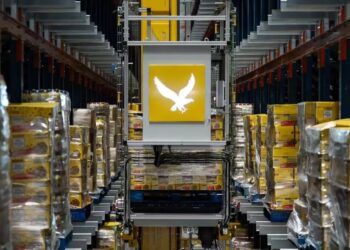
This warning arrives amid accelerating AI integration across logistics infrastructure. For example, Lapp USA deployed Corvus Robotics’ autonomous inventory drones in 2025 at its 134,000-square-foot Brownsburg, Indiana facility—replacing manual cycle counts previously performed only twice per year. That effort reduced labor dedicated to inventory tasks from 12.5% of the workforce to near-zero while improving accuracy and fulfillment speed. Meanwhile, broader industry signals reinforce Gartner’s concern: Honeywell sold its Intelligrated division to private equity in April 2026, and Hirschbach Motor Lines announced plans to buy 500 autonomous truck systems in April 2026. Yet none of these deployments address foundational talent development—the gap Gartner flags as critical.
Practitioner Implications for Supply Chain Teams
- Organizations must treat AI implementation as a capability-building initiative, not a cost-cutting lever—requiring parallel investment in training programs, mentorship structures, and rotational assignments for early-career hires.
- Hiring managers should benchmark current entry-level salary bands against projected 15%+ premiums anticipated by 2030 to quantify opportunity cost of delayed hiring.
- Supply chain IT teams deploying AI on legacy systems (as noted in a separate Gartner report) must allocate budget not just for software licensing but for change management and upskilling—since 65% of pharma supply chain leaders already report limited confidence in AI implementation.
Source: DC Velocity
Compiled from international media by the SCI.AI editorial team.