Explore

  • Trending
  • Latest
  • Tools
  • Browse
  • Subscription Feed

Logistics

  • Ocean
  • Air Cargo
  • Road & Rail
  • Warehousing
  • Last Mile

Regions

  • Southeast Asia
  • South Asia
  • Central Asia
  • Japan & Korea
  • Middle East
  • Europe
  • Russia
  • Africa
  • North America
  • Latin America
  • Australia
SCI.AI
  • Supply Chain
    • Strategy & Planning
    • Logistics & Transport
    • Manufacturing
    • Inventory & Fulfillment
  • Procurement
    • Strategic Sourcing
    • Supplier Management
    • Supply Chain Finance
  • Technology
    • AI & Automation
    • Robotics
    • Digital Platforms
  • Risk & Resilience
  • Sustainability
  • Research
  • Expert Columns
  • English
    • Chinese
    • English
No Result
View All Result
  • Login
  • Register
SCI.AI
No Result
View All Result
Home Middle East Supply Chain

Geopolitical Risk Surge: 4-Nation Alliance Reshapes Middle East Supply Chains

2026/04/27
in Middle East Supply Chain
0 0
Geopolitical Risk Surge: 4-Nation Alliance Reshapes Middle East Supply Chains

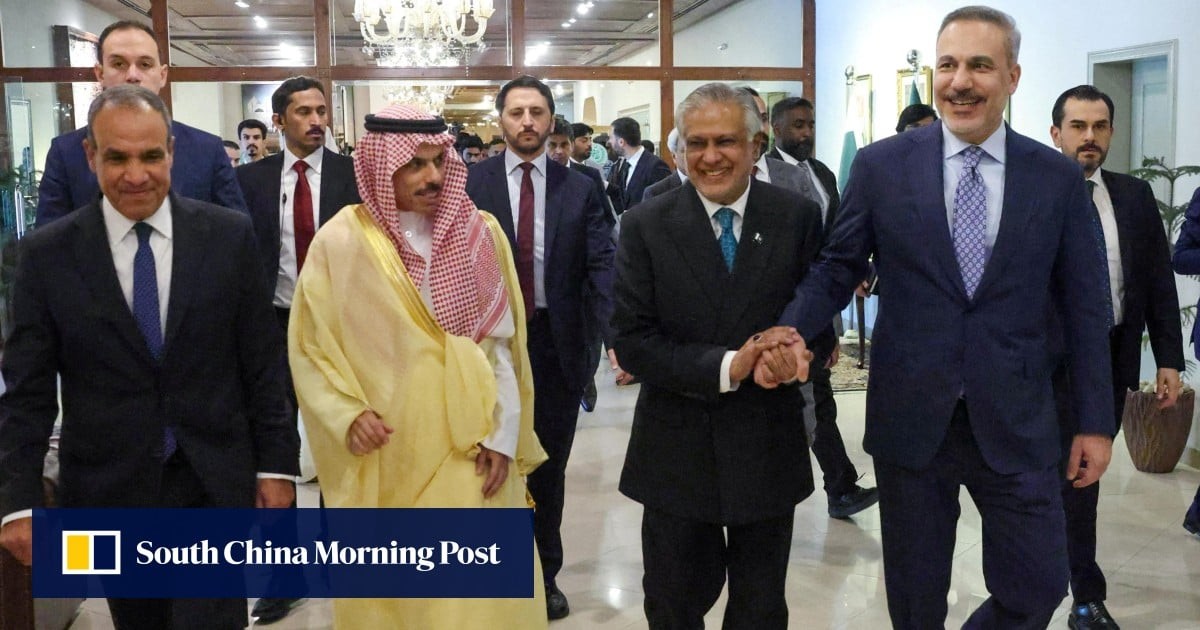
According to www.scmp.com, Pakistan, Turkey, Saudi Arabia, and Egypt have formed a new regional coordination framework amid the US-Israel war on Iran — a development with immediate implications for global supply chain resilience, particularly across the Middle East, South Asia, and Central Asia corridors.

A New Regional Coordination Framework

The grouping comprises NATO member Turkey, Saudi Arabia, Egypt — the Arab world’s largest military power, and nuclear-armed Pakistan. According to the report, this coalition is actively pressing for a negotiated settlement to the Iran war. Islamabad plays a dual role: mediator between Tehran and Washington, and trusted representative for its regional partners — “above all Riyadh.”

Drivers: Fear of US Abandonment

The source states that “fear of US abandonment is pushing states to build more diplomatic mass, even if they cannot yet build an integrated military bloc.” This sentiment reflects broader recalibrations among U.S. partners following perceived strategic unpredictability — a trend observed in recent years across multiple regions, including the Red Sea crisis and shifting security assurances in the Gulf.

“A mixed system” was emerging, he said – one in which multilateral formats “increasingly handle the grand strategic questions” while the hard security balance would still be dominated by Washington and whatever survives of Tehran’s proxy network. — Andreas Krieg, associate professor of defence studies at King’s College London who previously advised Qatar’s armed forces on behalf of the UK defence ministry

Supply Chain Implications for Practitioners

For global supply chain professionals, this realignment signals heightened complexity in risk mapping. The four-nation framework spans critical maritime chokepoints — including the Straits of Hormuz (Saudi Arabia, Egypt), the Suez Canal (Egypt), and key overland routes linking Central Asia to the Gulf (Turkey, Pakistan). Disruptions linked to diplomatic escalation, sanctions enforcement, or port access restrictions now carry layered exposure: not only from conflict zones but from coordinated policy shifts among these four capitals.

Historically, Egypt and Saudi Arabia have jointly managed Suez Canal and Red Sea corridor stability; Turkey has served as a multimodal transit hub between Europe and Asia; and Pakistan’s Gwadar Port — part of the China-Pakistan Economic Corridor — adds strategic depth to South Asian logistics. With these actors now coordinating diplomacy and security posture, supply chain teams must treat their joint statements and bilateral agreements as de facto early-warning indicators — especially regarding fuel availability, customs clearance protocols, and maritime insurance premiums.

This development follows similar moves by other major players: the EU’s recent emphasis on geopolitical risk in its CSDDD due diligence requirements, and Maersk’s 2025 announcement of diversified routing through the Black Sea and Gulf of Aden amid escalating Red Sea volatility. Unlike those responses, however, the Turkey-Saudi-Egypt-Pakistan framework represents a self-organized, non-Western multilateral initiative — one that may accelerate parallel standard-setting in cross-border documentation, cargo inspection reciprocity, and emergency port access agreements.

Source: South China Morning Post

Compiled from international media by the SCI.AI editorial team.
More on This Topic

  • Middle East Supply Chain Disruption Boosts Dow: Near-Term Tailwinds from Strait of Hormuz Closure (Apr 26, 2026)
  • Saudi Last Mile Delivery Surges 49% to 118M Orders in Q1 2026 (Apr 26, 2026)
  • UAE Boosts Supply Chain Resilience with 5 Key Customs & Corridor Initiatives (Apr 25, 2026)
  • GWC Group Q1 2026 Net Profit Hits QAR 33.7M Amid Supply Chain Disruption (Apr 24, 2026)
  • Hafeet Rail UAE-Oman Corridor 40% Complete (Apr 23, 2026)
ShareTweet

Related Posts

Middle East Supply Chain Disruption Boosts Dow: Near-Term Tailwinds from Strait of Hormuz Closure
Middle East Supply Chain

Middle East Supply Chain Disruption Boosts Dow: Near-Term Tailwinds from Strait of Hormuz Closure

April 26, 2026
4
Saudi Last Mile Delivery Surges 49% to 118M Orders in Q1 2026
Middle East Supply Chain

Saudi Last Mile Delivery Surges 49% to 118M Orders in Q1 2026

April 26, 2026
1
UAE Boosts Supply Chain Resilience with 5 Key Customs & Corridor Initiatives
Middle East Supply Chain

UAE Boosts Supply Chain Resilience with 5 Key Customs & Corridor Initiatives

April 25, 2026
2
GWC Group Q1 2026 Net Profit Hits QAR 33.7M Amid Supply Chain Disruption
Middle East Supply Chain

GWC Group Q1 2026 Net Profit Hits QAR 33.7M Amid Supply Chain Disruption

April 24, 2026
3
Hafeet Rail UAE-Oman Corridor 40% Complete
Middle East Supply Chain

Hafeet Rail UAE-Oman Corridor 40% Complete

April 23, 2026
4
Digital Twin Success Depends on Operational Model Strength
Middle East Supply Chain

Digital Twin Success Depends on Operational Model Strength

April 22, 2026
2

Leave a Reply Cancel reply

Your email address will not be published. Required fields are marked *

Recommended

Corvus Robotics融资,升级自主库存管理系统:提升效率与精准度的关键一步

Corvus Robotics Secures Funding to Upgrade Autonomous Inventory Management System: A Crucial Step towards Enhancing Efficiency and Accuracy

7 Views
February 16, 2026
The Midwest Premium Crisis: How $1/lb Aluminum and Unrelenting Tariffs Are Reshaping U.S. Metal Packaging Supply Chains in 2026

The Midwest Premium Crisis: How $1/lb Aluminum and Unrelenting Tariffs Are Reshaping U.S. Metal Packaging Supply Chains in 2026

32 Views
March 19, 2026
Japan Chip Plants: Cybersecurity Mandate for Subsidies Starting 2026

Japan Chip Plants: Cybersecurity Mandate for Subsidies Starting 2026

5 Views
April 26, 2026
Gartner 2026 Report: How AI-Driven Logistics Data Audit Creates Trillion-Dollar Competitive Advantage

Gartner 2026 Report: How AI-Driven Logistics Data Audit Creates Trillion-Dollar Competitive Advantage

4 Views
March 17, 2026
Show More

SCI.AI

Global Supply Chain Intelligence. Delivering real-time news, analysis, and insights for supply chain professionals worldwide.

Categories

  • Supply Chain Management
  • Procurement
  • Technology


  • Risk & Resilience
  • Sustainability
  • Research

© 2026 SCI.AI. All rights reserved.

Powered by SCI.AI Intelligence Platform

Welcome Back!

Sign In with Facebook
Sign In with Google
Sign In with Linked In
OR

Login to your account below

Forgotten Password? Sign Up

Create New Account!

Sign Up with Facebook
Sign Up with Google
Sign Up with Linked In
OR

Fill the forms below to register

All fields are required. Log In

Retrieve your password

Please enter your username or email address to reset your password.

Log In

Scan to share via WeChat

Open WeChat and scan the QR code to share

QR Code

Add New Playlist

No Result
View All Result
  • Supply Chain
    • Strategy & Planning
    • Logistics & Transport
    • Manufacturing
    • Inventory & Fulfillment
  • Procurement
    • Strategic Sourcing
    • Supplier Management
    • Supply Chain Finance
  • Technology
    • AI & Automation
    • Robotics
    • Digital Platforms
  • Risk & Resilience
  • Sustainability
  • Research
  • Expert Columns
  • English
    • Chinese
    • English
  • Login
  • Sign Up

© 2026 SCI.AI