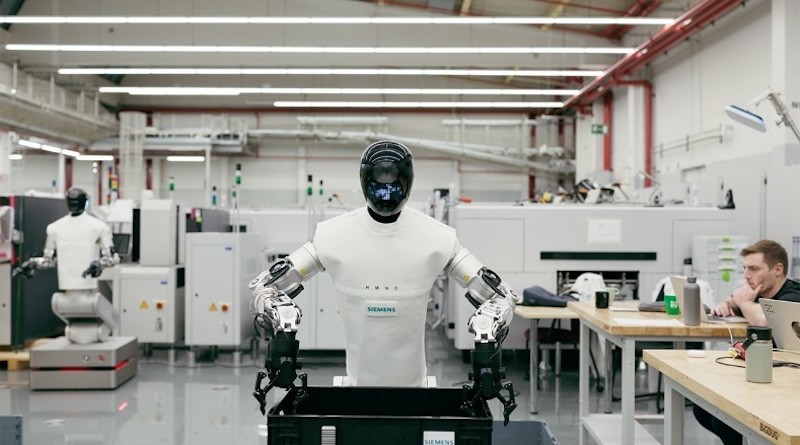
According to roboticsandautomationnews.com, Siemens, Nvidia, and UK-based robotics company Humanoid have jointly demonstrated the first factory-grade deployment of a physical AI-powered humanoid robot — the HMND 01 Alpha — performing autonomous logistics tasks at Siemens’ electronics factory in Erlangen, Germany.
Real-World Performance Metrics
The HMND 01 Alpha, built using Nvidia’s physical AI stack and integrated into Siemens’ industrial infrastructure, autonomously executed tote-handling operations: picking, transporting, and placing containers for human operators. All target performance metrics were met, including a throughput of 60 tote moves per hour, uptime exceeding 8 hours, and autonomous pick-and-place success rates above 90 percent.
Siemens Xcelerator: The Industrial Integration Backbone
For humanoid robots to function as collaborative assets—not isolated novelties—they require deep integration with existing production systems. Siemens provides this through its Siemens Xcelerator portfolio, which includes digital twin capabilities, AI-enabled perception, integrated control and PLC-robot interfaces, fleet management, industrial communication networks, and high-performance drives. This ecosystem enables real-time data exchange with other autonomous guided vehicles (AGVs), synchronized workflows with machinery and human operators, and adaptive behavior responsive to dynamic shop-floor conditions.
Nvidia’s Physical AI Stack Accelerates Development
Humanoid integrated Nvidia’s full physical AI stack into the HMND 01 platform, including:
- Nvidia Jetson Thor for edge compute
- Nvidia Isaac Sim for simulation
- Nvidia Isaac Lab for reinforcement learning and policy training
This simulation-first approach enabled virtual optimization of actuator selection, joint strength, and mass distribution—reducing prototype development time from a typical 18–24 months to just 7 months.
Leadership Perspectives
“Factories of the future demand robots that can perceive, reason, and adapt autonomously alongside human workers, tackling the labor shortages and operational complexity that traditional automation struggled to handle. With Siemens providing the industrial integration backbone and Humanoid deploying Nvidia’s full physical AI stack — from simulation-first training to real-time edge inference — this deployment paves the way for humanoid robots meeting real production targets on a live factory floor.” — Deepu Talla, vice president of Robotics and Edge AI at Nvidia
“Our mission is to create humanoid robots that perform not only in controlled lab settings, but also in real-world factory environments, handling meaningful industrial tasks. Our collaboration with Siemens and Nvidia gives us a powerful advantage by combining Nvidia’s leading AI infrastructure, simulation tools, and frameworks with Siemens’ deep industrial expertise and integration capabilities. Together, we’ve proven that humanoid robots are ready for real-world industrial deployment.” — Artem Sokolov, CEO and founder of Humanoid
Context for Supply Chain Professionals
While industrial robotics has long supported material handling via fixed-arm robots and AGVs, humanoid platforms represent a paradigm shift toward flexible, human-space-compatible automation — especially valuable amid persistent global labor shortages and rising demand for agile, reconfigurable logistics within smart factories. Unlike legacy systems requiring dedicated pathways or safety cages, wheeled humanoids like the HMND 01 operate in existing human-centric layouts, reducing retrofitting costs and accelerating ROI. This aligns with broader industry trends: Jabil recently reported scaling humanoid deployments from prototype to production lines; Path Robotics launched mobile AI-welding systems; and Siemens’ prior CES announcement with Nvidia targeted fully AI-driven, adaptive manufacturing sites — now validated by this Erlangen pilot. For supply chain professionals, the implication is clear: physical AI is no longer theoretical. It is being stress-tested against throughput, uptime, and integration benchmarks that directly impact line-side replenishment, kitting efficiency, and warehouse-to-production-floor handoffs.
Source: Robotics & Automation News
Compiled from international media by the SCI.AI editorial team.