How private yards became autonomous trucking’s most promising frontier
The Strategic Pivot: From Highway to Yard
Before Yibiao Zhao and Chris Baker launched ISEE AI in 2017, the two co-founders were deep in research at the Massachusetts Institute of Technology, building artificial intelligence for what they called “collaborative robots.” The focus: teaching machines to understand human social intentions and navigate complex environments the way people do.
“We were building AI for robots to understand social intention: how a robot understands humans in a complex environment, how to navigate similarly to a human,” Zhao, ISEE AI’s CEO, said in an interview with FreightWaves at ACT Expo. “At that time we were looking at how this should be very useful for the age of physical AI.”
That “theory of mind” research would prove foundational for the company’s eventual product — autonomous yard trucks that must operate alongside human workers ranging from forklift operators to over-the-road drivers in chaotic, unstructured environments.
ISEE AI’s initial bet was on the highway. By 2018, the company was hauling loads for a large e-commerce customer on the busy Dallas-Houston corridor.
“At that time we could already engage ours without any intervention between Dallas and Houston,” Zhao said. “It was very easy to do a demo.”
The problem was everything beyond the demo. Highway trucking demands fail-operational systems that can handle nearly infinite edge cases at high speeds with 45,000 pounds of kinetic energy in tow. Customers saw the capability, but they then offered a different challenge.
“Our customers said, ‘Oh, I really like your technology. Why don’t you look at my backyard?’” Zhao recalled. “Because it’s private property, there’s no regulation. There’s no random people, no teenage drivers. Everyone wears safety vests, lower speeds. We always have an option to stop.”
By late 2018, ISEE AI had pivoted entirely to yard operations. The move let the company shift from fail-operational requirements to a fail-safe, fail-stop architecture. The regulatory landscape simplified, and public-acceptance issues largely disappeared. The only remaining hurdle was proving to customers that the technology worked.
Mastering the ‘Inverted Pendulum’: Technical Challenges of Backing
Yard operations demand constant backing — coupling to trailers, parking in tight dock doors and repositioning loads. For autonomous systems, going backward is fundamentally harder than driving forward.
“Unlike other autonomous trucking companies, when they pull forward the trailer follows you,” Zhao explained. “But when you’re backing, it’s kind of like an inverted pendulum — it’s an unstable system. You push something, it’s very easy to diverge, so you have to very actively control it.”
Complicating matters: Every trailer is different. Sizes vary, tandem positions shift and weight distributions change dramatically — from 10,000 to 45,000 pounds depending on the load. Traditional autonomous systems calibrate over days or months. ISEE AI has only seconds to make a connection in a busy yard.
“We use machine learning to learn that in real time,” Zhao said. “Before we get to the parking — because usually we’ll pull out before we get to parking — we already have a very accurate understanding of the trailer and its kinematics and dynamics.”
The result: better-than-human backing performance and what Chris Baker, ISEE AI’s chief scientist, called “one-stop, one-shot parking” more than 98% of the time.
“No realignment, no pulling out, pulling back — which takes two to three minutes if you had to realign and reset your parking angle,” Baker said.
Solving Auto-Coupling: Three Paths to Connection
The “last foot” of yard automation involves physically connecting air and electric lines to trailers. This remains one of the industry’s hardest problems. ISEE AI offers three solutions depending on customer constraints.
- The first is a robotic arm that uses computer vision to connect directly to trailer glad hands. It requires no permanent trailer modifications, making it ideal for customers who don’t own their fleets.
- The second option leverages a partnership with Electrans, which provides a cassette-style permanent trailer modification for customers who own their equipment and are willing to make the capital investment.
- The third — ISEE AI’s own magnetic trailer adapter — splits the difference. The device attaches magnetically to the bottom of a trailer, standardizing the connection interface without permanent modification. Attachment and detachment take roughly 30 seconds.
“It allows temporary attachment,” Zhao said. “Before they leave the yard they can disconnect and remove it if they need to.”
Efficiency Gains and Operational Impact
Beyond backing precision, autonomous yard trucks eliminate the operational drag of human breaks. There are no lunch stops, restroom visits or smoke breaks.
“You’re gaining at least an hour per shift off of no breaks — continuous operations,” Baker said.
Customers also report dramatic reductions in damage claims and safety incidents. Zhao described one customer site where an over-the-road driver placed a trailer at the wrong dock door. A yard driver, unaware that warehouse workers had already loaded a conveyor system inside, pulled the trailer — and “the whole conveyor system fell.”
“That’s like hundreds of thousands of dollars in damage just because of that,” Zhao said. “For us, we follow the customer workflows step by step, and we make sure those things won’t happen.”
ISEE AI currently operates more than 20 autonomous vehicles at customer sites, executing thousands of moves per week with no reported safety incidents.
Safety Case Completion and Future Scaling
The company’s path to mass deployment cleared a critical milestone with completion of its safety case, validated by third-party assessor FEV against ISO 26262 and Safety of the Intended Functionality (SOTIF) standards under ISO 21448.
“Customers poked us with a thousand questions — show me this, show me that, show me the data, show me the video,” Zhao said. “Eventually they say, ‘Yeah, this is bulletproof. You basically covered everything.’”
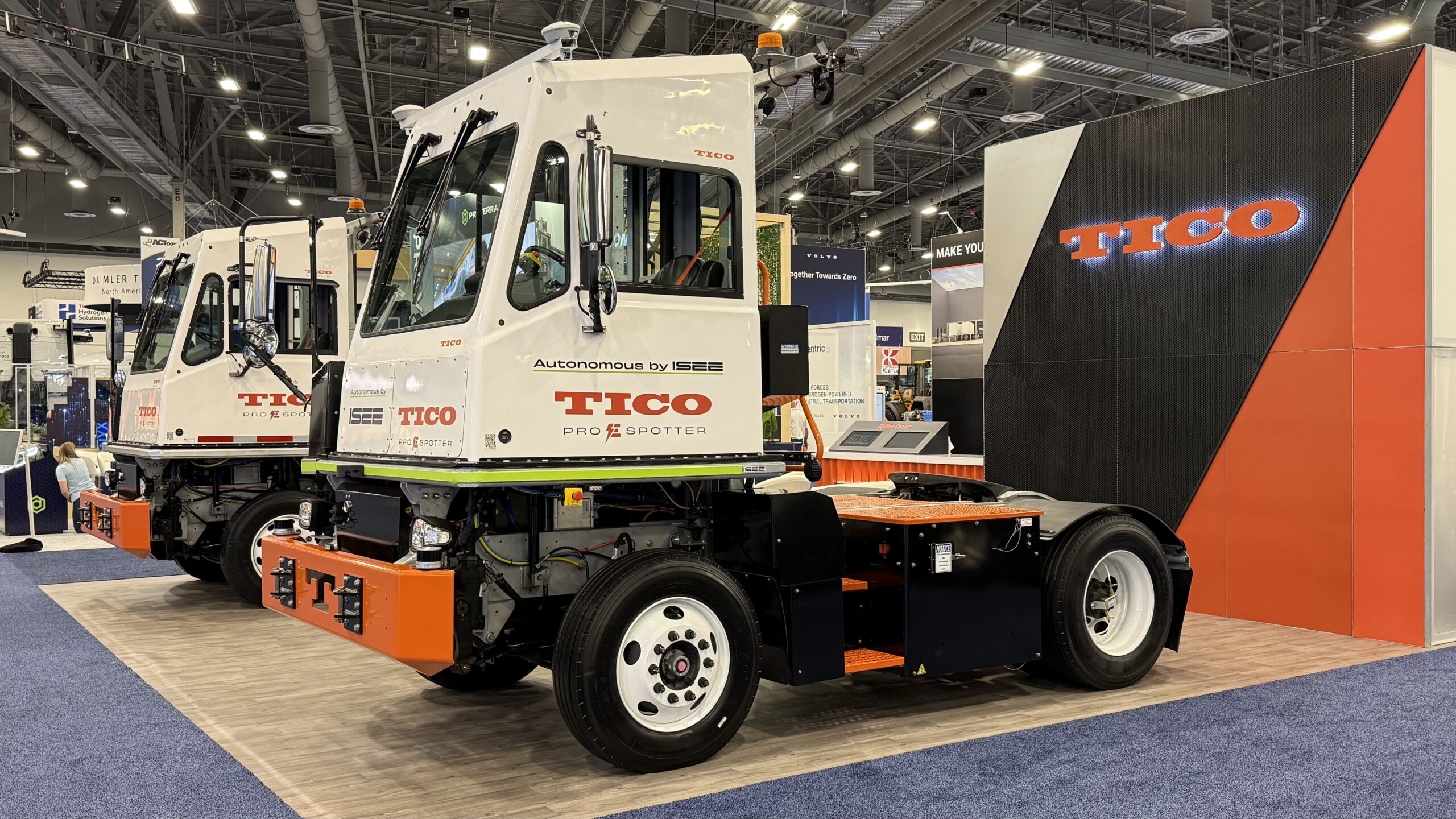
With the Generation 7 autonomy kit now finalized and a manufacturing partnership with terminal tractor OEM TICO in place, ISEE AI is targeting serial production for 2027. The company is securing orders for hundreds of trucks in the coming year.
“The turning point is the closure of the safety case as well as the next-generation truck,” Zhao said. “Now we’re ready to really push forward to large-scale deployment.”
Source: FreightWaves
Compiled from international media by the SCI.AI editorial team.