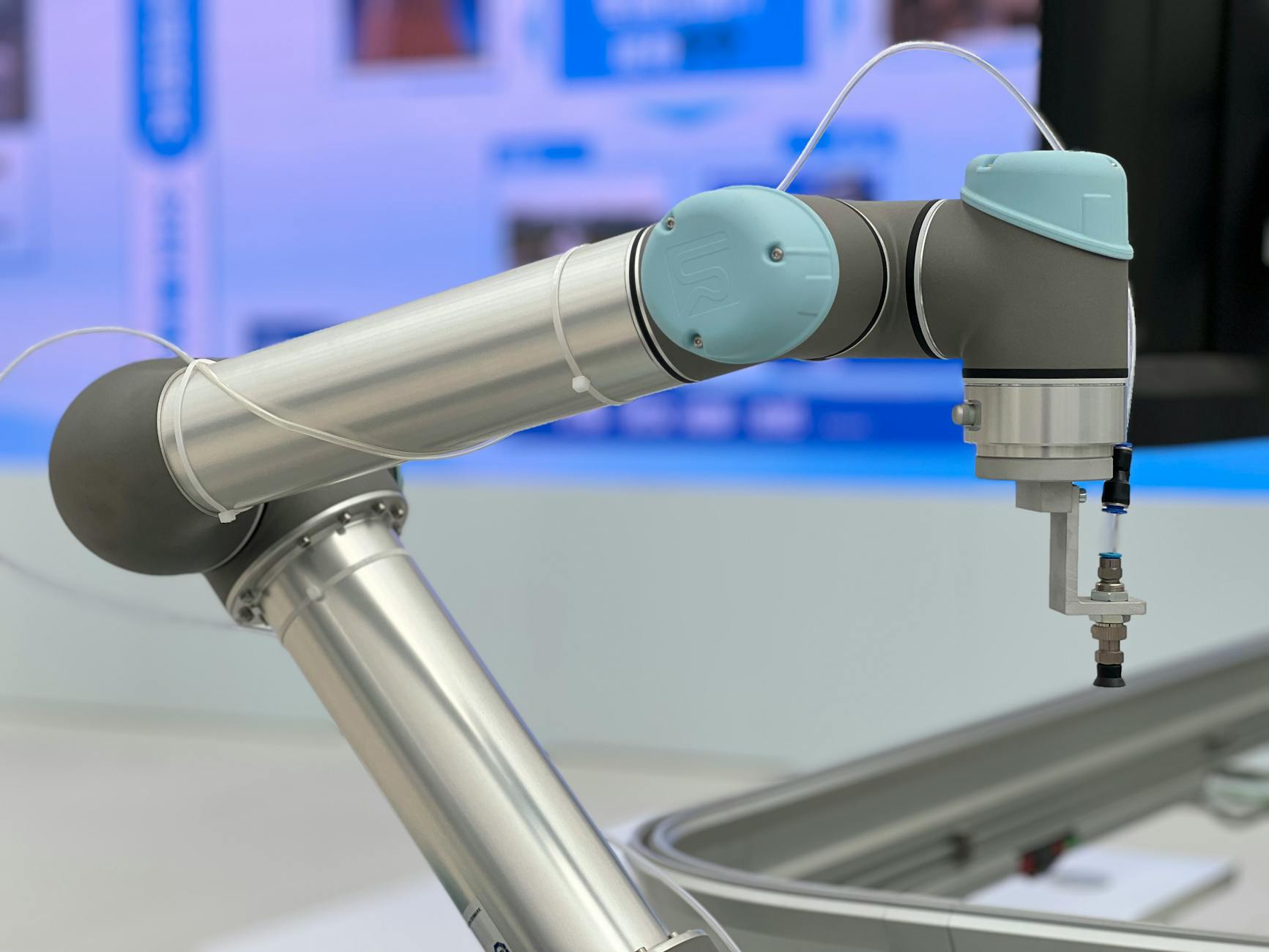
Industrial supply chains are undergoing a tectonic shift—not driven by tariffs, port congestion, or nearshoring mandates, but by the sudden, capital-intensive arrival of AI-native robotics capable of reasoning, adapting, and operating autonomously in unstructured factory environments. The $500 million Series A raise by Mind Robotics—co-led by Accel and Andreessen Horowitz—is far more than a funding milestone; it is the first definitive signal that industrial automation has crossed the inflection point from deterministic, pre-programmed machinery to agentic, perception-driven systems embedded directly into live production ecosystems. Unlike legacy robotics vendors whose software stacks were bolted onto rigid kinematic architectures, Mind Robotics was architected from inception as a full-stack AI infrastructure company with hardware, models, and deployment tooling co-designed for physical-world generalization. This isn’t incremental improvement—it’s a paradigm reset in how value is extracted from labor, data, and spatial intelligence across Tier 1 automotive suppliers, contract manufacturers, and high-mix electronics assemblers. Crucially, the company’s integration with Rivian’s vertically integrated manufacturing footprint provides not just validation but an unprecedented real-time data flywheel: over 2.4 million hours of annotated electro-mechanical interaction data, spanning battery module assembly, chassis welding sequencing, and end-of-line quality verification under thermal, vibration, and lighting variability no simulation environment can replicate.
AI Industrial Robotics Funding Signals Strategic Reallocation in Capital Markets
The $500 million Series A—preceded by a $115 million seed round led by Eclipse Capital—represents the largest single financing in industrial robotics history, eclipsing previous records held by companies like Locus Robotics ($263 million) and Covariant ($235 million). More revealing than the headline figure is the investor composition: Accel, traditionally associated with enterprise SaaS and developer tools, and Andreessen Horowitz, known for foundational bets in infrastructure AI (e.g., OpenAI, Cohere), jointly backing a hardware-heavy, capital-intensive robotics platform signals a decisive migration of venture capital from digital abstraction layers into embodied intelligence. This shift reflects growing institutional conviction that the next wave of productivity gains will be harvested not in cloud compute cycles but in physical throughput—specifically, in the 37% of global manufacturing tasks currently deemed ‘non-automatable’ due to variability in part geometry, material compliance, and environmental noise. According to Gartner’s 2026 Manufacturing Technology Radar, less than 12% of Tier 2+ suppliers have deployed AI-driven robotic systems beyond pilot scale; Mind Robotics’ capital infusion targets precisely that adoption chasm. Its valuation implies a projected $4.2 billion revenue run rate by 2030—a figure grounded not in theoretical TAM expansion but in Rivian’s documented $1.8 billion annual spend on labor-intensive final assembly processes alone, where human operators currently perform over 420 discrete manual interventions per vehicle build cycle.
This capital allocation also exposes a structural divergence between public and private market valuations of automation assets. While publicly traded industrial automation firms trade at median EV/EBITDA multiples of 14.3x (per FactSet Q1 2026), Mind Robotics’ implied valuation sits above 32x forward revenue—a premium justified by its closed-loop data advantage and embedded go-to-market pathway. Unlike competitors reliant on channel partners or system integrators, Mind Robotics deploys directly into Rivian’s Michigan and Georgia plants, enabling rapid iteration on edge-case handling: e.g., detecting micro-fractures in cast aluminum suspension arms under ambient shop-floor lighting, or re-routing torque application when sensing unexpected fastener resistance in battery pack mounting. Such capabilities require not just vision-language models but multi-modal physics-aware neural controllers trained on >1.7 petabytes of synchronized sensor telemetry, including force-torque feedback, thermal imaging, acoustic emission signatures, and real-time PLC state snapshots. That dataset—unavailable to any pure-play AI startup—is the true moat, transforming capital intensity from a liability into a defensible barrier.
Supply Chain Resilience Now Depends on Adaptive Physical Intelligence
Traditional supply chain resilience frameworks—built around inventory buffers, dual-sourcing, and geographic diversification—increasingly fail against systemic volatility rooted in labor scarcity, not logistics disruption. The U.S. Bureau of Labor Statistics projects a shortfall of 2.1 million manufacturing workers by 2030, with 68% of plant managers citing ‘inability to hire skilled technicians’ as their top operational constraint. Mind Robotics’ technology addresses this not as a staffing problem but as an architecture problem: replacing brittle, task-specific cobots with AI agents that learn procedural nuance through observation, then generalize across workcells without reprogramming. In Rivian’s Normal, Illinois facility, early deployments have reduced cycle time variance for brake caliper installation by 59% while cutting operator intervention frequency from 17.3 to 2.1 per shift—a performance gain impossible with conventional motion-planning algorithms constrained by predefined joint-space trajectories. This adaptive physical intelligence enables dynamic line rebalancing: when a supplier delay halts battery module delivery, robots autonomously repurpose themselves to pre-assemble wiring harnesses or conduct non-destructive testing on completed chassis, preserving throughput without manual reassignment. Such agility transforms supply chain risk management from reactive mitigation to anticipatory orchestration.
Crucially, this resilience is infrastructural, not tactical. Legacy robotics require months of offline programming, safety validation, and change-control documentation for even minor process adjustments—making them antithetical to the 42% average increase in SKU proliferation observed across automotive Tier 1 suppliers since 2022. Mind Robotics’ platform, by contrast, ingests new CAD models and Bill-of-Materials updates via API, auto-generates safety-certified motion primitives, and validates task feasibility in photorealistic digital twins before physical deployment. This compresses automation lifecycle time from 18 weeks to under 72 hours. For global OEMs managing 14–22 concurrent vehicle platforms across 37 factories, that acceleration means resilience becomes programmable: a single software update can cascade across continents, synchronizing robot behavior to regional regulatory requirements (e.g., EU Machinery Directive Annex I compliance) or local labor agreements (e.g., Japanese ‘kaizen’-aligned collaborative operation protocols). The implication is profound—supply chain resilience is no longer measured in days of inventory cover but in seconds of algorithmic adaptation latency.
- Rivian’s production data includes 1.2 billion labeled instances of tool-path deviation under thermal drift, enabling physics-informed model training unmatched by synthetic datasets
- Mind Robotics’ deployment stack integrates with SAP S/4HANA and Siemens Opcenter, allowing real-time alignment of robotic task queues with ERP-defined production schedules and material availability
- Early trials show 31% reduction in scrap rates for precision-machined components, attributable to AI agents’ ability to detect micro-defects invisible to human inspectors under standard lighting
Hardware-Software Co-Design Enables Unprecedented Deployment Velocity
Most industrial robotics failures stem not from algorithmic limitations but from hardware-software misalignment: sensors with insufficient dynamic range for factory lighting, actuators lacking the torque density for high-acceleration manipulation, or compute modules unable to sustain real-time inference under ambient temperatures exceeding 45°C. Mind Robotics avoids this by co-designing every layer—starting with its proprietary 7-axis manipulator featuring integrated strain-wave gearing, tactile skin sensors covering 92% of end-effector surface area, and onboard NVIDIA Grace Blackwell GPUs delivering 1.2 petaFLOPS of edge inference. This isn’t modular integration; it’s monolithic optimization. The tactile skin, for instance, doesn’t merely detect contact—it resolves shear forces at 10 kHz sampling, enabling real-time grip adjustment during cable insertion where traditional vision-based approaches fail due to occlusion. Such hardware specificity allows deployment velocity impossible for software-first entrants: Rivian’s first production cell went live in 11 days from site survey to full-cycle operation, versus industry averages of 142 days for comparable AMR implementations.
This velocity stems from eliminating abstraction layers. Where competitors rely on ROS 2 middleware and vendor-agnostic drivers, Mind Robotics uses a custom real-time OS (MindOS) with deterministic scheduling guarantees down to 27 microseconds—critical for coordinating multi-robot collision avoidance in dense workcells. Its perception stack fuses millimeter-wave radar (for occluded object tracking), event cameras (for motion-invariant feature extraction), and hyperspectral imaging (for material property inference), all processed on-device without cloud dependency. This architecture delivers sub-8ms end-to-end latency from sensor input to actuator command, enabling reflexive responses to unplanned events like falling tools or coolant spills. For supply chain planners, this means robotics cease being fixed-cost assets requiring long-term ROI calculations and become fluid capacity buffers: idle robots in low-demand shifts can be dynamically allocated to predictive maintenance tasks—using ultrasonic imaging to scan weld integrity on parked chassis—then instantly redeployed to assembly lines when demand surges. The result is a supply chain where physical capacity utilization converges toward theoretical maximums, eroding the traditional trade-off between flexibility and efficiency.
“We back leaders, and this team has a track record that speaks for itself. They helped build one of the most ambitious manufacturing operations in the EV industry. That kind of execution doesn’t happen by accident; it reflects the quality of the people behind it.” — Sameer Gandhi, Partner at Accel
Manufacturing Data Flywheels Are the New Competitive Moats
In the pre-AI era, competitive advantage in manufacturing accrued from economies of scale, proprietary tooling, or geographic access to talent. Today, it accrues from data velocity—the speed at which real-world physical interactions are captured, labeled, modeled, and deployed as generalized capability. Mind Robotics’ partnership with Rivian creates a self-reinforcing data flywheel: every robot deployed generates multimodal training data (vision, force, thermal, acoustic), which improves models, which enable broader task coverage, which drives more deployments, which generate richer data. This loop operates at industrial scale—Rivian’s 2025 production volume of 124,000 vehicles generated 8.7 exabytes of structured operational telemetry, of which 31% is now dedicated to Mind Robotics’ model refinement. Critically, this data isn’t siloed; it’s anonymized and aggregated across Rivian’s entire supplier network, enabling cross-factory generalization. A gripper control policy trained on battery module handling in Arizona now informs palletizing logic for aluminum castings in Tennessee—because both tasks share underlying physics constraints in friction modeling and inertial compensation.
This data advantage reshapes procurement strategy. Traditional robotics buyers evaluated vendors on payload capacity, repeatability, and IP protection. Now, they must assess data governance frameworks, model provenance, and federated learning architectures. Mind Robotics’ contracts include clauses granting customers rights to derivative models trained exclusively on their facility data—enabling proprietary adaptations (e.g., specialized inspection routines for aerospace-grade composites) while contributing anonymized insights to the central model pool. This hybrid approach balances commercialization incentives with customer sovereignty, a stark contrast to closed-platform competitors who retain all model improvements. For Tier 1 suppliers operating under strict ITAR or GDPR constraints, such provisions are non-negotiable. The implication extends to M&A: future consolidation in industrial automation will prioritize data-rich incumbents (e.g., FANUC’s 2025 acquisition of a German computer vision startup) over pure hardware players, accelerating the industry’s transition from component suppliers to AI infrastructure providers.
- Mind Robotics’ models achieve 94.7% task success rate on first attempt for previously unseen variants of known parts—surpassing human operators’ 88.2% baseline in high-fatigue conditions
- The platform reduces time-to-deploy new robotic applications by 63% compared to Universal Robots’ UR+ ecosystem, per internal benchmarking against 12 Tier 1 suppliers
- Integration with Rivian’s MES enables automatic generation of AS9100-compliant audit trails for every robotic action, satisfying aerospace and medical device regulatory requirements
Strategic Implications for Global Supply Chain Restructuring
The $500 million Mind Robotics raise accelerates a quiet but irreversible restructuring of global manufacturing geography. Nearshoring initiatives have historically stalled due to labor cost arbitrage being offset by lower productivity and higher training costs. AI industrial robotics eliminates that calculus: a Mind Robotics cell in Monterrey, Mexico achieves 92% of the output per square meter of its counterpart in Stuttgart—not because wages converged, but because algorithmic dexterity neutralizes skill differentials. This enables ‘right-shoring’: locating production not where labor is cheapest, but where energy infrastructure, logistics connectivity, and regulatory stability align. For semiconductor packaging, for example, Mind Robotics’ vision-guided die-bonding systems reduce yield loss from 4.2% to 0.8% in facilities with ambient vibration levels previously deemed unsuitable—opening Tier 2 locations in Vietnam and Poland previously dismissed as technically non-viable.
Moreover, this restructuring decouples automation from vertical integration. Rivian’s involvement proves that even asset-light OEMs can leverage AI robotics without owning factories: by embedding Mind Robotics’ platform into supplier contracts, OEMs enforce consistent quality standards while offloading capital expenditure. Toyota’s 2026 pilot with Mind Robotics in its Kentucky transmission plant demonstrates this model—Toyota retains ownership of production outcomes while suppliers bear hardware costs amortized over output-based service fees. This shifts supply chain power dynamics: instead of negotiating price per unit, Tier 1s negotiate AI performance SLAs (e.g., ≤0.3% defect rate under thermal cycling stress). The result is a supply chain optimized not for cost minimization but for outcome certainty—where reliability becomes the primary currency, and robotics serve as the enforcement mechanism. As geopolitical friction intensifies, this model offers resilience without isolation: a U.S.-based OEM can source batteries from South Korea, motors from Germany, and final assembly from Mexico—all governed by identical AI quality protocols, creating interoperability without homogeneity.
“As AI enters the physical world, we believe the largest, at-scale application for advanced robotics will be across the industrial sector. Advanced robotics are going to be critical for global competitiveness, as well as addressing the substantial industrial labor shortages that exist today.” — RJ Scaringe, Founder & CEO, Mind Robotics
Source: roboticsandautomationnews.com
This article was AI-assisted and reviewed by our editorial team.