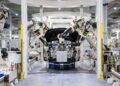
According to readlion.com, a Missouri legislative committee advanced the Missouri Defense and Energy Independence Act in February 2026, aiming to reduce U.S. dependence on China and India for critical medicines and minerals. The bill, sponsored by Sen. Kurtis Gregory, R-Marshall, would provide up to $40 million in annual tax credits starting in 2027 to Missouri-based manufacturers of essential supplies.
Critical Materials and National Security
Sen. Gregory emphasized the defense implications during a February committee hearing, citing that the F-35 fighter jet requires 900 pounds of critical materials — including cobalt, nickel, and gallium — some of which are geologically present in Missouri. He stated the legislation is “purely about national defense and restoring critical supply chains back to American soil.” The bill explicitly bars businesses headquartered in “hostile nations” from receiving state funds, targeting jurisdictions identified by federal agencies as adversarial to U.S. interests.
Market Dominance and Vulnerability
Douglas Jost, CEO of St. Louis–based Jost Chemical Co., testified that China and India collectively produce 80–90% of the world’s essential medicines and a wide range of critical raw materials. He drew an analogy to geopolitical chokepoints:
“Our Strait of Hormuz with China and India is they make 80–90% of the medicines and also a variety of critical materials for us, so they can really bend our knee if they want to.” — Douglas Jost, CEO, Jost Chemical Co.
This vulnerability was demonstrated during the pandemic, when India halted exports of life-saving drugs — cutting off the sole treatment for patients with rare brain cancer, according to Matt Thompson of the St. Louis–based API Innovation Center.
Economic and Regulatory Realities
The bill seeks to level the playing field for domestic producers facing steep compliance costs. Jost noted that U.S. firms must comply with strict EPA regulations, while overseas competitors undercut prices using “slave-like work conditions and child labor” and sourcing cheap Chinese materials to bypass tariffs. To accelerate onshoring, the legislation expands Missouri’s manufacturing sales tax exemption to cover equipment and materials used in producing critical goods and creates a dedicated $10 million fund to help Missouri companies build new FDA-compliant facilities. Thompson added that Missouri already hosts existing, FDA-approved manufacturing spaces, positioning it to produce generic medicines at competitive prices.
Business and Policy Support
Industry advocates strongly endorse the measure. Jared Hankinson, vice president of governmental relations for the Missouri Chamber of Commerce and Industry, called it “one of, if not the best, opportunities the state of Missouri has to put ourselves on the map and be a national leader in an industry sector.” The bill aligns with broader federal efforts: the U.S. government has identified hundreds of drugs requiring domestic production to prevent future shortages. It also reflects a growing trend among U.S. states — Arizona passed a similar $15 million semiconductor incentive package in 2025, and Texas allocated $3 billion for critical mineral processing infrastructure in 2024 — underscoring regional competition to attract strategic manufacturing.
Source: readlion.com
Compiled from international media by the SCI.AI editorial team.