According to indiafoundation.in, India’s manufacturing sector attracted 69% more FDI equity inflow in the decade 2014–24 compared to 2004–14 — a key indicator of its growing role in global supply chain reconfiguration.
Geopolitical Catalysts Accelerating India’s Manufacturing Rise
The source identifies three interlocking imperatives driving India’s emergence as a manufacturing hub: first, the Trump tariff effect, under which India faces 26% reciprocal tariffs on exports to the US; second, Pakistan’s constrained economic trajectory — marked by tepid growth, low productivity, and lack of domestic reform — which hinders regional supply chain integration and deprives South Asia of shared prosperity; and third, lessons from China and East Asia, where deep integration into global supply chains generated jobs and unprecedented growth despite trade policy uncertainty.
The May 6, 2025, India-Pakistan conflict triggered a full halt in all direct and indirect trade between the two nations, ending a $10 billion annual exchange of goods. While this has paused regional economic integration, the report underscores that geographical proximity, shared borders, and cultural affinity remain immutable foundations for future cooperation.
Global MNCs Expand Footprint in India
Starting in June 2025, all Apple iPhones destined for the U.S. market will be manufactured in India — a move described as commercially viable even after accounting for new U.S. tariffs. The shift is not reactive but part of a longer-term recalibration: multinational companies had already begun reducing dependence on China before the pandemic, as its appeal as a manufacturing base receded among Western firms.
Other major announcements cited include:
- Samsung expanding its manufacturing footprint in India
- Volvo increasing local production capacity
- Siemens scaling up industrial equipment assembly
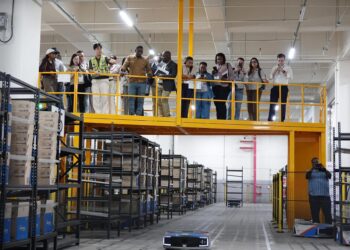
- Amazon broadening its domestic manufacturing and logistics infrastructure
- Toyota establishing a new plant in Karnataka
- Hyundai’s 2024 investment in Maharashtra, enhancing both capacity and technological capability
India’s manufacturing strengths span automotives, pharmaceuticals, and electronics assembly — sectors supported by policy initiatives and reinforced by structural advantages including rapid economic growth, a large educated labour pool, and a vast domestic market (Economic and Social Commission for Asia and the Pacific, 2023).
Measurable Momentum in Manufacturing Activity
India’s Purchasing Managers Index (PMI) stands well above 50, signalling sustained expansion in manufacturing conditions — a level notably higher than comparator economies including China and Indonesia (ADB, 2025). This reflects improving sentiment among purchasing managers and corroborates macro-level investment trends.
The report contrasts two development paradigms: one centred on services-led growth — advocated by Rajan and Lamba (2024), who highlight India’s demographic dividend and digital services potential — and another rooted in manufacturing-led industrialisation. Citing historical precedent, the source stresses that the East Asian miracle (Japan, Korea, Taiwan, Hong Kong, Singapore, and later China) and earlier industrial revolutions in the UK, Germany, and the US all relied on robust manufacturing expansion to generate high-quality jobs and lift entire economies beyond lower-middle-income status.
Regional Trade Diplomacy Gains Traction
South Asia is increasingly leaning toward trade-driven integration in the current geopolitical context. Sri Lanka recently signed FTAs with Thailand and Singapore; Bangladesh is actively negotiating FTAs with multiple Asian countries. These moves reflect a shared regional aspiration to build the supply chain ecosystem required for an ambitious trade agenda.
The source concludes that while India’s rise as a complementary Asian manufacturing hub to China is now widely acknowledged (Wignaraja, 2023), its success hinges on sustaining policy coherence, deepening regional connectivity, and ensuring neighbours are integrated as partners — not just passive recipients — in the new supply chain architecture.
Source: indiafoundation.in
Compiled from international media by the SCI.AI editorial team.