7 Warehouse Automation Trends in 2026: How Software, AI and Robotics Are Reshaping Logistics
According to the latest “2026 Warehouse Automation Trends” report from systems integrator Hy-Tek Intralogistics, software intelligence, artificial intelligence (AI), and robotics are powering a new wave of warehouse automation that is redefining warehousing and distribution operations. Based on in-depth research of industry-leading companies, the report reveals seven key trends that will reshape the logistics industry in the coming year.
As global supply chains continue to face multiple challenges including labor shortages, surging e-commerce demand, and rising operational costs, warehouse automation is transitioning from an “optional solution” to “essential infrastructure.” According to the latest “2026 Warehouse Automation Trends” report from systems integrator Hy-Tek Intralogistics, software intelligence, artificial intelligence (AI), and robotics are powering a new wave of warehouse automation that is redefining warehousing and distribution operations. Based on in-depth research of industry-leading companies, the report reveals seven key trends that will reshape the logistics industry in the coming year.
Trend 1: Focus Shifts to Inbound Automation
While many automation projects previously focused primarily on outbound fulfillment, inbound automation is now capturing the spotlight. Companies are looking to reduce bottlenecks and increase efficiency in receiving, putaway, and pallet handling. Traditionally, warehouses had to take inbound products out of their original cases and put them into bins, trays, or new cartons that could interact with storage equipment. Now, load exchangers and case handlers enable robotic picking of cases into trays or direct movement of cases to shelving without intermediate unpacking. Major investments are expected in robotic depalletizing and pallet-building systems, AI-enabled vision inspection for real-time product and barcode identification, and autonomous mobile robots (AMRs) for case and pallet transport—all focused on the inbound side. According to Hy-Tek’s report, companies focusing on inbound automation can expect to improve receiving efficiency by over 40% while reducing manual intervention requirements by 30%.
Trend 2: Robotics-as-a-Service (RaaS) Adoption Accelerates
Organizations no longer need to expend significant capital to add robotics to their warehousing operations. Through flexible subscription models known as Robotics-as-a-Service (RaaS) arrangements, companies can deploy and scale robotic fleets. With providers managing updates, maintenance, and scalability, operations teams can focus on fulfilling orders rather than servicing equipment. While the RaaS model is most widely used for mobile robots, similar subscription models are being employed by other automation companies, including computer vision startups and drone providers. Industry data shows that companies adopting RaaS models can reduce robot deployment time by 60% while cutting maintenance costs by 35%. This model is particularly suitable for small and medium-sized logistics enterprises that can benefit from advanced automation technology without bearing high capital expenditures.
Trend 3: Software Becomes the Central Driver
While hardware remains important, software is driving many of the biggest advances in modern warehouse operations. Warehouse execution systems (WES), orchestration platforms, and low-code/no-code integration tools are redefining facility operations by coordinating and integrating previously separate systems and processes, making configurations much easier. These systems also connect enterprise resource planning (ERP) systems, warehouse management systems (WMS), robotics, and internet of things (IoT) devices into one unified ecosystem, allowing data to drive every process. According to the report, companies adopting advanced software platforms can achieve 25% improvement in operational efficiency while reducing system integration time from weeks to days. Software-driven automation not only increases flexibility but also enables warehouses to adapt more quickly to changing market demands.
Trend 4: Robotic Programming Gets Easier
Programming a robotic arm used to require specialized technicians, but low-code interfaces and digital twins now allow operators to configure tasks using visual tools like drop-down menus or through “teach-by-demonstration” where they physically guide the arm. Because configuration is simpler, robots can switch more easily from performing one task (like decartoning) to another (such as kitting or inspection). As a result, downtime and engineering costs are reduced. Hy-Tek data shows that warehouses adopting new programming methods can reduce robot reconfiguration time by 70% while cutting programming-related labor costs by 45%. This technological advancement enables more warehouse staff to participate in robot operations, not just specialized engineering teams.
Trend 5: Vision Systems Get Smarter
Vision technology solutions have evolved significantly. Modern imagers equipped with neural processing units can now identify, classify, and track products in real time. Many traditional vision systems rely on predefined templates or image databases, which can make scaling to large numbers of SKUs cumbersome. In contrast, vision systems using neural-network models can be trained on broader classes of products. One application pairs such a vision system with a robotic arm so it can begin reliable picking after a relatively short training period. Reports indicate that warehouses using intelligent vision systems can improve picking accuracy to over 99.9% while reducing training time for new SKUs from days to hours. This technological progress is particularly important for e-commerce warehouses handling high SKU diversity.
Trend 6: Storage Systems Become More Dynamic
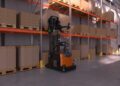
Traditional pick modules are increasingly being replaced by robotic automated storage and retrieval systems (AS/RS) that can dynamically optimize storage and retrieval. These systems reduce travel time, increase accuracy, and adapt to changing demand patterns in real time. Unlike static racking, pick modules, and conveyor layouts—which are difficult to change once installed—robotic storage systems are typically modular and can be reconfigured as order volumes, SKU mix, or service levels change. For facilities not ready to commit to full-scale AS/RS, mini-load systems provide an alternative. These compact, high-throughput systems can integrate with conveyors, shuttles, or robotic palletizers and offer scalable capacity that grows with operations. Industry data shows that warehouses adopting dynamic storage systems can increase storage density by 300% while reducing order fulfillment time by 50%.
Trend 7: Robotic Sorters Redefine “High-Speed” Operations
For many years, automated A-frame dispensers were the go-to technology for high-speed piece picking. However, robotic sorters can now deliver comparable or better throughput with much greater flexibility. By combining vision intelligence with adaptive routing, these systems handle greater SKU diversity and volume while maintaining uptime and flexibility. The new generation of sorters isn’t just faster—it’s smarter. According to the report, robotic sorting systems can increase sorting speed to over 10,000 pieces per hour while reducing error rates to below 0.01%. This technological advancement is particularly valuable for retail and e-commerce warehouses handling seasonal peaks and promotional events, as they can process order surges without additional labor.
Hy-Tek Intralogistics’ report emphasizes that the future of warehouse automation lies not in single-technology breakthroughs but in the convergence of software, AI, and robotics. This convergence is creating smarter, more flexible, and more efficient warehousing ecosystems capable of adapting to rapidly changing supply chain demands. As companies continue investing in these technologies, 2026 is expected to bring more innovative applications, from predictive maintenance to fully autonomous warehouse operations. For logistics professionals, understanding these trends and developing corresponding technology adoption strategies will be key to maintaining competitiveness and achieving sustainable growth.
Source: DC Velocity
This article was AI-assisted and reviewed by our editorial team.