Skip to content

Robotics · Strategy & Planning · Supply Chain · Technology

Integrating Robots and Drones for Food Delivery

We Are Indeed Racing Towards the Future: Serve Robotics Manufactures Sidewalk Delivery Robots

Original source: Source information pending

Integrating Robots and Drones for Food Delivery

Ask SCI.AI about this story

📋 本文要点

We Are Indeed Racing Towards the Future: Serve Robotics Manufactures Sidewalk Delivery Robots

# Combining Robots and Drones for Food Delivery

Author: Rain Noe
– October 3rd

Category: [Tech](https://www.core77.com/Tech?utm_source=from_tags) | [Food](https://www.core77.com/Food?utm_source=from_tags)

Ladies and gentlemen, we are rapidly heading towards the future.

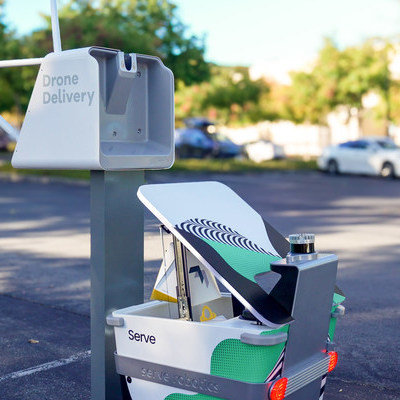
A company called Serve Robotics manufactures these sidewalk delivery robots.

Restaurant staff load items into the robot, which then autonomously delivers them to your building. Although these robots have a delivery range of up to 25 miles, they do not travel fast, with a top speed of only 6 mph, making them most suitable for deliveries within a two-mile radius.

However, this company has now partnered with drone delivery provider Wing Aviation. Under this arrangement, Serve’s robots transport the delivery items to nearby Wing Autoloader stations, where Wing’s drones take over and swiftly fly the orders to your building.

Dr. Ali Kashani, CEO of Serve, states that this means they can offer “city-wide automatic deliveries within 30 minutes.”

Other advantages:

> **- Speed:** Wing’s drones can fly over traffic congestion while Serve’s robots operate solely on sidewalks, thus avoiding street traffic altogether.

> **- Cost-effective:** Drones and robots reduce delivery costs for both operators and consumers, eliminating the need to pay tips.

> **- Environmentally friendly:** Both Wing and Serve are fully electric, reducing vehicle emissions associated with food deliveries while also decreasing traffic volume and congestion.

> **- Safety:** By reducing the number of vehicles on the road, Serve and Wing help lower the incidence of traffic accidents.

> **- Convenience:** Curbside robot package pickup allows businesses to use drone delivery without modifying their facilities or installing new equipment.

The two companies state they will roll out this arrangement in “the coming months,” though no specific locations have been mentioned. (Let me guess: San Francisco.)

—

Source Website: Core77

Ask SCI.AI Finished reading? Continue with SCI.AI. Explore the related policy, route, company and historical context. Continue asking
Stay ahead of supply chain shifts

One email a week: the stories that matter and new risk events — in English, free.

Prefer RSS? Articles Risk events

North American robot orders hit highest level since 2022 boom
Strategy & Planning

North American robot orders hit highest level since 2022 boom

North American robot orders climbed to their highest level since the 2022 boom and continued that trend into 2026, according to Association for Advancing Automation data reported by DC Velocity. Strong demand from semiconductor and electronics, pharmaceutical, and food and beverage industries offset declining automotive orders in the first half of 2026, with shipments up 21% and 24% year over year. Rocrich AGV, a joint venture of Logisnext Americas and Jungheinrich, supplies automated guided vehicles for warehouse automation. Shifting trade policies and a warehouse labor shortage intensified by tightened immigration policies are pushing more companies toward automation, while falling costs are making the technology accessible to small and medium-sized players.

Warehouse automation market to double to €42B by 2030
Robotics

Warehouse automation market to double to €42B by 2030

The global warehouse automation market is forecast to grow from around €21 billion in 2025 to €42 billion by 2030, according to an L.E.K Consulting analysis published by logisticsbusiness.com. Partners Florian Funke and Harpreet Singh and Principal Charles Sealy argue that robots are moving from transporting goods to manipulating them through picking, stowing, depalletising and packing, while AI handles real-time decisions on storage, routing and task allocation. Warehouse stock growth is expected to slow from roughly 5% a year in 2020-25 to 3-4% a year towards 2030 across Europe, the US and Asia-Pacific, pushing operators toward modular automation and retrofits. High-density matrix AS/RS adoption is estimated to grow 20-25% over five years.

China-Europe air cargo falls 17% as EU fees reshape e-commerce
Strategy & Planning

China-Europe air cargo falls 17% as EU fees reshape e-commerce

WorldACD data shows air cargo volumes from China and Hong Kong to Europe fell 17% year on year in October, with Hong Kong-origin volumes down 32% and mainland China down 8%. The decline follows the EU's July introduction of a €3 charge on items under €150 and comes as platforms shift toward consolidated B2B imports. A further €2 per-item handling fee took effect 1 November. Rates on the lane still rose 9% month on month and 14% year on year to $4.85 per kg. By contrast, China-Hong Kong to US tonnages rose 8% year on year.

Welcome Back!

Login to your account below

Create New Account!

Fill the forms below to register

Retrieve your password

Please enter your username or email address to reset your password.

Scan to share via WeChat

Open WeChat and scan the QR code to share

QR Code

Add New Playlist