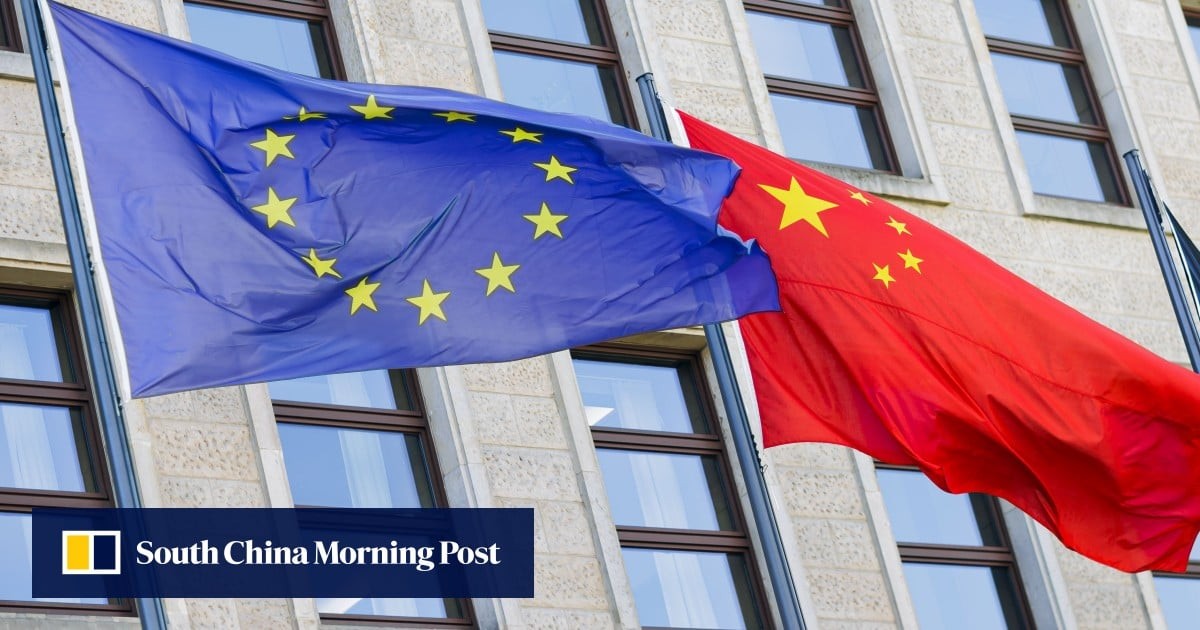
According to www.scmp.com, China’s Ministry of Commerce added 14 European Union-based entities to its export control list on 24 July 2026, effective immediately.
Retaliatory measure against EU sanctions
The move directly responds to the European Union’s 21st round of sanctions against Russia, announced on 23 July 2026, which included restrictions targeting 14 companies from mainland China and Hong Kong. In its official statement, China’s Ministry of Commerce labeled the EU’s actions “
egregious
” and explicitly cited them as the justification for the new export controls.
The EU sanctions prohibited the export of dual-use goods and technologies — items with both civilian and military applications — to 51 entities globally. Firms from mainland China, Hong Kong, India, Turkey, and the United Arab Emirates were among those newly listed by Brussels. China’s countermeasure mirrors this structure but narrows its scope to EU-based actors, applying identical regulatory logic: restricting access to dual-use items originating in or exported from China.
Named entities include major defense and industrial firms
Among the 14 EU entities placed on China’s list are Rheinmetall, the German defense conglomerate; Lafert, an Italian electric motor manufacturer; and Cavok UAS, a French drone development company. The list covers firms across defense, aerospace, electronics, and advanced manufacturing sectors — all industries closely tied to dual-use technology supply chains.
Under the order, Chinese exporters are barred from shipping dual-use items — including certain rare earth elements, specialized software, and precision components — to these named entities. The restriction also applies to any shipment of dual-use items of Chinese origin destined for these organizations, regardless of transit point or intermediary involvement. This effectively severs formal commercial channels for sensitive inputs between Chinese suppliers and the listed EU firms.
Impact on global supply chain resilience
The action underscores intensifying friction over critical mineral flows and technology sovereignty. Rare earth elements — many of which are processed in China and essential for high-performance magnets in defense systems and electric vehicles — feature prominently in the dual-use category affected by the ban. According to the report, the prohibition takes effect immediately, granting no grace period for contract fulfillment or inventory drawdown.
Supply chain professionals must now reassess sourcing continuity for components reliant on EU-China technical collaboration. For example, Rheinmetall’s artillery and air-defense systems incorporate sensors and materials subject to strict export controls; disruptions in Chinese-sourced rare earth processing could delay production timelines. Similarly, Cavok UAS’s unmanned aerial platforms depend on precision electronics whose supply may now face customs scrutiny or outright denial at Chinese ports.
The timing — just days after the EU’s 21st round of Russia-related sanctions — signals coordinated escalation in geopolitical economic tools. Unlike tariffs or investment bans, export controls target specific corporate entities and technical inputs, making compliance monitoring highly granular and enforcement technically demanding for multinational procurement teams.
Broader regulatory context
This is not China’s first use of export controls as a diplomatic instrument. In 2023, Beijing imposed similar restrictions on U.S. semiconductor equipment firms following Washington’s export curbs on advanced AI chips. The current action expands that precedent to the EU, reflecting a deliberate strategy of calibrated reciprocity rather than blanket trade barriers.
Meanwhile, the EU’s 21st round sanctions mark a notable expansion beyond Russian entities to include third-country intermediaries — a trend increasingly adopted by Western regulators to close circumvention loopholes. That approach triggered China’s response, confirming that export control regimes are now central levers in geopolitical risk management. For logistics and compliance officers, the dual listings — 14 EU firms by China and 14 Chinese/Hong Kong firms by the EU — create parallel, asymmetric compliance obligations requiring real-time screening across multiple jurisdictional lists.
Source: South China Morning Post
Compiled from international media by the SCI.AI editorial team.