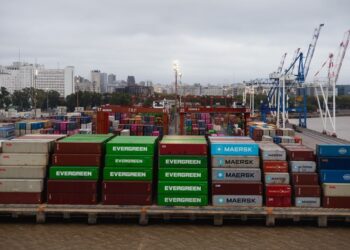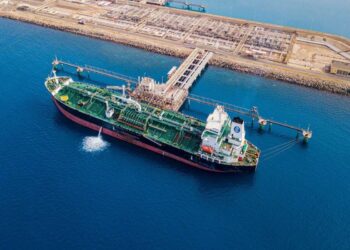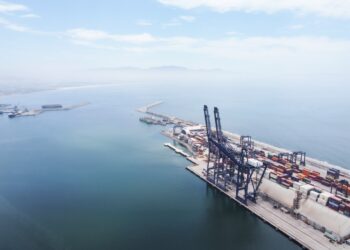
According to theloadstar.com, container shipping lines are deploying additional vessel capacity on East Asia–Australia routes amid a sharp freight rate surge — with the Shanghai-Melbourne spot rate rising to $1,808 per TEU on 18 June 2026, more than double its year-ago level of $763 per TEU.
New services ramp up capacity
CMA CGM’s Australian subsidiary ANL is partnering with OOCL, a Cosco affiliate, to launch the Australia-China Express (ACX) service on 27 July 2026. The service will deploy six vessels ranging from 3,000 to 4,000 TEU, calling at Qingdao, Shanghai, Shekou, Melbourne, Sydney and returning to Qingdao. Its 42-day round-trip cycle begins with the 3,338 TEU vessel Colombo departing Qingdao on launch day.
ANL already operates the A3N service linking Yokohama, Osaka, Busan, Qingdao, Shanghai, Ningbo and Kaohsiung to Melbourne southbound, and Melbourne, Sydney and Brisbane to Yokohama northbound. This expansion follows Maersk’s scheduled launch of its Qilin service on 24 July 2026, connecting Shanghai directly to Sydney and Melbourne using five vessels sized between 2,500 and 2,800 TEU. The Qilin service complements Maersk’s existing Dragon service, which serves Qingdao, Ningbo, Shanghai, Hong Kong and Yantian en route to Sydney, Melbourne and Brisbane.
Fare pressure intensifies across key lanes
Freight forwarders report that carriers are now quoting $2,000 per TEU for Far East–Australia spot shipments — a clear signal of acute capacity constraints. The Shanghai Containerised Freight Index (SCFI) recorded a 4% weekly increase in the Shanghai–Melbourne rate between 11 and 18 June 2026. Meanwhile, Korea Ocean Business Corp’s Container Composite Index shows the Busan–Australia rate climbed 10% week-on-week to $3,096 per 40ft container.
This price escalation stems from sustained demand across intra-Asia and long-haul routes, compounded by port congestion in major hubs. According to the report, tight capacity — not carrier-led surcharges — is driving upward pressure. The Port of Melbourne CEO Saul Cannon confirmed that container trade rose more than 2% year-on-year in Q1 2026 despite geopolitical volatility affecting fuel supply and shipping reliability.
Australia’s port growth and export shift
In April 2026 alone, the Port of Melbourne posted 7% year-on-year growth in container throughput. Last year, the port handled 660,000 TEU in exports. Notably, Southeast Asia has emerged as a pivotal growth engine: it now accounts for more than a quarter of Australia’s total container exports — underscoring structural shifts in regional trade flows.
The surge reflects broader supply chain recalibrations, including manufacturing diversification away from single-source dependencies and increased near-shoring within Asia-Pacific. For supply chain professionals, this means higher short-term freight costs but also expanded scheduling options and greater port call flexibility — particularly for shippers serving both eastern and western Australian markets via Melbourne and Sydney.
Source: The Loadstar
Compiled from international media by the SCI.AI editorial team.