Explore

  • Trending
  • Latest
  • Tools
  • Browse
  • AI Assistant
  • Subscription Feed

Logistics

  • Ocean
  • Air Cargo
  • Road & Rail
  • Warehousing
  • Last Mile

Regions

  • Southeast Asia
  • South Asia
  • Central Asia
  • Japan & Korea
  • Middle East
  • Europe
  • Russia
  • Africa
  • North America
  • Latin America
  • Australia
SCI.AI
  • Supply Chain
    • Strategy & Planning
    • Logistics & Transport
    • Manufacturing
    • Inventory & Fulfillment
  • Procurement
    • Strategic Sourcing
    • Supplier Management
    • Supply Chain Finance
  • Technology
    • AI & Automation
    • Robotics
    • Digital Platforms
  • Risk & Resilience
  • Sustainability
  • Research
  • Expert Columns
  • English
    • Chinese
    • English
No Result
View All Result
  • Login
  • Register
SCI.AI
No Result
View All Result
Home Risk & Resilience Disruptions

Swiss Re: 43% of EU Fortune 500 assess only own facilities

2026/07/27
in Disruptions, Risk & Resilience
0 0
Swiss Re: 43% of EU Fortune 500 assess only own facilities

According to www.dcvelocity.com, a Swiss Re Corporate Solutions report warns that supply chain disruption increasingly originates not from a company’s internal operations—but from vulnerable suppliers, infrastructure providers, and third-party logistics partners.

Hidden Dependencies Drive Business Interruption Risk

The Zurich-based insurer’s report, titled “Emerging Risks: Hidden Dependencies in Global Supply Chains,” identifies a critical gap in enterprise risk management. While companies have invested heavily in fortifying their own facilities against climate events, geopolitical shocks, and infrastructure failures, they routinely overlook dependencies outside their direct control. As Adrian Hall, US CEO of Swiss Re Corporate Solutions, stated:

“Businesses have become much better at understanding the risks to their own facilities. The next challenge is understanding the dependencies beyond their own operations that can determine whether they recover quickly or face prolonged disruption.” — Adrian Hall, US CEO, Swiss Re Corporate Solutions

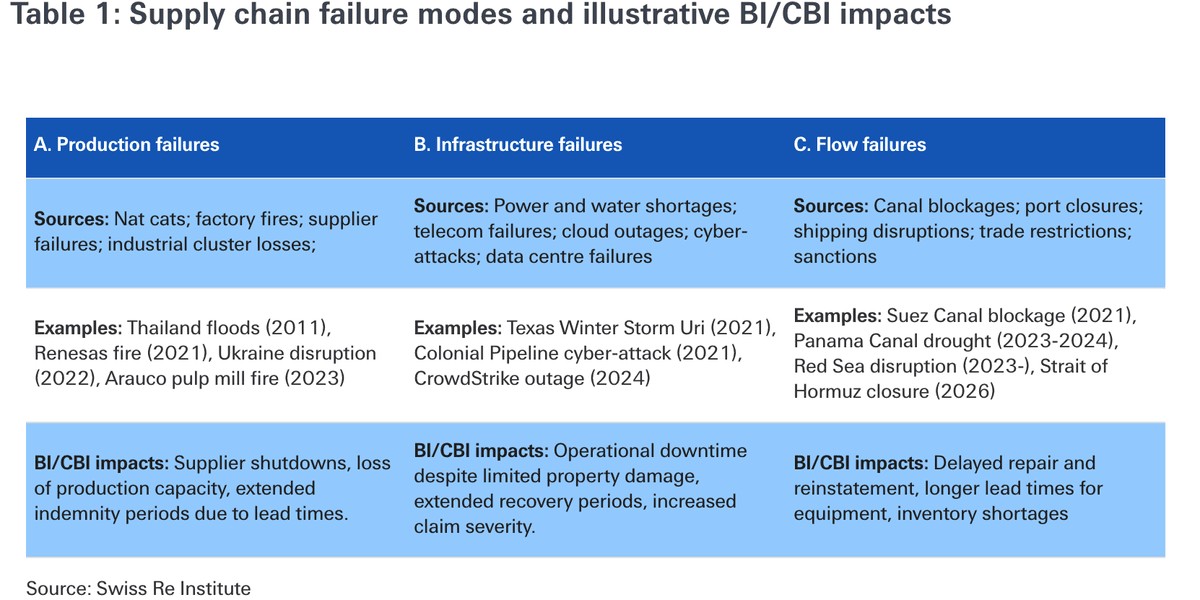
The report underscores how interconnected modern supply chains are: a power outage at a Tier-2 semiconductor supplier in Taiwan, a port closure in the Red Sea, or rail congestion in Eastern Europe can cascade across continents—delaying repairs, halting production lines, and triggering contingent business interruption (CBI) losses far from the original incident site.

Assessment Gap: 43% vs. 7% vs. 2%

Quantitative findings reveal stark disparities in risk assessment scope. According to the report, 43% of Fortune 500 companies headquartered in Europe assess physical risk to their own facilities—but only 7% publicly disclose extending those assessments to supplier facilities. Even more critically, fewer than 2% report evaluating the broader infrastructure they rely on—including electricity grids, transport hubs, and customs clearance systems.

This data gap leaves enterprises exposed: when the Middle East conflict escalated in early 2026, it became the fourth major global supply shock within six years—following the Suez Canal blockage, the Ukraine war’s Black Sea shipping disruptions, and pandemic-era port congestion. Each event triggered cascading delays in equipment replacement, raw material inputs, and finished-goods distribution—amplifying insured business interruption (BI) and CBI losses.

Data Deficiency Undermines Resilience Modeling

Swiss Re notes that advanced tools now exist to model downtime and infrastructure interdependencies at scale—yet their effectiveness hinges entirely on data quality. The report states that many firms still lack foundational visibility into supplier locations, tiered logistics networks, and regional infrastructure vulnerabilities. Without granular data on supplier facilities, power provider reliability, and transport hub capacity, even sophisticated models produce misleading outputs.

For example, a manufacturer may simulate recovery time after a fire at its own plant—but without knowing whether its sole battery-cell supplier relies on a single substation prone to monsoon-related outages, the model fails to capture true contingent risk. Similarly, rerouting shipments via alternative ports becomes operationally futile if customs processing capacity at those ports is already saturated—a condition Swiss Re found unassessed by 98% of surveyed EU Fortune 500 firms.

Practical Implications for Supply Chain Professionals

From a practitioner standpoint, the report signals an urgent shift from siloed risk ownership to network-wide accountability. Supply chain professionals must now treat supplier due diligence—not as procurement compliance—but as core insurance underwriting. This includes mapping Tier-2 and Tier-3 suppliers, validating infrastructure redundancy (e.g., dual-power feeds, backup freight corridors), and embedding contractual clauses requiring real-time incident reporting from logistics partners.

Industry benchmarks suggest progress remains slow: while 2024 saw a 12% rise in supplier risk audits among top-tier shippers, less than 5% integrated infrastructure failure scenarios into their annual continuity planning. Meanwhile, insurers like Swiss Re are beginning to require documented dependency maps before issuing CBI coverage—making transparency a commercial necessity, not just a best practice.

Source: DC Velocity

Compiled from international media by the SCI.AI editorial team.

More on This Topic

  • Bangladesh Gas Crisis Raises Textile Costs 20%, Cuts Output 30–40% (Jul 28, 2026)
  • Golden Leo sinks after Russian missile strike in Black Sea (Jul 28, 2026)
  • Houthi blockade cuts Red Sea traffic 40%, raises Middle East conflict risk (Jul 27, 2026)
  • China adds 14 EU entities to export control list (Jul 27, 2026)
  • India’s August crude imports face dual risk: Russian port attacks, Red Sea costs triple (Jul 27, 2026)
ShareTweet

Related Posts

Bangladesh Gas Crisis Raises Textile Costs 20%, Cuts Output 30–40%
Disruptions

Bangladesh Gas Crisis Raises Textile Costs 20%, Cuts Output 30–40%

July 28, 2026
0
Golden Leo sinks after Russian missile strike in Black Sea
Disruptions

Golden Leo sinks after Russian missile strike in Black Sea

July 28, 2026
0
Houthi blockade cuts Red Sea traffic 40%, raises Middle East conflict risk
Geopolitics

Houthi blockade cuts Red Sea traffic 40%, raises Middle East conflict risk

July 27, 2026
6
China adds 14 EU entities to export control list
Geopolitics

China adds 14 EU entities to export control list

July 27, 2026
8
India’s August crude imports face dual risk: Russian port attacks, Red Sea costs triple
Disruptions

India’s August crude imports face dual risk: Russian port attacks, Red Sea costs triple

July 27, 2026
4
C.H. Robinson hit with $604M nuclear verdict, 3PL stocks plunge
AI & Automation

C.H. Robinson hit with $604M nuclear verdict, 3PL stocks plunge

July 26, 2026
7

Leave a Reply Cancel reply

Your email address will not be published. Required fields are marked *

Recommended

76% of Fashion Executives Say Tariffs Will Reshape 2026: McKinsey Reveals Four Strategic Sourcing Shifts in Apparel

76% of Fashion Executives Say Tariffs Will Reshape 2026: McKinsey Reveals Four Strategic Sourcing Shifts in Apparel

90 Views
March 9, 2026
Apple Cuts iPhone Component Tariffs in India Through 2029

Apple Cuts iPhone Component Tariffs in India Through 2029

24 Views
July 10, 2026
EU Seeks US Trade Talks Amid 25% Trump Car Tariff Threat — www.ttnews.com

EU Seeks US Trade Talks Amid 25% Trump Car Tariff Threat — www.ttnews.com

26 Views
May 5, 2026
DHL Air Cargo Outlook: Asia-Europe Capacity Surges 11% While Transpacific Drops 10% in Q1 2026

DHL Air Cargo Outlook: Asia-Europe Capacity Surges 11% While Transpacific Drops 10% in Q1 2026

61 Views
February 21, 2026
Show More

SCI.AI

Global Supply Chain Intelligence. Delivering real-time news, analysis, and insights for supply chain professionals worldwide.

Categories

  • Supply Chain Management
  • Procurement
  • Technology


  • Risk & Resilience
  • Sustainability
  • Research

© 2026 SCI.AI. All rights reserved.

Powered by SCI.AI Intelligence Platform

Welcome Back!

Sign In with Facebook
Sign In with Google
Sign In with Linked In
OR

Login to your account below

Forgotten Password? Sign Up

Create New Account!

Sign Up with Facebook
Sign Up with Google
Sign Up with Linked In
OR

Fill the forms below to register

All fields are required. Log In

Retrieve your password

Please enter your username or email address to reset your password.

Log In

Scan to share via WeChat

Open WeChat and scan the QR code to share

QR Code

Add New Playlist

No Result
View All Result
  • Supply Chain
    • Strategy & Planning
    • Logistics & Transport
    • Manufacturing
    • Inventory & Fulfillment
  • Procurement
    • Strategic Sourcing
    • Supplier Management
    • Supply Chain Finance
  • Technology
    • AI & Automation
    • Robotics
    • Digital Platforms
  • Risk & Resilience
  • Sustainability
  • Research
  • Expert Columns
  • English
    • Chinese
    • English
  • Login
  • Sign Up

© 2026 SCI.AI