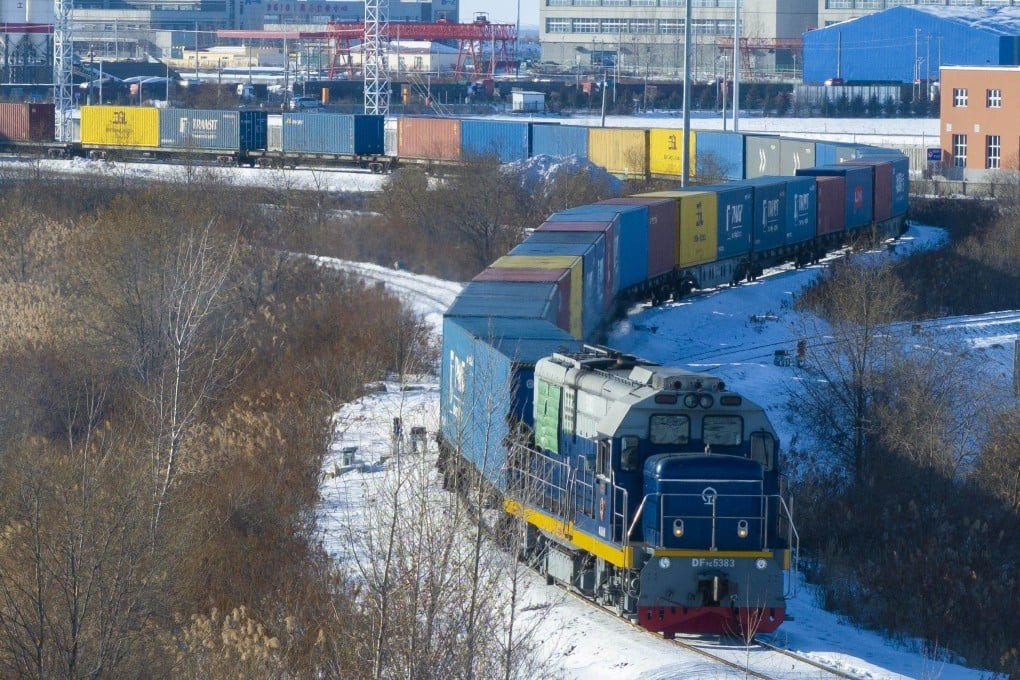
According to www.scmp.com, the China-Europe railway network has surpassed 17,000 annual goods train trips between 2020 and 2023 — a doubling of volume over that period — as geopolitical disruptions elevate its role in global supply chain resilience.
From Experiment to Essential Infrastructure
What began as sporadic trial runs has matured into a sprawling rail network linking 235 cities across 26 European countries with more than 120 Chinese cities. The system evolved from a nascent logistical experiment into a growing commercial alternative to maritime and air freight — and, according to the source, is now assuming an unanticipated role as a key security provider for transcontinental supply chains.
Geopolitical Catalysts Accelerate Adoption
The US-Israel war on Iran — referenced in the source as a trigger — compounds existing pressures on maritime routes through the Middle East. This follows earlier geopolitical shocks: Russia’s 2022 invasion of Ukraine prompted Chinese and European operators to accelerate investment in the trans-Caspian corridor (also known as the Middle Corridor). This route traverses Kazakhstan, crosses the Caspian Sea, then passes through Azerbaijan, Georgia, and Turkey before entering Eastern Europe — reducing dependence on Russian territory and adding strategic diversification.
Pandemic Proved Early Resilience
The Covid-19 pandemic acted as a catalyst, as air freight capacity collapsed and sea lanes suffered port congestion and container shortages. During this period, the railway demonstrated reliability by transporting critical goods — including personal protective equipment and vaccines — enhancing its reputation among logistics firms. Commercial uptake was further enabled by bilateral customs agreements, standardised container tracking, and coordinated border procedures.
Practitioner Implications
For global supply chain professionals, the growth of the China-Europe railway signals a structural shift in multimodal planning. With Red Sea and Suez Canal volatility persisting — and sanctions reshaping Eurasian transit options — the Middle Corridor offers a viable land-based alternative requiring new capabilities: cross-border documentation harmonisation across five jurisdictions, intermodal terminal coordination (rail-to-ferry-to-rail), and real-time visibility across fragmented national rail systems. Unlike container shipping, which faces well-documented port delays and insurance cost spikes in conflict zones, rail offers more predictable transit windows (12–18 days vs. 30–45 days by sea), albeit at higher per-container cost. According to the report, this trade-off is increasingly accepted when continuity of supply outweighs unit economics — especially for time-sensitive industrial components and pharmaceuticals.
Industry Context
This expansion aligns with broader industry moves toward route diversification. Following the 2022 Red Sea crisis, Maersk and MSC rerouted over 40% of Asia-Europe sailings around Africa, increasing voyage times and costs; meanwhile, DHL and DB Schenker expanded rail forwarding services along the Middle Corridor, citing double-digit annual growth in client demand since 2023. Public data from the International Union of Railways (UIC) confirms that Eurasian rail freight volumes grew 14% year-on-year in Q1 2026 — the strongest quarterly increase since 2019. Unlike traditional rail corridors dependent on single-state infrastructure (e.g., Russia’s Trans-Siberian), the Middle Corridor’s multi-sovereign structure necessitates deeper public-private alignment — a dynamic now mirrored in EU’s recently adopted Global Gateway transport financing framework, which includes €1.2 billion earmarked for Caspian Sea port modernisation.
Source: South China Morning Post
Compiled from international media by the SCI.AI editorial team.