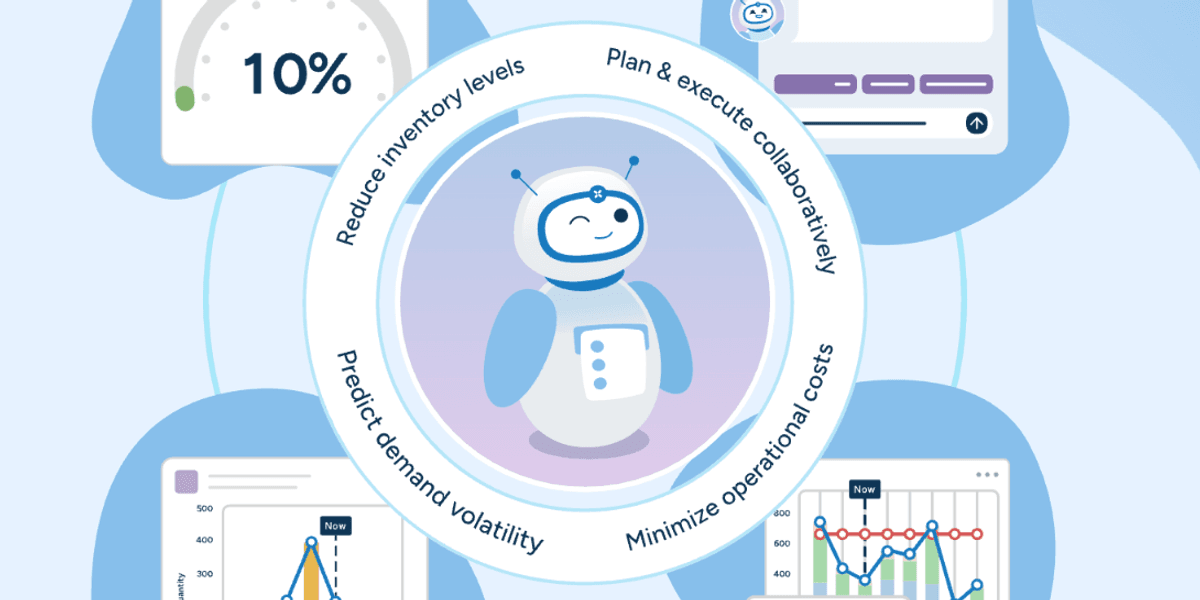
According to www.dcvelocity.com, a January 2026 survey of 514 retail, manufacturing, wholesale, and supply chain leaders reveals a pronounced yet pragmatic stance toward artificial intelligence: while AI is rapidly embedding itself into daily planning workflows, only 10% of executives would entrust it to make fully independent supply chain decisions. The study — titled “State of Supply Chain 2026: Volatility, Trade-Offs & the Rise of AI” and conducted by Researchscape for tech vendor Relex Solutions — underscores a decisive preference for human oversight. A majority — 54% — favor AI as a recommendation engine, with final authority retained by people. This reflects not resistance to AI, but a calibrated adoption model grounded in accountability, traceability, and risk mitigation — all critical in global supply chains where errors cascade across tiers, geographies, and compliance regimes. The findings come amid accelerating deployment: 67% report increased confidence in using AI for supply chain decision-making compared with the prior year, signaling maturation beyond pilot-stage experimentation into operational integration.
Adoption Patterns Across Functions and Sectors
The survey documents concrete implementation trends across functional domains. Nearly half — 47% — of respondents are already using or actively planning to deploy AI-driven inventory and supply optimization tools, recognizing their capacity to reconcile multi-echelon stock levels, lead-time variability, and service-level targets under uncertainty. In logistics, 41% are applying AI to routing and transportation planning — a domain where real-time traffic data, carrier performance history, fuel cost fluctuations, and carbon constraints increasingly demand dynamic recalibration. Sectoral priorities diverge meaningfully: retailers cite consumer demand volatility as their foremost challenge, with 44% naming it a top-three pressure over the next three years; 30% specifically identify adapting to sudden shifts in consumer behavior as a major operational hurdle. This drives investment in AI-powered forecasting engines that ingest point-of-sale data, social sentiment signals, promotional calendars, and weather patterns to shorten forecast horizons and improve short-term accuracy. Manufacturers, by contrast, prioritize resilience over responsiveness: 57% identify raw material procurement disruption as the most impacted segment of their supply chain — reflecting ongoing exposure to geopolitical shocks, export controls, and single-source dependencies — while 34% flag regulatory and compliance pressures as intensifying operational concerns, particularly in industries subject to evolving ESG reporting mandates or product safety regulations.
Strategic Investment Trajectories and Underlying Drivers
Looking ahead, organizational commitment to AI infrastructure is robust and forward-looking. 71% of surveyed leaders plan to invest in generative and agentic AI capabilities over the next three to five years — technologies capable of synthesizing unstructured data (e.g., supplier emails, customs documentation, regulatory bulletins), generating scenario narratives, and autonomously initiating low-risk workflow actions like replenishment triggers or exception alerts. Simultaneously, 60% plan investments in predictive AI, which relies on statistical modeling and time-series analysis to anticipate disruptions before they manifest. These dual tracks reflect a layered strategy: predictive AI strengthens foundational visibility and early warning systems, while generative and agentic AI augments human judgment with contextual reasoning and adaptive task execution. Crucially, these investments are not speculative; they respond directly to measurable pain points. Consumer demand volatility remains the dominant catalyst, cited by 44% as the primary driver — a figure consistent with broader industry benchmarks showing global demand forecast error rates averaging 35–40% in volatile categories, according to Gartner’s 2025 Supply Chain Top 25 report. Similarly, procurement fragility aligns with the World Economic Forum’s 2025 Global Risks Report, which ranks ‘supply chain disruption due to geopolitical conflict’ among the top five global risks for the third consecutive year. For practitioners, this means AI is no longer an optional analytics add-on but a core enabler of control tower functionality — requiring cross-functional alignment between procurement, logistics, demand planning, and IT teams to ensure data quality, model governance, and change management protocols keep pace with technical capability.
Practitioner Implications: From Tool Integration to Process Redesign
For global supply chain professionals, the implications extend far beyond software selection. The 54% preference for AI-as-recommender implies that human decision rights, escalation paths, and accountability frameworks must be explicitly redesigned — not assumed. Teams must codify when and how AI inputs trigger review cycles, define thresholds for human override, and document rationale for deviations from AI suggestions to support audit readiness. Training curricula are shifting: planners now require fluency in interpreting model outputs (e.g., confidence intervals, feature importance scores) rather than just reading dashboards. Procurement specialists need to assess AI vendor data provenance — especially for models trained on third-party supplier risk databases or trade flow archives — to avoid compounding bias or outdated assumptions. Moreover, the 71% generative AI investment intent signals rising expectations for natural-language interfaces: practitioners will increasingly query systems in plain English (“What’s the optimal safety stock for SKU X if port Y faces a 10-day strike?”) rather than navigating complex parameter menus. This demands rigorous testing of hallucination risks and grounding in authoritative sources. Critically, success hinges less on algorithmic sophistication and more on operational discipline: ensuring master data integrity across ERP, WMS, and TMS systems, standardizing event taxonomies (e.g., defining “disruption” consistently across regions), and embedding feedback loops so AI recommendations improve through observed outcomes — not just historical data. As Madhav Durbha, group vice president of manufacturing industry strategy at Relex Solutions, observed in the official release:
“AI is becoming part of everyday supply chain decision-making. As volatility persists, companies are investing in AI-driven forecasting, optimization, and decision support to respond faster and operate with greater confidence, even when conditions change quickly.” — Madhav Durbha, Group Vice President of Manufacturing Industry Strategy at Relex Solutions
This article was AI-assisted and reviewed by the SCI.AI editorial team before publication.
Source: DC Velocity