According to www.automotivelogistics.media, Beijing-headquartered commercial vehicle manufacturer Foton Motor and global shipping giant COSCO Shipping have officially launched Guangzhou Yuanfu Automotive Supply Chain, a joint venture designed to establish an independent global maritime supply chain system for the transport of Foton vehicles.
Vertical Integration for Ocean Freight Control
This vertical integration between automaker and shipping company gives Foton greater control over its logistics network, securing long-term, dedicated ocean freight capacity. By shifting from outsourced logistics to owning and operating aligned maritime assets, Foton aims to reduce exposure to freight rate instability, capacity shortages, and unpredictable delivery schedules — thereby bolstering supply chain resilience.
Foton’s Global Footprint and Export Scale
Established in Beijing in 1996, Foton Motor produces medium and heavy-duty trucks, light-duty trucks, mini trucks, vans, pick-up trucks, buses, and industrial and construction vehicles. For 15 consecutive years, the company has ranked first in overseas commercial vehicle sales from China; in 2025, it sold 164,500 units to overseas markets. To support expansion, Foton operates local manufacturing bases in China, Brazil, Thailand, India, Russia, and South Africa.
First Deployment: Kai Yuankou and South America Shipment
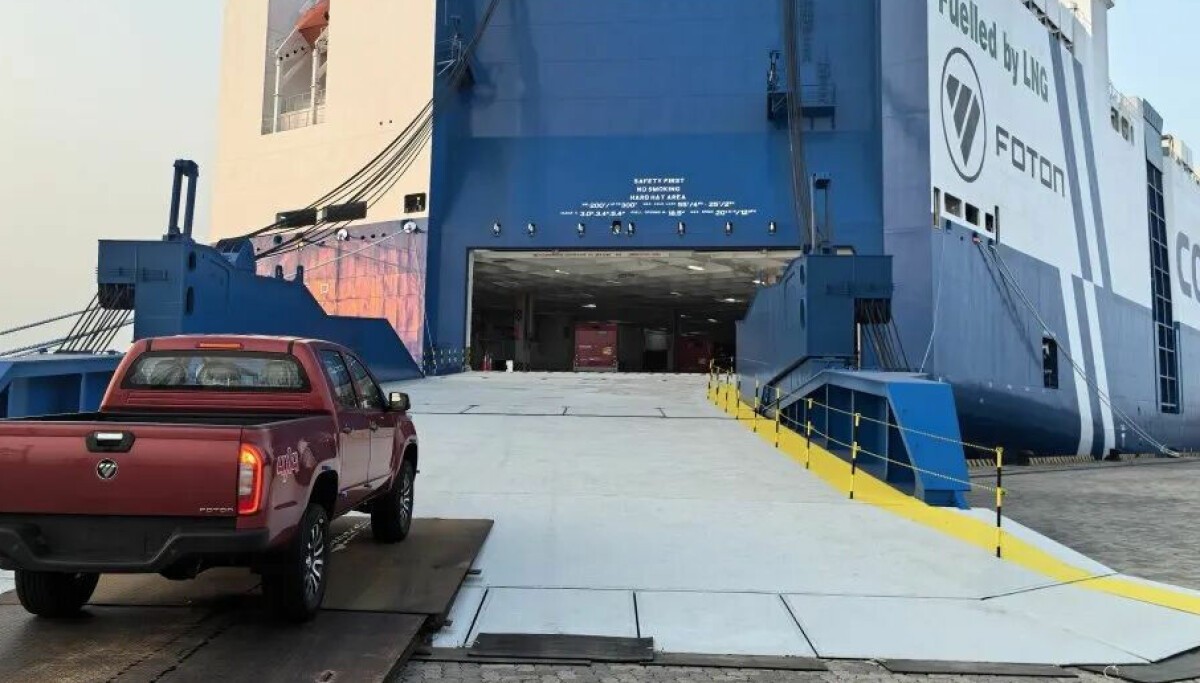
Upon launch, 600 Foton pick-up trucks were loaded onto the newly delivered RoRo vessel Kai Yuankou, which was delivered in March 2026 and branded with the logos of both Foton Motor and COSCO Shipping. The vessel’s deployment supports Foton’s strategy of “local production and regional distribution”, enabling steady market penetration across its established regions.
Strategic Rationale and Industry Implications
The joint venture is positioned as more than a bilateral arrangement: it intends to provide a “replicable and scalable” model for other Chinese automakers advancing coordinated overseas expansion. It reflects Foton’s broader “comprehensive internationalisation” strategy — transitioning from product exports to a systematic global presence.
“The joint venture with COSCO Shipping Specialized Carriers is a natural step as the company’s overseas business has grown to its current scale. This is not only a new partnership but also an upgrade to Foton Motor’s comprehensive internationalisation strategy.” — Zhu Youfu, vice president of Foton Motor
“By strengthening cooperation with Foton Motor, the two parties will set a new benchmark for synergy between the automotive and shipping industries, and contribute to building a secure and resilient supply chain for Chinese vehicles going global.” — Zhang Chi, deputy general manager of COSCO Shipping Specialized Carriers
Practitioner Perspective for Supply Chain Professionals
- Foton’s move signals a growing trend among high-volume Chinese OEMs to internalise critical ocean freight capacity — particularly RoRo — to de-risk reliance on volatile spot markets and third-party carriers.
- With Foton exporting 164,500 units overseas in 2025, its scale justifies asset-based investment; professionals should assess whether their own volume thresholds (e.g., consistent >100,000 annual vehicle exports) could similarly warrant dedicated capacity partnerships or JVs.
- The joint venture structure — co-branded vessel, shared governance, and explicit focus on replicability — offers a blueprint for OEM-logistics provider collaboration that balances control, capital efficiency, and scalability without full vertical acquisition.
Source: www.automotivelogistics.media
Compiled from international media by the SCI.AI editorial team.