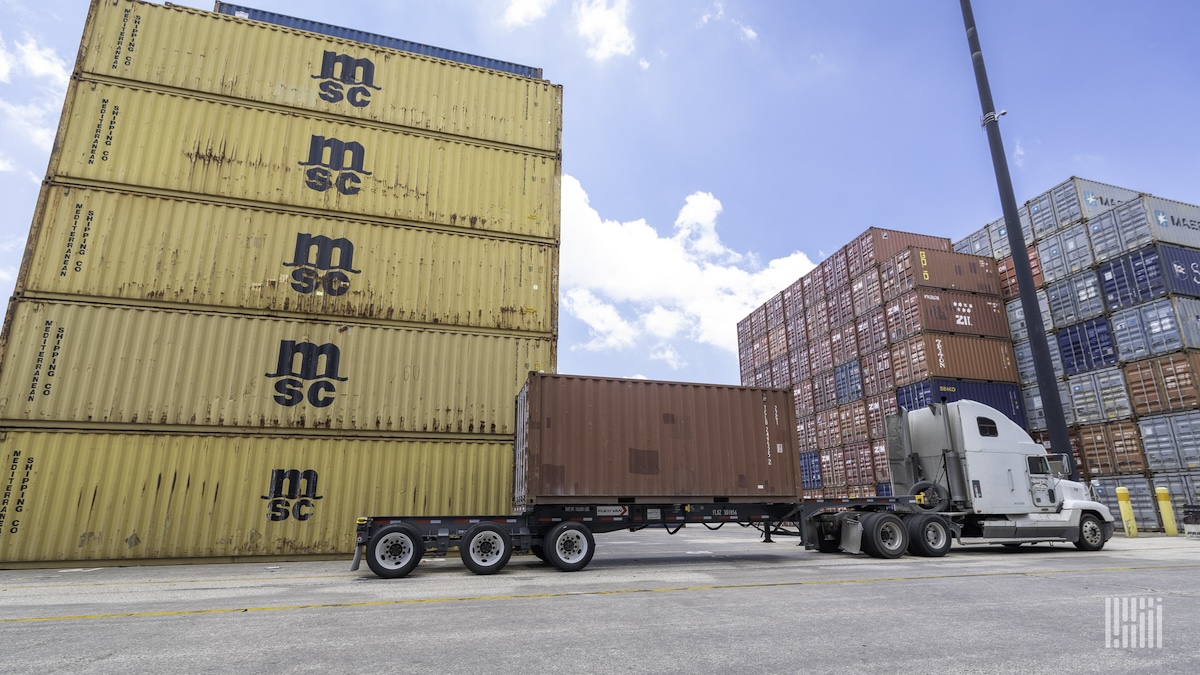
According to www.freightwaves.com, manufacturers and retailers across North America are increasingly adopting mobile storage trailers as a flexible, cost-effective alternative to traditional warehouse space amid tariff volatility, labor shortages, and rising logistics costs.
Flexible Capacity Meets Real-Time Supply Chain Pressure
Warehouse on Wheels — a mobile storage provider headquartered in Crestview Hills, Kentucky — operates approximately 37,000 trailers across roughly 37 locations in the U.S., Canada, and Mexico, serving more than 7,000 customers in manufacturing, retail, and nonprofit sectors. Its trailers function as temporary, on-demand capacity when warehouses are full or supply chains are disrupted.
“The instinct is to build more or lease more warehouse space, but you can’t easily go less,” Brooks told FreightWaves. “We exist to be the pressure relief valve between a corporate forecast and a frontline fire drill.”
Companies rent trailers month-to-month and deploy them at factories, distribution centers, or ports — avoiding long-term lease commitments while maintaining operational continuity.
Cost Advantage: $6.64 vs. $11 per Square Foot
An internal analysis by Warehouse on Wheels shows traditional warehouse leases average about $11 per square foot before operating expenses, whereas mobile trailer storage costs roughly $6.64 per square foot. This represents a significant reduction for temporary capacity needs.
- Trailers are typically refurbished units with forklift-rated floors
- Suitable for both static storage and short-distance regional cartage
- Enable rapid deployment — no lease negotiation or construction delays
“When you calculate the opportunity cost of a fixed warehouse lease versus renting a trailer for a few hundred dollars a month, the logic becomes pretty clear,” Brooks said. “We want to be another tool in the toolbox for supply chain leaders.”
Disruption-Driven Adoption Across Sectors
Demand has intensified due to just-in-time supply chain fragility — where tariff changes, port congestion, and sudden inventory shifts trigger immediate capacity needs. Companies use trailers to store inbound inventory, stage components for production, or hold reusable packaging. One Midwest automotive assembly plant scaled its trailer usage from ~60 to over 1,600 units, reflecting institutionalized reliance on mobile capacity.
Nearshoring Accelerates Cross-Border Trailer Use
Warehouse on Wheels reports strong demand along key North American logistics corridors — particularly Monterrey, Laredo, and El Paso — driven by nearshoring and USMCA-aligned cross-border trade. Manufacturers prefer dedicated, scalable trailer networks over ad hoc borrowing from local trucking providers.
By contrast, the Canadian market remains softer, attributed to slower macroeconomic conditions.
Growth Trajectory: 100 Locations, 100K Trailers Targeted
The company has expanded rapidly via acquisitions and greenfield launches, integrating regional trailer rental providers. Its long-term goal is 100 locations and ~100,000 trailers across North America. Because trailer demand correlates closely with warehouse utilization and production ramp-ups, Warehouse on Wheels serves as an early indicator of supply chain activity — with Brooks noting “early green shoots and a bit of an uptick heading into 2026.”
Source: FreightWaves
Compiled from international media by the SCI.AI editorial team.