The Emergence of AI Agent-to-Agent Laboratory Automation
The partnership between HighRes and Opentrons marks a significant milestone in the evolution of laboratory automation. By integrating HighRes’ scheduling and orchestration software with Opentrons’ robotic platforms and AI capabilities, this collaboration aims to redefine how laboratory workflows are executed. The AI agent-to-agent workflow is a testament to the growing sophistication of automation systems, where the intelligence is not confined to a single device but is distributed across multiple agents, working in concert to streamline complex processes.
This shift towards distributed intelligence is not just about automating tasks; it’s about enabling a new level of efficiency and flexibility in scientific research. By allowing agents to communicate and coordinate with each other, the system can adapt to changing requirements and optimize processes in real-time, which is crucial in the fast-paced world of life sciences where experiments are often iterative and require quick adjustments.
The Intersection of Robotics and AI in Lab Automation
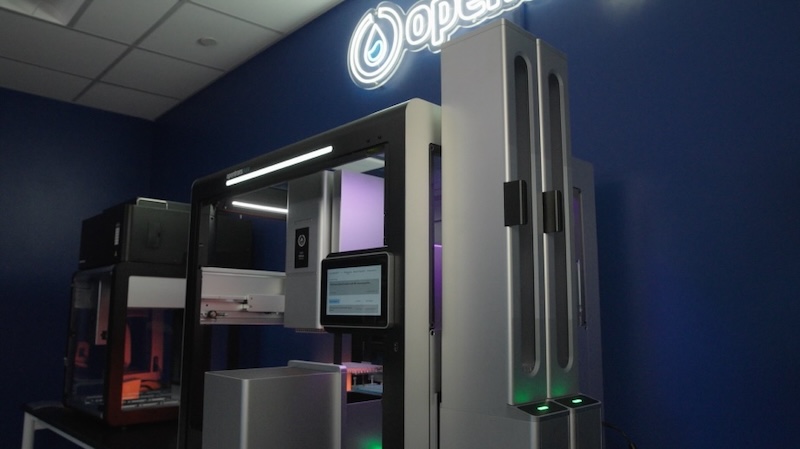
The integration of robotics and AI in laboratory automation is not a new concept, but the level of sophistication achieved by HighRes and Opentrons is noteworthy. The Opentrons Flex robotic platforms, combined with OpentronsAI, provide the physical infrastructure and intelligence needed for autonomous operation. HighRes’ Cellario software, on the other hand, serves as the orchestrator, ensuring that all components work together seamlessly.
This synergy between robotics and AI is what enables the agent-to-agent workflow. The robots can perform tasks with precision and speed, while the AI can interpret complex instructions and make decisions based on real-time data. The result is a system that is both highly automated and highly adaptable, capable of handling a wide range of experiments and protocols.
The Impact on Scientific Research
The introduction of the AI agent-to-agent laboratory workflow is expected to have a profound impact on scientific research. By reducing the time and effort required for experimental setup and execution, scientists can focus more on the analysis and interpretation of data, leading to faster breakthroughs and innovations. The scalability of the system also means that as research becomes more complex, the automation can grow with it, ensuring that the benefits are realized across a wide range of projects.
Moreover, the open and extensible nature of the system means that it can be integrated with a variety of other tools and technologies, further expanding its utility. This interoperability is essential in a field where collaboration and data sharing are increasingly important.
The Future of Laboratory Automation
The collaboration between HighRes and Opentrons is a glimpse into the future of laboratory automation. As AI and robotics continue to advance, we can expect to see even more sophisticated systems that can handle an even wider range of tasks. The key will be the ability to integrate these technologies in a way that is both user-friendly and adaptable to the unique needs of each research project.
Looking ahead, the challenges will include ensuring the security and privacy of data, as well as addressing ethical considerations related to the use of AI in research. However, the potential benefits are enormous, and the industry is poised for a transformative period of growth and innovation.
The Role of Interoperability in Advancing Lab Automation
Interoperability is a cornerstone of the HighRes and Opentrons partnership. By providing open APIs and transparent system architectures, the companies are ensuring that their solutions can be easily integrated with other tools and technologies. This approach is critical for the advancement of lab automation, as it allows for the creation of more complex and comprehensive systems.
Interoperability also fosters innovation, as it encourages the development of new tools and technologies that can work alongside existing systems. This is particularly important in life sciences, where the pace of technological advancement is rapid and the need for cutting-edge tools is constant.
The Broader Context of AI in Life Sciences
The use of AI in life sciences is already having a significant impact, and the AI agent-to-agent laboratory workflow is just one example of this. AI is being used to analyze complex biological data, predict outcomes of experiments, and even design new drugs. The potential of AI in this field is vast, and the pace of innovation is only expected to accelerate.
As AI becomes more integrated into laboratory workflows, it will not only change how experiments are conducted but also how scientists think about their research. The ability to automate repetitive tasks and to analyze data at unprecedented speeds will free up scientists to focus on higher-level tasks, leading to new discoveries and advancements.
Source: roboticsandautomationnews.com
This article was AI-assisted and reviewed by our editorial team.