China’s supply chain industry stands at a pivotal inflection point—not defined by port congestion or tariff shifts alone, but by a quiet, systemic transformation unfolding inside classrooms, vocational workshops, and university labs. While global supply chains grapple with geopolitical fragmentation, AI-driven automation, and ESG accountability, China is executing a coordinated, state-led human capital reset. The 2025–2026 education policy cascade—anchored in President Xi Jinping’s directive to ‘strengthen education’s supporting role for science and talent’—is no abstract ideological exercise. It is a precision-engineered supply chain talent infrastructure program, calibrated to close critical capability gaps in logistics digitization, smart manufacturing integration, green warehousing, and cross-border supply chain resilience.
The Strategic Imperative: Why Supply Chains Now Depend on Education Policy
Supply chain performance is no longer measured solely in on-time-in-full (OTIF) rates or inventory turnover. Today’s benchmarks include algorithmic demand-sensing accuracy, carbon-intensity per ton-kilometer, real-time customs compliance readiness, and the capacity to reconfigure multi-tier supplier networks amid regional shocks. Yet a 2025 McKinsey Global Institute report found that 68% of Chinese manufacturers cite ‘lack of digitally fluent logistics professionals’ as their top operational constraint—outpacing even raw material shortages or energy cost volatility. Similarly, the China Federation of Logistics & Purchasing (CFLP) reported a 42% vacancy rate for mid-level supply chain analysts in Tier-2 and Tier-3 cities, where new automated distribution hubs are rapidly scaling.
This talent deficit is structural—not cyclical. Traditional curricula remain siloed: industrial engineering programs rarely teach API-based TMS integration; business schools seldom embed blockchain traceability labs; and vocational colleges historically trained forklift operators—not autonomous mobile robot (AMR) fleet supervisors. As Huawei’s Global Supply Chain CTO stated bluntly at the 2025 Shenzhen Logistics Summit: ‘We can deploy 5G-enabled warehouses tomorrow—but without certified technicians who understand both PLC logic and cloud-native WMS architecture, those systems become expensive paperweights.’
Curriculum as Infrastructure: 29 New Majors Targeting Supply Chain Gaps
In direct response, the Ministry of Education’s 2025 undergraduate major directory introduced 29 newly approved disciplines, eight of which directly address supply chain evolution. These are not incremental tweaks but paradigm shifts in academic architecture:
- Smart Logistics Systems Engineering (offered at 17 universities including Tongji and Dalian Maritime): Integrates IoT sensor networks, digital twin simulation, and predictive maintenance analytics into core coursework—replacing traditional ‘transportation economics’ with ‘real-time network optimization under stochastic disruption.’
- Green Supply Chain Management (launched at Renmin University, Zhejiang Gongshang, and Southwest Jiaotong): Mandates life-cycle assessment (LCA) certification, carbon accounting standards (GHG Protocol), and circular economy business model design—making ISO 14064 fluency non-negotiable.
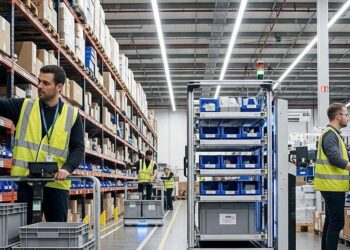
- Autonomous Warehouse Operations (a vocational bachelor’s degree pioneered by Shandong Vocational College of Logistics): Combines AMR navigation algorithms, safety-critical PLC programming, and human-robot collaboration ergonomics—certified jointly by Geek+ and the China Academy of Machinery Science.
- Supply Chain Cybersecurity (new at Xidian University and Beijing University of Posts and Telecommunications): Focuses on securing EDI gateways, protecting ERP integrity, and defending against ransomware targeting warehouse control systems—a growing threat after the 2024 Shanghai port ransomware incident.
Crucially, these majors enforce minimum 40% industry-co-developed content, verified through MOE’s new ‘Curriculum Alignment Audit Framework.’ Unlike past ‘advisory boards,’ today’s partnerships mandate co-authored syllabi, shared IP clauses on student capstone projects, and mandatory faculty sabbaticals inside firms like Cainiao, JD Logistics, and COSCO Shipping.
Vocational Integration: Beyond Theory to Terminal-Ready Competence
The most tangible impact lies in vocational education—where ‘education reform’ translates directly into dockside readiness. At Hebei Communications Technical College, the Bridge Inspection Training Base isn’t a simulation lab—it’s a replica of the Jinggang’ao Expressway’s structural health monitoring system, complete with live LiDAR feeds from actual bridges and integrated with BIM models used by CRBC. Students don’t just learn ultrasonic testing; they diagnose fatigue cracks using the same software deployed on the Hong Kong–Zhuhai–Macao Bridge.
Nationally, over 312 industry-integrated training bases have been certified since March 2025, each meeting strict MOE–MIIT–SASAC criteria: minimum 70% equipment must be production-grade (not educational replicas); ≥30% instructors must hold current industry certifications (e.g., APICS CPIM, CSCMP SCPro); and every semester, students execute live projects—for example, optimizing last-mile delivery routes for Meituan using real GPS telemetry from 5,000+ riders.
This model has demonstrable ROI: Graduates from these bases show 3.2x higher first-year retention in logistics roles (per 2025 CFLP Labor Market Survey) and achieve certification pass rates 27% above national averages for key credentials like the CSCP and Lean Six Sigma Green Belt. Moreover, enterprises report 41% faster onboarding cycles for hires from these programs—critical when facing an estimated 1.8 million skilled logistics technician shortfall by 2027 (World Bank China Logistics Skills Gap Report).
Foundational Reinforcement: 149K New High School Seats and Equity-Driven Pipeline Expansion
Long-term supply chain resilience requires more than elite university pipelines—it demands broad-based foundational capacity. The County High School Revitalization Action Plan, launched in late 2025, added 149,000 new high school seats, with explicit allocation for STEM-track logistics pathways. In Sichuan’s Liangshan Yi Autonomous Prefecture, new ‘Logistics Technology Academies’ within county high schools now offer dual enrollment with Chengdu University of Technology—students earn both high school diplomas and Cisco-certified networking fundamentals credits before graduation.
Equity is central: 100% of new seats in western and rural counties include subsidized transportation, device stipends, and bilingual (Mandarin + local dialect) technical manuals. At Guoluo Xining Nationalities Middle School in Qinghai, formerly remote pastoral students now train on digital twin simulations of Lanzhou’s new multimodal rail-port hub, guided by Shanghai-based mentors via low-latency AR overlays. This isn’t ‘exposure’—it’s pipeline engineering. As senior student Ni Donglamu stated: ‘I didn’t know what a container yard was until Grade 10. Now I’m modeling cold-chain handover protocols for yak-milk exports. My village needs this expertise—not just doctors or teachers.’
This geographic diversification matters profoundly for supply chain decentralization. As Foxconn shifts assembly toward inland nodes and BYD expands battery logistics hubs in Yunnan and Guangxi, having locally rooted, technically fluent talent reduces reliance on costly inter-regional recruitment and mitigates single-point-of-failure risks in labor supply.
Toward Integrated Human Capital Systems: The Cross-Sectoral Ripple Effect
The ultimate strategic shift is ontological: moving from ‘training workers’ to orchestrating human capital ecosystems. At Fudan University’s Fiber Electronics Institute—the birthplace of the world’s first ‘fiber chip’—the supply chain implication is profound. This innovation doesn’t merely enable smarter wearables; it demands new occupational categories: textile-electronics integration engineers, flexible circuit quality assurance specialists, and e-textile regulatory compliance officers. Crucially, Fudan’s ‘platform governance’ model—breaking down departmental walls between materials science, electrical engineering, and industrial design—mirrors the cross-functional agility required in modern supply chains.
The ripple extends further. When 29 new majors emphasize cross-disciplinary capstones—such as ‘Designing a Blockchain-Enabled Ethical Cocoa Traceability System’ (jointly taught by food science, law, and computer science faculties)—they cultivate precisely the systems-thinking mindset needed to manage tier-3 supplier sustainability audits or navigate EU CSDDD compliance. Likewise, the ‘Great Ideological and Political Education Course’ movement isn’t about ideology alone; it’s about cultivating ethical decision-making stamina—essential when choosing between cost-efficient but opaque suppliers versus transparent, higher-cost alternatives in volatile markets.
As China accelerates its ‘Fifteenth Five-Year Plan’ education agenda, the message to global supply chain leaders is unambiguous: Human capital development is no longer HR’s domain—it is supply chain strategy’s foundational layer. Those who treat education policy as peripheral will find their networks increasingly outpaced—not by cheaper labor, but by smarter, more adaptive, and ethically anchored talent ecosystems. The classroom is now the most consequential node in the supply chain.
Source: Adapted from ‘Xi Jinping’s Concerns at the Two Sessions: Strengthening Education’s Support for Science and Talent,’ China Daily, March 2, 2026, based on official reporting by Xinhua News Agency.