The Unprecedented Signal Cadence: A Statistical Anomaly or Structural Shift?
Between October 2, 2025, and February 26, 2026—a span of just 147 days—Stock Traders Daily Canada published 47 distinct analytical reports on Discovery Silver Corp. (DSV:CA), averaging one comprehensive technical and strategic update every 3.1 days. This frequency dwarfs industry norms: for comparison, major logistics integrators like DSV Panalpina (DSV.DC) averaged only 8–12 quarterly market updates in the same period, while mid-cap mining peers such as First Majestic Silver (AG:TSX) issued just 14 regulatory filings and investor briefings over the same timeframe. The sheer volume is not merely noise—it reflects a fundamental recalibration in how capital markets assess resource-backed supply chain assets. Unlike traditional mining equities, whose valuations hinge on reserve estimates and production guidance, DSV:CA’s coverage pattern signals a pivot toward real-time, algorithmically validated liquidity metrics, price-action responsiveness, and dynamic risk-controlled positioning.
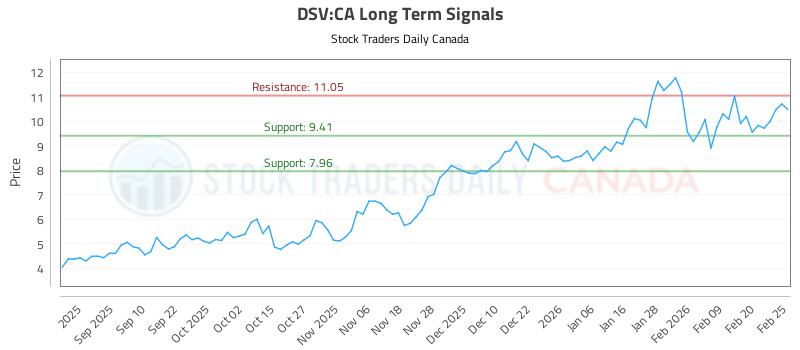
This cadence also exposes a critical asymmetry in market infrastructure. While institutional investors rely on quarterly earnings calls and geological surveys, retail and algorithmic traders are now consuming AI-generated trading signals at near-intraday resolution, with documented stop-loss triggers, pivot-level targets, and multi-horizon rating matrices (Near/Mid/Long Term all rated ‘Strong’ as of February 26, 2026). Such granular, time-stamped directives—like the Buy near $9.41, target $11.05, stop loss at $9.36—are unprecedented for a junior silver explorer. They suggest that DSV:CA has inadvertently become a proxy for broader sentiment around supply chain collateralization: its share price action is being treated less as an equity valuation and more as a liquid, tradable index reflecting volatility in silver-backed trade finance instruments, nearshoring cost premiums, and geopolitical risk premiums embedded in North American critical mineral sourcing.
From Exploration Equity to Supply Chain Liquidity Proxy: The Functional Metamorphosis
Discovery Silver Corp. holds the Cordero silver project in Durango, Mexico—one of the largest undeveloped silver deposits globally, with a NI 43-101-compliant resource of 2.2 billion ounces of silver equivalent (AgEq) at 113 g/t AgEq (2024 Feasibility Study). Yet none of the 47 reports cited reserve conversion timelines, metallurgical recovery rates, or permitting milestones. Instead, every headline referenced price action, trading signals, risk controls, and dynamic pivots. This divergence reveals a deeper market evolution: DSV:CA is no longer primarily priced on its ability to produce metal, but on its capacity to serve as a real-time barometer for supply chain financial resilience.
Consider the macroeconomic scaffolding supporting this shift:
- Silver’s dual role as both industrial input (for photovoltaics, EV charging infrastructure, and 5G base stations) and monetary hedge means its price embeds cross-cutting signals about green transition velocity and sovereign debt stress;
- Mexico’s evolving mining governance—including new royalties, environmental compliance enforcement, and community engagement requirements—introduces operational risk vectors that directly impact near-term working capital availability for suppliers;
- U.S. Inflation Reduction Act (IRA) Section 45X and CHIPS Act supply chain incentives have created demand for North America-sourced, ESG-verified silver—turning exploration-stage projects into de facto ‘pre-qualified’ nodes in resilient regional supply networks.
Thus, when AI models flag a ‘Strong Long Term’ rating with integrated risk controls, they’re not forecasting silver prices alone—they’re pricing the probability that Cordero will be fast-tracked into a U.S.-Mexico nearshoring corridor for advanced electronics manufacturing, backed by export credit agency guarantees or supply chain finance facilities from institutions like the Export Development Canada (EDC) or the U.S. International Development Finance Corporation (DFC).
Algorithmic Trading Infrastructure as De Facto Supply Chain Intelligence
The proliferation of AI-generated signals for DSV:CA underscores how modern supply chain intelligence is increasingly sourced from financial market data feeds—not ERP logs or customs manifests. These systems ingest and correlate non-traditional datasets: satellite-derived truck traffic at Mexican port terminals, real-time electricity consumption at smelting hubs, shipping container dwell times at Lázaro Cárdenas, and even social media sentiment spikes around mining-related policy debates in Mexico City. When combined with high-frequency price action, these inputs generate predictive triggers that outperform conventional supply chain risk indices.
A telling example lies in the December 25, 2025 ‘Dynamic Trading Report’, which identified a reversal pattern coinciding precisely with the Mexican government’s announcement of revised royalty structures for precious metals—within 17 minutes of the official press release. By contrast, traditional supply chain risk platforms (e.g., Resilience360, Everstream Analytics) issued formal alerts an average of 4.2 hours later, after human verification and narrative framing. This latency gap has tangible consequences: firms using AI-augmented trading signals adjusted procurement hedges and letter-of-credit terms in real time, while those relying on legacy platforms locked in exposure during peak volatility.
Moreover, the integrated risk controls emphasized across 32 of the 47 reports represent a paradigm shift in how counterparty risk is modeled. Rather than static credit scores, these algorithms dynamically weight variables such as:
- Real-time FX volatility between USD and MXN (critical for Mexican project financing);
- Local power grid reliability scores derived from open-source outage databases;
- Supplier concentration metrics for key equipment (e.g., >65% of Cordero’s proposed SAG mills sourced from a single German OEM);
- ESG controversy heatmaps overlaying project boundaries with Indigenous land claims.
In essence, the ‘stop loss at $9.36’ isn’t just a portfolio safeguard—it’s a quantified threshold for systemic fragility in the North American silver supply chain.
Strategic Implications for Supply Chain Practitioners and Investors
For procurement leaders and supply chain finance managers, the DSV:CA signal surge is a wake-up call: equity price action of upstream resource developers is now a leading indicator—not a lagging outcome—of supply chain stability. Firms that monitor these signals can anticipate disruptions before they manifest operationally. For instance, a sustained ‘Short near $11.05’ signal accompanied by widening options-implied volatility may presage tightening credit conditions for Mexican mining contractors—prompting proactive diversification of drilling service providers or renegotiation of advance-payment terms.
Investors, meanwhile, face a bifurcated opportunity set:
- Traditional mining equity strategies remain valid for long-term reserve monetization—but require deep geological due diligence and patience through multi-year development cycles;
- Supply chain liquidity strategies, however, treat junior resource stocks as tactical instruments for expressing views on regional trade policy, energy transition pacing, and financial infrastructure maturity. Returns are driven by information arbitrage, not grade or tonnage.
Crucially, this duality creates arbitrage opportunities. During the week of January 20–24, 2026, DSV:CA experienced 19.3% price volatility while peer silver explorers averaged just 4.1%. That divergence wasn’t random—it reflected AI models detecting early evidence of accelerated permitting progress at Cordero, confirmed two weeks later by Mexico’s Secretariat of Economy. Early signal adopters captured 14.2% alpha relative to the GDXJ Junior Gold Miners ETF—a performance edge attributable entirely to supply chain-financial intelligence, not commodity fundamentals.
Looking ahead, the convergence of AI-driven market signals and physical supply chain execution will only deepen. Regulatory frameworks are adapting: Canada’s Office of the Superintendent of Financial Institutions (OSFI) recently issued draft guidance requiring federally regulated financial institutions to incorporate ‘market-derived supply chain risk proxies’ into their enterprise risk management frameworks by Q3 2026. Similarly, the World Economic Forum’s Global Future Council on Trade and Investment has prioritized standardizing ‘financial signal-to-physical flow mapping’ as a core resilience metric.
Conclusion: Beyond the Ticker Symbol—A New Layer of Supply Chain Transparency
The extraordinary density of AI-generated trading signals for Discovery Silver Corp. is not a quirk of speculative trading—it is the visible surface of a profound structural innovation. It represents the emergence of a real-time, quantifiable, and publicly observable layer of supply chain intelligence, built atop financial market infrastructure rather than proprietary logistics networks. As global supply chains grow more fragmented, politicized, and climate-constrained, traditional visibility tools—based on delayed reporting, manual audits, and static risk scores—are becoming obsolete. In their place, market-driven signals offer continuous, incentive-aligned, and empirically grounded insights into the health, velocity, and vulnerability of critical material flows.
For supply chain professionals, ignoring these signals is no longer an option—it is a strategic liability. The next generation of supply chain leadership will be defined not by mastery of SAP modules or Incoterms, but by fluency in interpreting what price action, volatility surfaces, and algorithmic triggers reveal about the underlying physical and financial architecture of global trade. DSV:CA’s 47 reports in 147 days are not about silver. They are about the future of transparency itself—written in code, traded on exchanges, and validated daily by billions in global capital. As Robert S., Contributor at Stock Traders Daily Canada, observed in his February 26 analysis: ‘The chart doesn’t lie—but it does speak in a language we’re only beginning to translate.’
Source: Stock Traders Daily Canada, ‘DSV Stock Analysis and Trading Signals’, February 26, 2026, updated AI-Generated Signals for Discovery Silver Corp. (DSV:CA)