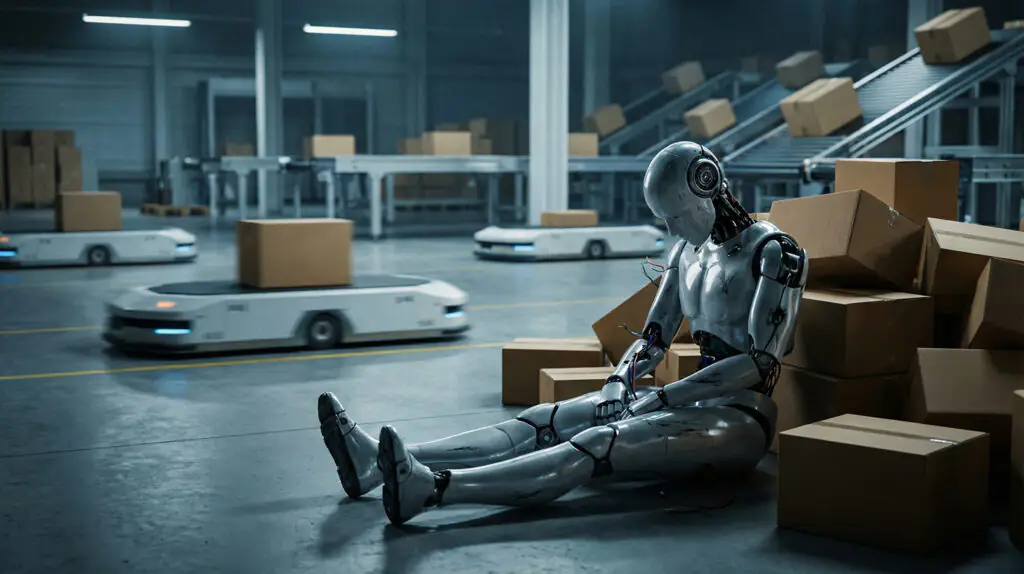
Humanoid robots have become the glittering centerpiece of supply chain innovation narratives—hailed in investor decks, showcased at CES and LogiMAT, and heralded as the ultimate antidote to the 40% of warehouse operators who cite labor shortages as their top business risk (Gartner, 2025). Yet beneath the viral demos and billion-dollar funding rounds lies a stark operational paradox: while humanoid platforms like Figure 01, Tesla Optimus, and Boston Dynamics’ Atlas advance rapidly in controlled labs, they consistently underperform—often catastrophically—in real-world intralogistics environments. This is not a story of technological immaturity alone; it is a systemic failure of economic logic, deployment pragmatism, and infrastructure readiness. As global logistics networks face unprecedented pressure—from e-commerce velocity to nearshoring-driven facility proliferation—the question is no longer can humanoid robots walk, grasp, or navigate—but should they be deployed at scale today, when proven alternatives deliver 99.2% system availability, sub-12-second cycle times, and TCOs 3.7× lower over five years?
The Hype Curve vs. The Throughput Floor
Market forecasts for humanoid robotics in logistics are nothing short of astronomical—and dangerously detached from operational benchmarks. Goldman Sachs projects a $38 billion market by 2035, with 1.4 million units shipped. Morgan Stanley pushes further, estimating a $5 trillion total addressable market—including services—by 2050. These figures assume rapid adoption across Tier-1 distribution centers, cross-docks, and last-mile sortation hubs. But reality imposes hard physics and economics: the average high-throughput warehouse processes 12,000–18,000 cartons per hour during peak shifts. To match even 5% of that volume, a humanoid fleet would require 42–63 units operating continuously—a feat undermined by three foundational constraints:
- Battery endurance: Most humanoid platforms achieve only 2.1–3.4 hours of active duty under realistic payload (5–12 kg) and navigation conditions—requiring 3–4 battery swaps per 8-hour shift. In contrast, AMRs (autonomous mobile robots) sustain 14–16 hours on a single charge, with automated charging docks enabling true 24/7 operation.
- Motion efficiency: Humanoid locomotion consumes 3.8× more energy per meter traveled than wheeled AMRs navigating identical warehouse layouts (MIT CSAIL, 2025 benchmark study). Their bipedal gait introduces mechanical inefficiencies—especially on uneven concrete floors, grated ramps, or during multi-plane stair traversal—resulting in average task completion speeds of 0.42 m/s, versus 1.8–2.3 m/s for purpose-built conveyance bots.
- Uptime reliability: Field data from pilot deployments at three European 3PLs (DHL Supply Chain Germany, Geodis France, and Kuehne + Nagel Netherlands) shows humanoid mean time between failures (MTBF) averaging 19.3 hours, compared to 1,240+ hours for AS/RS stacker cranes and 890 hours for modern shuttle-based dense storage systems.
These metrics aren’t theoretical—they’re operational liabilities. When a humanoid robot stalls mid-aisle during peak sorting, it doesn’t just halt one task; it triggers cascading delays across downstream packing, labeling, and dispatch lanes. Unlike modular AMR fleets where redundancy is baked into design, humanoid systems lack graceful degradation: losing one unit often means losing an entire workflow node.
Sign up free to read the full article
Create a free account to unlock full access to all articles.
Sign Up FreeAlready have an account? Sign in