Beyond Chatbots: Oracle’s Autonomous AI Agents Redefine Enterprise Supply Chain Operations
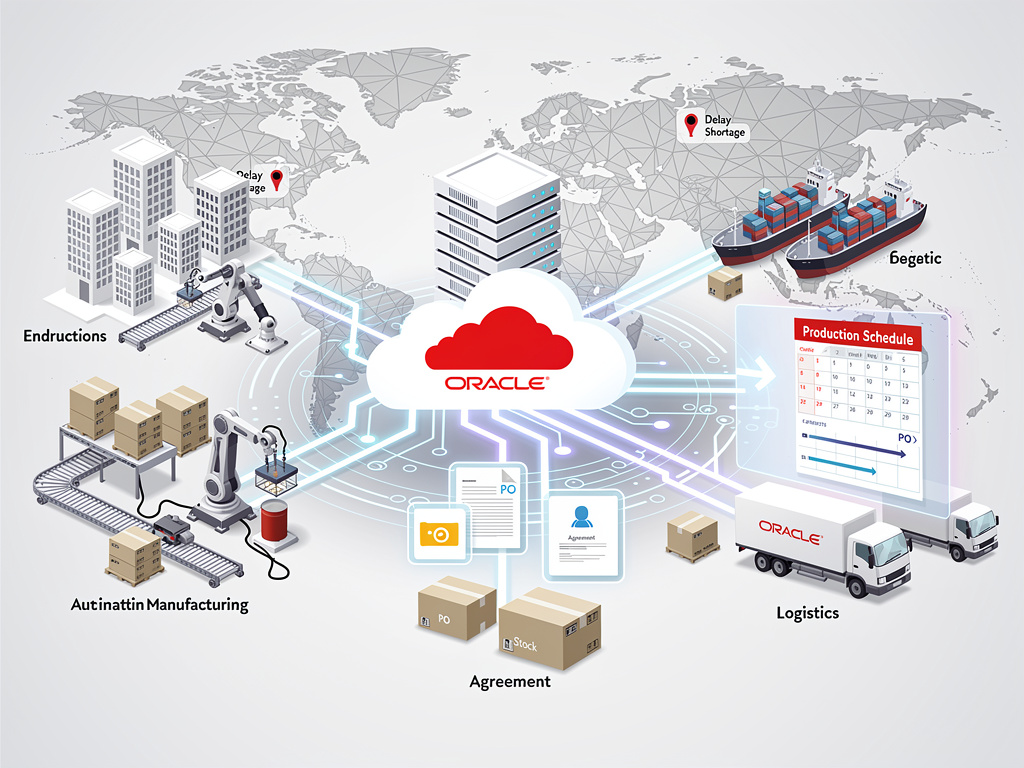
In February 2026, Oracle Corporation unveiled a comprehensive suite of AI agents embedded within its Fusion Cloud Applications and Oracle Cloud Infrastructure, marking what may be the most significant architectural shift in enterprise supply chain software in over a decade. These are not the chatbots or recommendation engines that have dominated enterprise AI marketing in recent years. Oracle’s AI agents are autonomous software entities capable of executing complex, multi-step processes — simultaneously evaluating demand forecasts, supplier lead times, transportation constraints, and financial targets — and then independently executing procurement orders or adjusting production schedules without requiring human approval at every stage. The depth of integration is what distinguishes this release: rather than layering AI on top of existing workflows, Oracle has woven these agents directly into its cloud ERP and supply chain management platforms, granting them native access to transactional data, business rules, and cross-functional processes.
Central to Oracle’s design philosophy is what the company calls “exception-based management.” Instead of requiring human operators to monitor dashboards and manually intervene at every anomaly, the AI agents autonomously handle all routine operations and escalate only genuine exceptions — unusual demand spikes, supplier failures, quality anomalies — to human decision-makers. This represents a fundamental restructuring of the human-machine relationship in supply chain management. For supply chain teams already stretched thin by persistent talent shortages, this shift from continuous monitoring to strategic exception handling could be transformative, freeing professionals to focus on supplier relationship development, risk mitigation strategy, and long-term planning rather than drowning in operational minutiae.
The Four-Way Battle for Agentic AI Supremacy in Enterprise Software
Oracle’s announcement arrives amid a fierce competitive landscape. SAP has integrated its Joule AI copilot across the S/4HANA platform, aiming to simplify enterprise operations through natural language interaction. Microsoft continues expanding its Copilot ecosystem into supply chain and operations management via Dynamics 365, leveraging its dominant position in workplace productivity tools. Salesforce has launched Agentforce, targeting intelligent automation of sales, service, and commerce workflows. Each technology giant is pursuing its own vision of how agentic AI — autonomous software capable of sensing, reasoning, and acting — should be embedded into the operational fabric of global enterprises.
What gives Oracle a distinctive edge in this race, according to industry analysts, is its combination of deep vertical expertise and full-stack integration capability. Oracle has maintained a massive installed base in manufacturing and supply chain for decades, giving it an intimate understanding of factory floor realities and logistics network complexities. On the technology side, Oracle offers an end-to-end stack — from AI model training and inference on Oracle Cloud Infrastructure to application-level agent execution within Fusion Cloud — that reduces the integration complexity plaguing multi-vendor AI deployments. This “chip-to-application” vertical integration strategy could prove decisive as enterprises evaluate which platform to standardize on for mission-critical supply chain operations, particularly in manufacturing environments where system stability and data security requirements are non-negotiable.
The 2.1 Million Worker Shortfall Driving the AI Agent Imperative
Understanding the strategic urgency behind Oracle’s release requires confronting a stark reality: according to projections from Deloitte and the Manufacturing Institute, the United States manufacturing sector alone faces a shortfall of 2.1 million skilled positions by 2030. Supply chain management roles — which demand a rare combination of analytical capability, technical proficiency, and domain expertise — are among the most difficult positions to fill. Globally, from Southeast Asian factories to European distribution centers, the structural shortage of skilled supply chain labor is becoming the single greatest constraint on operational efficiency improvement. Against this backdrop, the value proposition of AI agents is not workforce replacement but workforce multiplication — enabling existing teams to achieve order-of-magnitude productivity gains.
Oracle’s data paints a compelling picture: a typical supply chain analyst currently spends approximately 60% of their working hours on routine data collection and report generation. With AI agents handling these repetitive tasks autonomously, analysts can redirect their energy toward strategic decision-making, supplier performance optimization, and process innovation. This transformation fundamentally elevates the supply chain professional’s role from “data operator” to “strategic decision-maker,” with AI agents serving as the bridge between oceans of operational data and actionable intelligence. For Chief Supply Chain Officers worldwide, the message is unambiguous: you cannot hire your way out of the talent crisis, but you can deploy AI agents to bridge the gap.
Real-World Scenario: Hours Instead of Weeks for Global Crisis Response
To appreciate the practical impact of Oracle’s AI agents, consider a scenario that plays out regularly across global manufacturing networks. A Tier 1 automotive parts supplier operating plants across North America, Europe, and Asia receives an unexpected surge in orders from a major OEM customer, while simultaneously confronting a raw material shortage caused by a port disruption in Southeast Asia. In a conventional ERP environment, responding to this dual crisis requires demand planning, procurement, logistics, and production scheduling teams to coordinate manually — exchanging emails, building spreadsheet models, and conducting cross-functional meetings over days or potentially weeks.
Under Oracle’s AI agent framework, this entire response can be orchestrated autonomously within hours. A demand-sensing agent detects the order surge and immediately flags capacity and material implications. A procurement agent identifies alternative suppliers, evaluates their pricing and lead times, and initiates purchase orders. A logistics agent reroutes shipments and optimizes transportation modes to work around the port disruption. A production scheduling agent rebalances workloads across plants to maximize throughput. Human managers review and approve only the highest-stakes decisions. The significance extends beyond speed — from week-level to hour-level response times — to demonstrate how AI agents can achieve seamless cross-functional, cross-geographic coordination, dismantling the information silos and departmental barriers that have long plagued traditional supply chain management.
Governance Gaps and Data Quality: The Obstacles That Could Slow Adoption
For all the transformative potential, significant obstacles remain before agentic AI can be deployed at scale in high-stakes manufacturing environments. AI governance is still in its infancy: when an AI agent makes a costly procurement error or misallocates production capacity, who bears responsibility? This question remains largely unresolved in both corporate policy and regulatory frameworks. Oracle has built configurable governance controls into its agent framework — allowing enterprises to define which decisions agents can make autonomously and which require human approval — but the real test will come during large-scale deployments where edge cases and cascading errors can generate millions of dollars in losses.
Data quality presents an equally formidable challenge. AI agents are only as effective as the data they consume, and many manufacturing enterprises continue to struggle with fragmented, inconsistent, or incomplete operational data across their organizations. Oracle’s integrated cloud platform provides a single source of truth that partially mitigates this issue, but companies migrating from legacy on-premises systems may face prolonged and expensive data harmonization processes before they can fully leverage agentic AI capabilities. Additionally, in the context of globalized operations, differences in data standards across regions and divergent data privacy regulations — from GDPR in Europe to data security laws in various jurisdictions — add layers of complexity to the data governance challenge that no single platform can fully resolve.
The Strategic Watershed: From Automation to Autonomy in Supply Chain Management
Oracle’s embedding of AI agents across its manufacturing and supply chain cloud applications is more than a product launch — it is a strategic declaration about the future of industrial operations. The company is betting that the next wave of enterprise value creation will come from autonomous AI systems capable of sensing, deciding, and acting across complex operational networks, rather than from incremental software feature improvements. If this vision materializes, supply chains could become self-healing — automatically rerouting around disruptions. Factories could become self-optimizing — continuously adjusting production parameters to maximize yield and minimize waste. Procurement could shift from reactive to predictive — anticipating shortages before they materialize and activating contingency plans proactively.
For supply chain leaders globally, Oracle’s announcement delivers an urgent signal: the era of agentic AI in industrial operations is not a distant prospect but an arriving reality. The enterprises that adopt these capabilities earliest and most effectively will secure significant competitive advantages in cost, speed, and resilience — advantages that may prove decisive in an era of persistent volatility and intensifying global competition. The agentic AI race is also accelerating a broader reshaping of the enterprise software market: choosing which platform to standardize on as the foundation for mission-critical AI is becoming a strategic decision that every CIO and CSCO must make in 2026, with implications that will echo for years to come.
Source: WebProNews