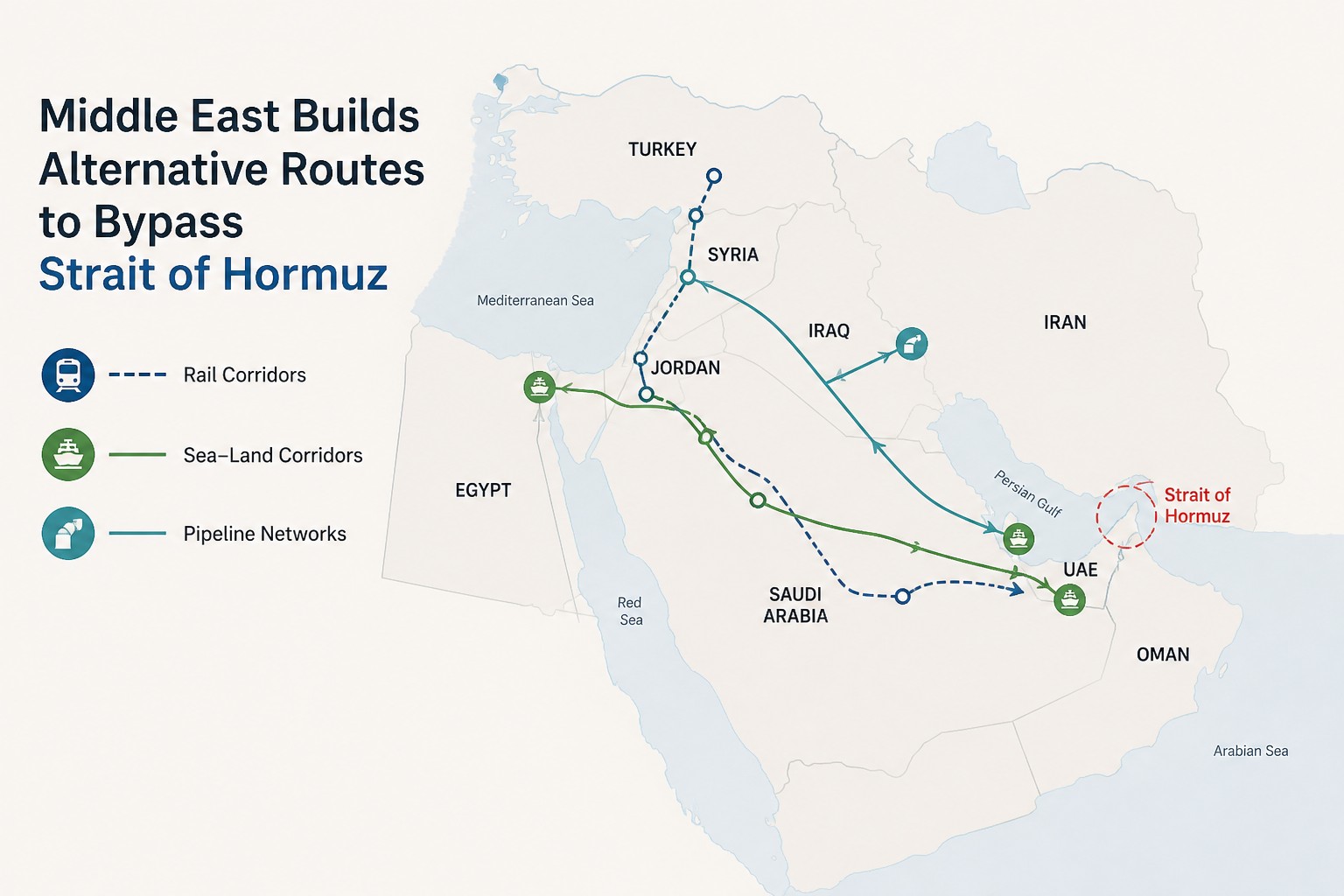
According to www.logisticsinsider.in, amid rising tensions between Iran and the United States, governments across the Middle East are accelerating development of at least five distinct alternative trade and energy corridors to reduce dependence on the Strait of Hormuz and the Red Sea. The initiative follows documented disruptions—including attacks and blockades—that reduced maritime traffic in key Gulf chokepoints. A South China Morning Post report cited by Logistics Insider confirms that Saudi Arabia, the UAE, Turkey, Jordan, and Egypt are jointly advancing overland rail links, hybrid sea-land corridors, cross-border pipelines, electricity interconnectors, and desalinated water networks.
Operational Corridors Already Active
Several routes are no longer conceptual: sea-land links connecting UAE ports Fujairah and Khor Fakkan to Saudi ports—and onward via rail to Jordan—were launched earlier in 2026. Saudi Arabia’s new cargo service from its Neom port established a direct link between the Suez Canal, Gulf markets, and Iraq. According to the source, this service began operations in Q1 2026 and supports both containerized and breakbulk freight. Port operators DP World and Abu Dhabi Ports have expanded into Jordan and Syria, securing concessions in Aqaba (Jordan) and Latakia (Syria), adding to their existing assets in Jeddah, Riyadh, and Alexandria.
Regional Railway Integration Accelerates
At the May 2026 GCC summit in Jeddah, member states—including Saudi Arabia, UAE, Qatar, Oman, Kuwait, and Bahrain—agreed to accelerate construction of a unified regional railway network. The GCC Rail Project aims for full interoperability by 2030, with an estimated capital investment of $22 billion (per GCC Secretariat public disclosures cited in regional infrastructure briefings). Parallel efforts include reviving the historic Hejaz Railway, which would reconnect Jeddah to Istanbul through Amman and Damascus. Engineering feasibility studies were completed in March 2026, with track-laying scheduled to begin in late 2026 between Amman and Ma’an.
Energy Infrastructure Diversification Underway
Alongside transport, multi-country energy infrastructure is being coordinated. Turkey is advancing a pipeline extension from Ceyhan (Turkey) to Basra (Iraq), with construction slated to commence in Q4 2026. The project is expected to carry up to 1.2 million barrels per day of crude oil once operational in 2029. In addition, Saudi Arabia, UAE, and Jordan are co-developing a 500-kilometer high-voltage electricity grid linking NEOM, Dubai, and Amman, targeting commissioning by December 2027. A joint desalination-water transfer agreement signed in April 2026 commits $1.8 billion to build three solar-powered desalination plants along the Red Sea coast, delivering 300,000 cubic meters/day to inland cities by 2028.
Strategic Rationale: Chokepoint Risk Mitigation
The shift reflects structural recalibration—not temporary adaptation. Air cargo demand in the region fell 4.8% year-on-year in March 2026, according to IATA data cited in related coverage on the site. Shipping delays through the Red Sea rose to an average of 14.3 days in Q1 2026, versus 4.1 days in Q1 2025. As one logistics practitioner noted in a follow-up interview published May 5, 2026:
“We’re not just rerouting containers—we’re redesigning origin-destination pairs. A shipment from Fujairah to Rotterdam now has three validated pathways: Suez, Neom–Mediterranean, or Fujairah–Amman–Piraeus.” — Ahmed Al-Mansoori, Head of Multimodal Operations, DP World Aqaba
This reallocation directly impacts global shippers: Maersk reported 12% of its Gulf-bound volume was shifted to land-based alternatives in Q1 2026, while COSCO diverted 8.5% of its Asia–Europe transits via the new UAE–Jordan rail corridor.
Source: www.logisticsinsider.in
Compiled from international media by the SCI.AI editorial team.