Skip to content

AI & Automation · Strategy & Planning · Supply Chain · Technology

Palletrone Flying Hand Truck Lifts Cargo Off the Ground for Seamless Operation

Flying Palletrone Trolley Aims to Solve Wheel Woes in Shopping Malls and Offices

Original source: Source information pending

Palletrone Flying Hand Truck Lifts Cargo Off the Ground for Seamless Operation

Ask SCI.AI about this story

📋 本文要点

Flying Palletrone Trolley Aims to Solve Wheel Woes in Shopping Malls and Offices

Palletrone Flying Trolley Elevates Cargo for Seamless Operation

Author: Paul Ridden

September 24, 2024

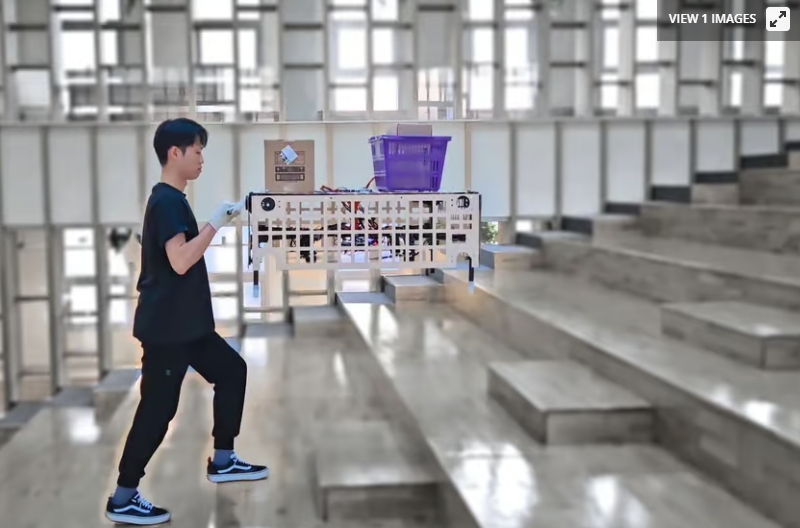
The Palletrone flies at chest height and maintains a stable upper cargo platform while being pushed by a human operator.

No matter if you’re moving items in a shopping mall or an office, you’ve likely encountered uneven-wheeled trolleys. Now, the flying Palletrone trolley could be the solution.

The concept essentially places a multi-rotor drone inside a cage to form a top-mounted platform that allows users to push cargo at chest height rather than using wheeled carts on the ground.

“The platform is designed with a spacious upper surface for easy loading of goods and comes equipped with a shopping cart-like rear handle,” noted the research team from SeoulTech in their project introduction paper. “Flight trajectory control is achieved by the human operator gripping the handle and applying three-dimensional forces and torques, while maintaining stable cargo transportation without rolling or pitching throughout the flight.”

The operator “controls the aircraft’s movement by applying force and torque to influence its flight path,” which means users steer forward momentum and direction via a handlebar, with hardware and software enabling the platform to hover above ground.

Users are encased in a porous enclosure that protects them from the high-speed rotating blades of the X-frame drone while allowing sufficient airflow for sustained flight with minimal performance loss.

Of course, one drawback is the noise generated by the drones. Another issue is the relatively low payload capacity of the current setup at 2.93 kg (6.5 lbs) — not enough to transport a week’s worth of groceries in the air or assist warehouse workers efficiently move items. Additionally, there are concerns about the limited flight time provided by onboard batteries.

However, these issues can be addressed through further adjustments, and one significant advantage is that Palletrone can easily navigate stairs. In its current version, researchers have utilized a basic flight control algorithm from previous studies of team members. The system also employs actuators to continuously adjust for roll and pitch, maintaining the platform’s level position during operation while accounting for forces applied by users.

The design assumes that all “disturbances applied to the system” come from the operator, so any obstacles encountered along the way could cause issues — the paper calls for further research in this area.

Regarding potential future applications beyond logistics or supermarket environments, team member Seung Jae Lee told IEEE Spectrum: “By mounting a camera on the platform, it can serve as a flying tripod and even as a shooting cart, allowing flexible camera movement and angles. This is particularly useful in environments where professional filming equipment is hard to come by.”

He also suggested that next steps might include developing a docking system for charging during flight to extend operational time.

Detailed information about the project can be found in the paper published on IEEE Robotics and Automation Letters.

Source: SeoulTech via IEEE Spectrum


Source Website: New Atlas

Ask SCI.AI Finished reading? Continue with SCI.AI. Explore the related policy, route, company and historical context. Continue asking
Stay ahead of supply chain shifts

One email a week: the stories that matter and new risk events — in English, free.

Prefer RSS? Articles Risk events

North American robot orders hit highest level since 2022 boom
Strategy & Planning

North American robot orders hit highest level since 2022 boom

North American robot orders climbed to their highest level since the 2022 boom and continued that trend into 2026, according to Association for Advancing Automation data reported by DC Velocity. Strong demand from semiconductor and electronics, pharmaceutical, and food and beverage industries offset declining automotive orders in the first half of 2026, with shipments up 21% and 24% year over year. Rocrich AGV, a joint venture of Logisnext Americas and Jungheinrich, supplies automated guided vehicles for warehouse automation. Shifting trade policies and a warehouse labor shortage intensified by tightened immigration policies are pushing more companies toward automation, while falling costs are making the technology accessible to small and medium-sized players.

China tungsten export curbs drive PCB drill bit prices up several-fold
AI & Automation

China tungsten export curbs drive PCB drill bit prices up several-fold

China's tungsten export controls have driven up prices for the micro drill bits used to bore holes in AI server PCBs several-fold, Nikkei Asia reported. Yet SMM estimates that 2026 tungsten consumption by PCB micro drills and WF6 comes to only about 3,800 tonnes of contained metal, roughly 4.6% of China's total. Comparing USGS data, China's Ministry of Commerce control notice, SMM price data and Sumitomo Electric papers points to three factors: the processing stage of controlled raw materials, the material quality demanded of very fine drills, and diverging price trends inside and outside China. China produced an estimated 67,000 tonnes of tungsten in 2025, a 78.8% world share.

China-Europe air cargo falls 17% as EU fees reshape e-commerce
Strategy & Planning

China-Europe air cargo falls 17% as EU fees reshape e-commerce

WorldACD data shows air cargo volumes from China and Hong Kong to Europe fell 17% year on year in October, with Hong Kong-origin volumes down 32% and mainland China down 8%. The decline follows the EU's July introduction of a €3 charge on items under €150 and comes as platforms shift toward consolidated B2B imports. A further €2 per-item handling fee took effect 1 November. Rates on the lane still rose 9% month on month and 14% year on year to $4.85 per kg. By contrast, China-Hong Kong to US tonnages rose 8% year on year.

Welcome Back!

Login to your account below

Create New Account!

Fill the forms below to register

Retrieve your password

Please enter your username or email address to reset your password.

Scan to share via WeChat

Open WeChat and scan the QR code to share

QR Code

Add New Playlist