China's tungsten export controls have driven up prices for the micro drill bits used to bore holes in AI server PCBs several-fold, Nikkei Asia reported. Yet SMM estimates that 2026 tungsten consumption by PCB micro drills and WF6 comes to only about 3,800 tonnes of contained metal, roughly 4.6% of China's total. Comparing USGS data, China's Ministry of Commerce control notice, SMM price data and Sumitomo Electric papers points to three factors: the processing stage of controlled raw materials, the material quality demanded of very fine drills, and diverging price trends inside and outside China. China produced an estimated 67,000 tonnes of tungsten in 2025, a 78.8% world share.
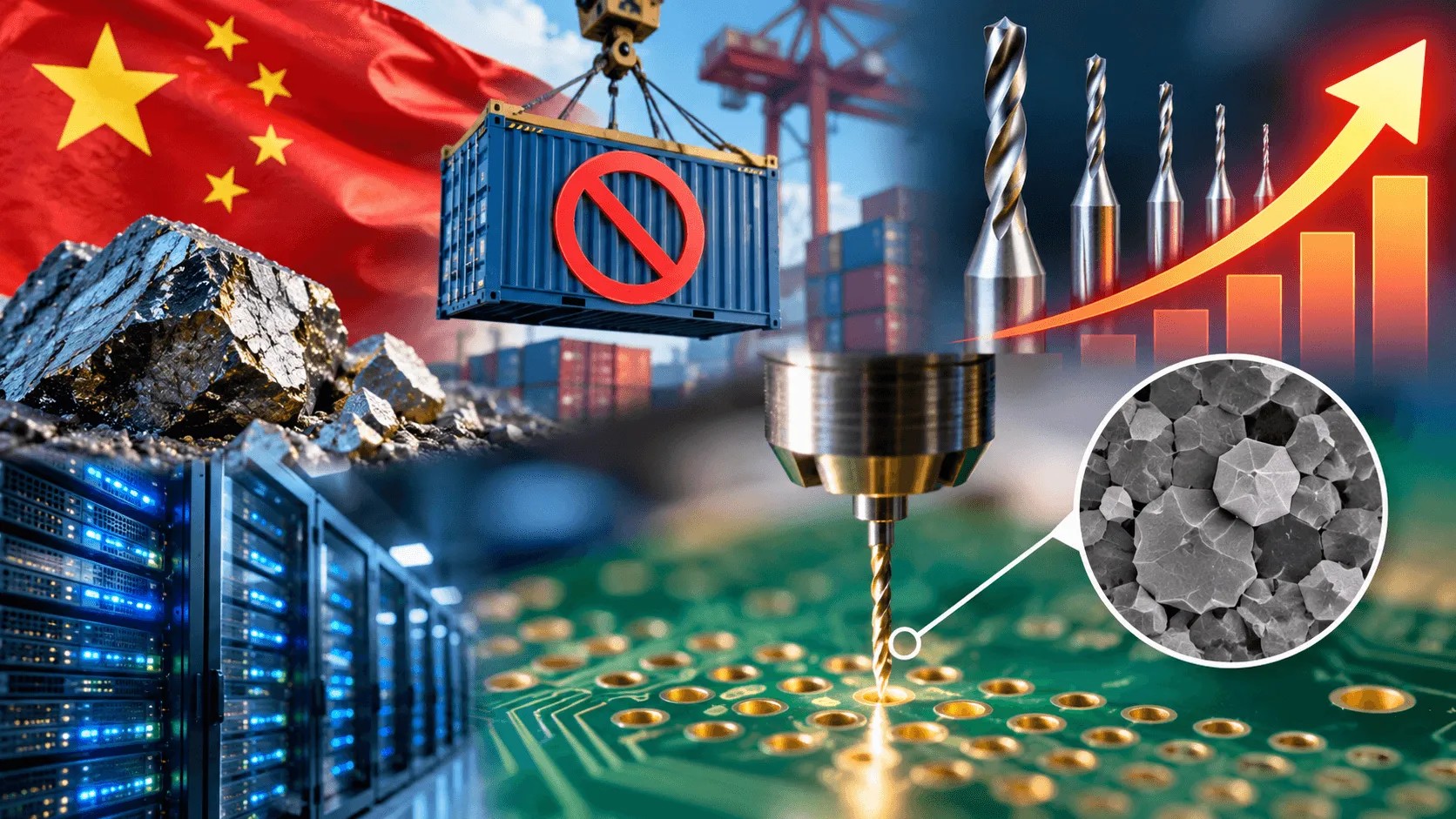
According to xenospectrum.com, China’s export controls on tungsten have pushed up the cost of manufacturing AI servers, with Nikkei Asia reporting that prices for the micro drill bits used to bore holes in printed circuit boards (PCBs) for AI servers have risen several-fold because of the controls.
The scale of the affected use is small. Estimates by Shanghai Metals Market (SMM) put combined 2026 tungsten consumption by PCB micro drills and tungsten hexafluoride (WF6), a gas used in semiconductor manufacturing, at only about 3,800 tonnes of contained metal — roughly 4.6% of China’s total.
Comparing U.S. Geological Survey (USGS) statistics, China’s Ministry of Commerce export control notice, SMM price data, and Sumitomo Electric’s price revisions and technical papers brings out three factors behind the outsized impact: the processing stage of the raw materials subject to controls, the material quality demanded of very fine drills, and the divergence between price trends inside and outside China.
China holds 78.8% of world output as domestic production stalls
According to the USGS Mineral Commodity Summaries 2026, China’s 2025 tungsten mine production was an estimated 67,000 tonnes of contained tungsten. Against a world total of 85,000 tonnes, that is a 78.8% share.
China also produced 67,000 tonnes in 2024, but the world total was 82,000 tonnes, giving China a share of 81.7%. Chinese output was therefore flat, but because global production grew, its share fell by about 3 percentage points. Part of that growth came from the start of mining at Kazakhstan’s Boguty deposit, which lifted the country’s output from zero in 2024 to 2,400 tonnes in 2025.
China also looms large in reserves. The USGS puts China’s tungsten reserves at 2.5 million tonnes, about half of the world total of more than 4.7 million tonnes. Yet China’s share of actual production is higher than its share of reserves, reflecting not only where deposits sit but also a concentration of mining and production capacity.
Even inside China, domestic tungsten concentrate production is falling. SMM estimates concentrate output in January–September 2026 fell 7.84% year on year, and full-year supply is expected to fall 6.1% to 101,000 standard tonnes.
Meanwhile, SMM calculations based on Chinese customs data show concentrate imports of about 17,400 standard tonnes in January–August 2026, up 118% from a year earlier — a sign China is increasingly making up for lower domestic output with imported concentrate. The “standard tonne” is an industry-specific unit converted to 65% tungsten trioxide (WO3) content, which differs from the contained-tungsten figures used by the USGS, so the two cannot be compared directly.
Controls reach the intermediate products used in drill bits
On February 4, 2025, China’s Ministry of Commerce and the General Administration of Customs issued Announcement No. 10 of 2025, putting export controls on tungsten and other related items into effect the same day.
For tungsten, ammonium paratungstate (APT), tungsten oxides, and tungsten carbide (WC) not covered by the separate control item 1C226 are listed under item 1C117.d. All are important intermediate materials used in metalworking and electronic component manufacturing.
Large solid tungsten items — including alloys with a tungsten content of 97% or more, tungsten-nickel-iron alloys, and the technologies to make them — also became subject to controls. The solid tungsten item excludes powders and particles and covers material that can be machined into cylinders of at least 120 mm in diameter and 50 mm in length. Exporters of covered items must obtain a license from China’s commerce authorities. The announcement also placed controls on items related to tellurium, bismuth, molybdenum, and indium.
PCB drill bits are made mainly from cemented carbide, produced by mixing WC powder with cobalt powder and sintering it. The announcement does not directly list cemented carbide rods or finished drill bits, but the WC used to make them, and the earlier-stage APT and tungsten oxides, are all covered. The USGS likewise explains that U.S. processors make tungsten metal powder and WC powder from tungsten concentrate, APT, tungsten oxides, scrap, and other feedstocks. The controls therefore reach not the finished drill bits but the refined intermediate materials needed to make them.
A 2011 technical paper published by Sumitomo Electric confirms the link between raw materials and manufacturing processes. To mass-produce fine-grained WC, the company developed its own carburization method that produces WC directly from tungsten oxide without going through tungsten metal. The starting material, tungsten oxide, is the same substance listed in China’s export control announcement; the paper does not state where the raw materials are sourced, so it cannot be confirmed whether Sumitomo Electric uses Chinese tungsten oxide.
SMM also explains that WC powder is subject to strict export screening as a dual-use item. According to its tally, China’s exports of intermediate tungsten products in January–August 2026 were about 9,071 tonnes, down roughly 15% year on year. Exports of carbide tools were 1,967 tonnes, also down about 15%. SMM cites weak operating rates at overseas manufacturers and tariff changes as factors in the carbide tool decline and does not attribute all of the drop to export controls.
A single 15 μm coarse grain can break a 0.1 mm drill
PCB drills are generally made with a shank diameter of 1/8 inch (3.175 mm) and an overall length of 1.5 inches (38.1 mm). According to Sumitomo Electric’s 2011 paper, solid types made entirely of cemented carbide had been the mainstream, but the industry was shifting to composite types in which only the cutting tip is cemented carbide, joined to a stainless steel shank by brazing or insertion — a technical change in the direction of using less cemented carbide per drill.
Drill diameters run from roughly 0.4 to 0.8 mm for automotive boards and down to about 0.1 mm for semiconductor package substrates, and products as thin as 0.05 mm, about the thickness of a human hair, were already in practical use. In such extremely fine drills, even a slight defect inside the material can lead to breakage.
European APT prices up about 4.4-fold, Chinese domestic prices up about 15%
Price trends inside and outside China have diverged sharply. European APT prices have risen about 4.4-fold, while Chinese domestic prices are up about 15%.
Diversifying supply sources is not the only difficulty; substituting other materials is not easy either. The USGS lists molybdenum and niobium carbides, ceramics, and cermets as candidate substitutes for tungsten-based cemented carbides, but notes that many can reduce tungsten use without fully replacing it. Constraints on changing materials are especially large in applications demanding high hardness and precision machining.
Source: xenospectrum.com
Compiled from international media by the SCI.AI editorial team.