Opentrons Labworks has closed a $40 million Series E round led by Avego, with BroadOak Capital Partners also investing. The laboratory automation company will use the capital to scale its robotics, software, and data infrastructure for AI-driven autonomous science. Opentrons says it has deployed more than 11,000 robots to labs in over 80 countries, including at 90 percent of the top 20 global pharmaceutical companies. CEO James Atwood said millions of scientists still spend much of their day on manual work robots can handle, and the company aims to return that time to discovery. The funding will support AI-driven experimental execution, faster protocol development, and expansion into new markets and geographies.
According to Robotics & Automation News, Opentrons Labworks has raised $40 million in Series E financing to scale its robotics, software, and data infrastructure for AI-driven laboratory work. The round was led by healthcare investor Avego, with additional participation from BroadOak Capital Partners.
The company plans to use the capital to expand the reach of its automation tools, which it says scientists worldwide increasingly depend on to speed up discovery. Opentrons argues that while AI can generate hypotheses and design experiments quickly, the physical laboratory has become the bottleneck in the research cycle.
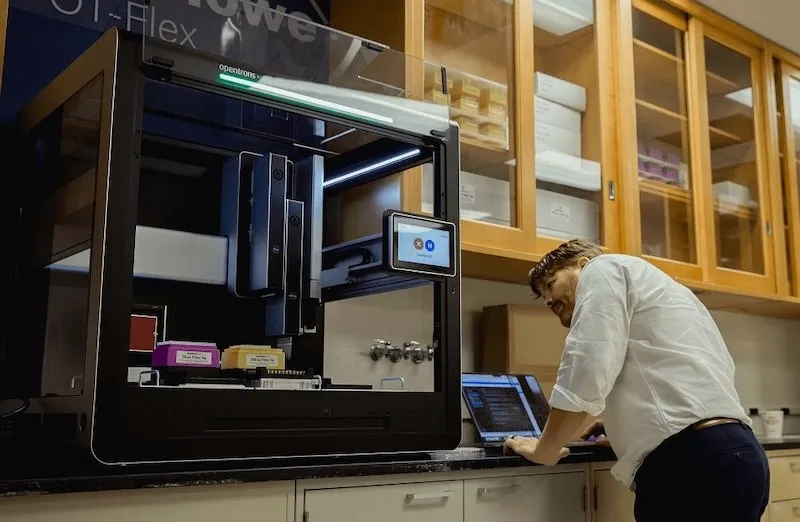
Its answer is the Opentrons Flex platform, which combines robots and AI systems so that experiments can be designed, run, and refined in a continuous loop. The company says this setup positions it at the center of autonomous science.
Installed base spans 80 countries
Opentrons reports that it has deployed more than 11,000 robots to laboratories in over 80 countries. That footprint includes installations at 90 percent of the top 20 global pharmaceutical companies, according to the company.
The scale of that installed base, combined with systems built for AI to run experiments directly, is the core of Opentrons’ pitch to investors and customers. The company says its open platform and more than a decade of laboratory automation experience support academic groups, diagnostics labs, and global pharmaceutical companies.
“Millions of scientists spend much of their day on manual work a robot can do. Giving that time back to discovery is the biggest opportunity in science.” — James Atwood, PhD, CEO of Opentrons
Atwood added that Opentrons made lab automation accessible to any lab and that its systems are built for AI to run experiments directly, which he said is why autonomous science is standardizing on the company’s platform.
Where the Series E funding goes
The $40 million round will fund Opentrons’ next growth phase in autonomous science, where its AI and robotics systems design, execute, and learn from experiments tied to customer scientific goals. The company said it will invest in AI-driven experimental execution and extend its automation capabilities.
Part of the funding is earmarked for geographic expansion into new markets, alongside faster protocol development through its software and AI. Opentrons also plans to broaden capabilities across its robots and instruments and deepen integration of its tools into the wider lab automation ecosystem.
James Flexner, managing partner at Avego, framed the investment around the persistence of physical testing. He noted that drug developers and AI companies alike are pushing experimental work toward automated workflows that generate usable data.
“Every AI-driven discovery still has to be tested in a real lab.” — James Flexner, managing partner at Avego
Flexner said Avego sees a significant opportunity for autonomous science to converge around Opentrons’ platform. The financing was announced on October 30, 2026, and reported by roboticsandautomationnews.com.
Source: Robotics & Automation News
Compiled from international media by the SCI.AI editorial team.