Skip to content

Air Cargo · Supply Chain · Warehousing & Transport

Amazon Air Sells Excess Cargo Capacity to Third-Party Freighters: Optimizing Logistics Resources and Creating New Revenue Opportunities

Amazon's Cargo Airline Welcomes Shipments from Logistics Companies and Other Enterprises to Better Utilize Its Private Fleet Originally Designed for E-commerce Sales Support

Original source: Source information pending

Amazon Air Sells Excess Cargo Capacity to Third-Party Freighters: Optimizing Logistics Resources and Creating New Revenue Opportunities

Ask SCI.AI about this story

📋 本文要点

Amazon's Cargo Airline Welcomes Shipments from Logistics Companies and Other Enterprises to Better Utilize Its Private Fleet Originally Designed for E-commerce Sales Support

Amazon has officially entered the external leasing market for air cargo, making its large fleet of freight aircraft widely available to freight forwarders and other businesses. This move positions Amazon to challenge FedEx and UPS by seeking a larger share in the domestic air cargo market. Since its establishment in 2016, Amazon Air now operates over 100 aircraft with multiple aviation sorting centers, executing more than 250 flights daily and forming a network connecting 54 airports across the United States.

Three weeks ago, Amazon launched the Amazon Air Cargo website to promote and book cargo services online. The service is available in North America, Europe, and India. Amazon Air Cargo offers shippers options for on-demand shipments, space reservation, or charter flights. This service primarily targets logistics companies, e-commerce retailers, and postal service providers.

Amazon has long offered cargo space on its aircraft to a select few clients but now fully opens this service to the public to maximize excess capacity. The new website enables Amazon Air to attract customers beyond those using Amazon Prime, opening the door to comprehensive air freight services.

On LinkedIn, Amazon’s logistics division announced: “Ready for takeoff! Amazon Air Cargo is now operational, serving domestic networks in North America, Europe, the Middle East, Africa, and Asia. Leveraging Amazon’s world-class logistics network, we are ready to handle, transport, and deliver your goods safely, reliably, and efficiently—every day.”

Amazon’s success in third-party freight will depend on the terms, conditions, and pricing offered, as express carriers typically prioritize their core business over freight forwarder cargo when capacity is tight. The move to sell air cargo services aligns with Amazon’s broader logistics strategy, including independent shipping services and global supply chain solutions.

Amazon primarily operates Boeing 737-800 narrow-body and Boeing 767 medium-widebody freighters, but in the past year, its fleet has expanded to include six Airbus A330-300 large freighters. As e-commerce sales normalize and shift towards a regional fulfillment model that reduces reliance on air transport, Amazon has been cautious about expanding its air network. This regional fulfillment strategy may free up spare capacity for third-party clients.

Amazon’s move to offer wholesale capacity is a logical evolution of an integrated express carrier similar to FedEx, UPS, and DHL Express, which have provided wholesale capacity for decades. Amazon will now compete directly with FedEx and UPS in the traditional domestic air freight market.

—

Source: FreightWaves
Ask SCI.AI Finished reading? Continue with SCI.AI. Explore the related policy, route, company and historical context. Continue asking
Stay ahead of supply chain shifts

One email a week: the stories that matter and new risk events — in English, free.

Prefer RSS? Articles Risk events

Xeneta: Asia-US West Coast spot rates jump 343% on Iran war
Warehousing & Transport

Xeneta: Asia-US West Coast spot rates jump 343% on Iran war

Asia-U.S. West Coast container spot rates were 343% above their February 28 level in October, just 14% below the pandemic-era record, according to freight-rate intelligence provider Xeneta. The company forecasts a 5% decline in long-term contract rates for 2027, with the global container fleet expected to grow 6.8% while demand rises between 2.5% and 4%. Xeneta chief analyst Peter Sand traces the volatility to the Red Sea conflict in 2024, U.S. tariffs in 2025 and the Strait of Hormuz closure in 2026, and warns that fuel costs and route disruptions could still upend the outlook.

AI hardware demand lifts air cargo rates 30% year over year
Warehousing & Transport

AI hardware demand lifts air cargo rates 30% year over year

Air cargo rates are up 30% year over year and volumes have grown about 6%, according to FreightWaves, as surging AI equipment demand offsets slower e-commerce and automotive flows. The strength has defied forecasts of a 2025 softening after a down 2024. Meanwhile, Walmart is deploying Wing and Zipline drones across nearly 300 stores; Zipline raised $1.5 billion and Wing plans a $125 million Texas factory ahead of anticipated FAA beyond-line-of-sight rules.

Truckload rejections hold at 12.8% as peak season stalls
Risk & Resilience

Truckload rejections hold at 12.8% as peak season stalls

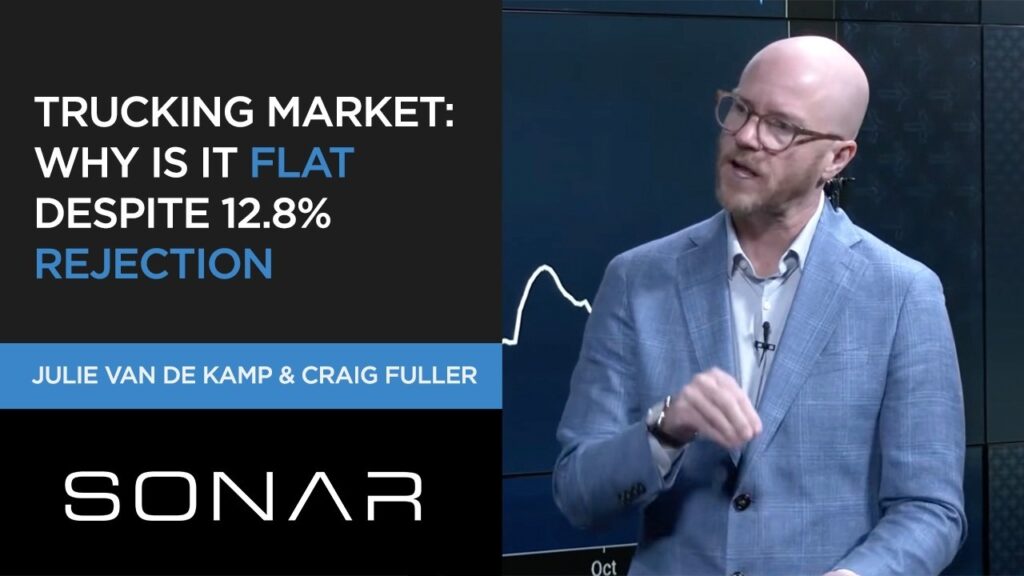
Truckload tender rejections are holding near 12.8%, roughly double the 6% recorded a year earlier, yet FreightWaves analysts Julie Van de Kamp and Craig Fuller say the market shows little of the tightening momentum normally seen ahead of peak season. The rejection index has slipped only about one percentage point in 20 days, even as November's Outbound Tender Volume Index averages 11,434, up 12% year over year and 3% from October. Refrigerated freight is the exception, with reefer rejections at 21% versus 12.6% last year, and a super El Niño could add further pressure on reefer capacity this winter.

Welcome Back!

Login to your account below

Create New Account!

Fill the forms below to register

Retrieve your password

Please enter your username or email address to reset your password.

Scan to share via WeChat

Open WeChat and scan the QR code to share

QR Code

Add New Playlist