Experts Recommend Driving Tests for Autonomous Vehicles
=====================================================
The federal government relies on self-certification mechanisms to monitor autonomous vehicle companies.

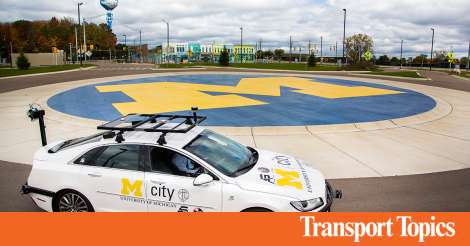
A specially modified Lincoln MKZ, stationed at Mcity, is an open-source connected and automated research vehicle used by University of Michigan faculty, students, startups, and others to accelerate innovation. (mcity/University of Michigan)
Ann Arbor, Michigan — As concerns over the safety of autonomous vehicles grow, a renowned expert is calling on the federal government to develop a national driving test that must be passed before these vehicles are allowed on the road.
This regulation would establish minimum standards to ensure vehicles demonstrate basic skills and capabilities in traffic conditions intended for use by manufacturers, said Henry Liu, director of the University of Michigan’s autonomous vehicle testing center.
“Ensuring safety is crucial for consumers, developers of autonomous vehicles, and the federal government,” Liu said in an interview. “The federal government has a responsibility to help set minimum standards and provide guidance on safety testing.”
In recent years, autonomous vehicles have been involved in several high-profile accidents, with surveys indicating widespread public concern about their safety. Liu suggests that testing vehicles’ proficiency across various traffic conditions could enhance public trust.

“Current vehicle safety regulations are passive, so we rely on self-regulation,” said Liu. (mcity/University of Michigan)
Liu says extensive research is still needed before autonomous vehicles can be safely deployed nationwide. However, he agrees with manufacturers that, in the long term, autonomous vehicles have the potential to save lives and improve national transportation efficiency.
Currently, there are no specific federal regulations for autonomous vehicles, with only a few states having their own requirements. As part of the Department of Transportation, the National Highway Traffic Safety Administration has been collecting data on accidents involving autonomous vehicles. However, so far, it has only issued voluntary guidelines that do not include driving tests.
Autonomous vehicles must still comply with federal safety standards applicable to all passenger cars, meaning government investigations are only initiated after serious incidents occur.
At the University of Michigan’s testing center, Liu operates a simulated city called Mcity, which includes traffic signals and a roundabout for companies and governments to test autonomous vehicles.
A regulation or voluntary test is needed because “we do not want to create public safety hazards,” Liu said during his October 8 speech announcing that Mcity can now be accessed remotely by researchers.
Liu suggests that driving tests should assess whether autonomous vehicles can make left turns at intersections without green arrow signals. He says the tests should also ensure vehicles come to a stop at stop signs and recognize and yield to small pedestrians crossing the road.
He argues that testing could prevent subpar robotic vehicles from being released into society, much like human driver tests prevent unqualified drivers from obtaining licenses. However, he acknowledges that no test can prevent all collisions involving autonomous vehicles.
Liu believes driving tests will help developers of autonomous vehicles “so when they plan to deploy in certain cities across the U.S., they face less city resistance.”
Tesla CEO Elon Musk has long complained that federal regulations hinder innovation. Tesla is developing a robotaxi system called “Full Self-Driving,” but these robotaxis cannot operate autonomously, and their drivers must be ready to intervene at any time.
Liu says basic driving standards would actually promote innovation and strengthen the deployment of autonomous vehicles. If companies are confident enough in large-scale deployments, he said, basic capability tests should be “a piece of cake.”
“Then why would this become an obstacle for deployment?” he asked.
Liu points out that Europe and China already have basic tests for third-party assessment of autonomous vehicles. However, the U.S. continues to rely on company self-certification.
Liu says he is now calling for driving test recommendations because autonomous vehicles have made progress in using “machine learning” computers for road decision-making. He predicts they will be widely deployed on American roads within five to ten years.
“Mass deployment is coming, which is why the federal government should take action,” Liu said.
Currently, Alphabet Inc.’s Waymo autonomous vehicle division has been operating driverless ride-hailing services in Phoenix and other areas. General Motors’ Cruise autonomous vehicle division previously operated robotaxis in San Francisco before a vehicle accident last year.
Additionally, Aurora Innovation plans to launch fully automated semi-truck freight operations on Texas highways by the end of this year. Another autonomous semi-truck company, Gatik, aims to achieve automated freight operations by the end of 2025.
In recent years, one notable incident involving an autonomous vehicle was a fatal crash in Arizona where an Uber self-driving SUV collided with a pedestrian while under human backup control. Another incident involved a Cruise self-driving Chevrolet Bolt dragging a pedestrian onto the roadside and causing severe injuries after the pedestrian was hit by another vehicle driven by a person and pushed into the path of the Bolt.
—
Source: Transport Topics