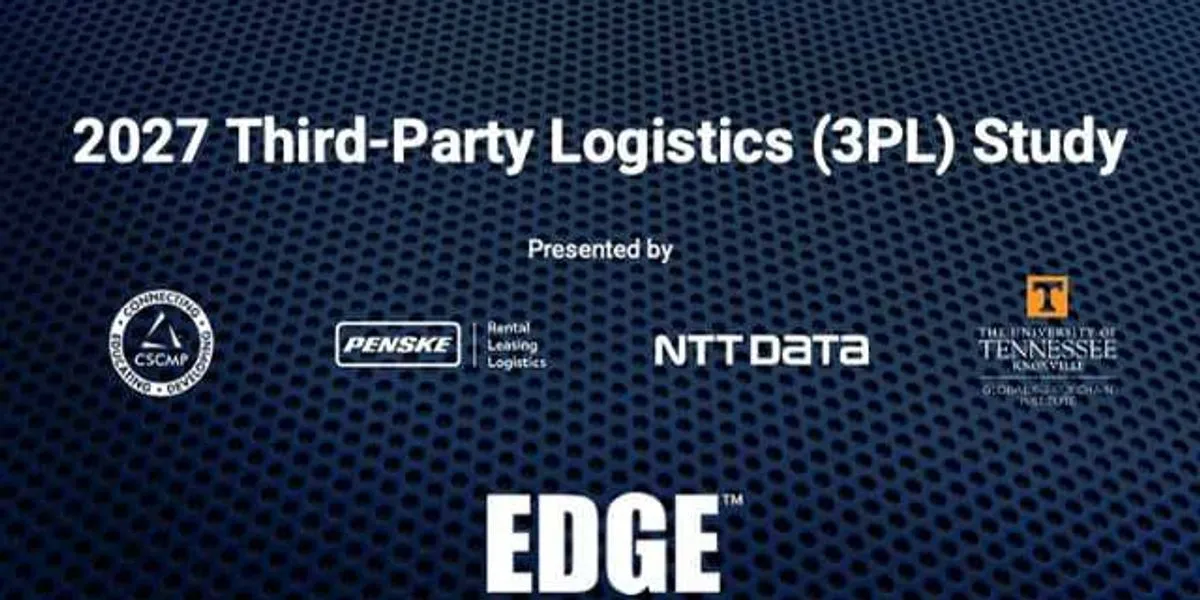
CSCMP presented the 2027 Third-Party Logistics Study at EDGE 2026, produced with Penske, NTT Data and the University of Tennessee-Knoxville Global Supply Chain Institute, per a Nov 04, 2026 posting by Supply Chain Xchange Staff. The same conference program featured a D-Wave quantum optimization masterclass with Murray Thom citing AT&T, BASF and Pfizer projects, and an InstaLILY session arguing agentic AI deployed on operations becomes an owned intelligence layer rather than a rented tool replaced within two years.
According to thescxchange.com, the Council of Supply Chain Management Professionals (CSCMP) used its EDGE 2026 conference to present the 2027 Third-Party Logistics (3PL) Study, a research effort produced jointly with Penske, NTT Data and the Global Supply Chain Institute at the University of Tennessee-Knoxville. The session was published by Supply Chain Xchange Staff on Nov 04, 2026.
The 3PL study carries a 2027 label, signaling that its findings are framed around the coming year’s logistics landscape rather than the current one. It brings together a logistics operator in Penske, a technology services provider in NTT Data, and an academic research center at the University of Tennessee-Knoxville, giving the project a combined industry-and-academic authorship.
Details of the study’s sample size, respondent mix and specific findings were not disclosed in the source material, which presented the research as a conference session within the broader EDGE 2026 video program. The source did not publish quantitative results from the 3PL study itself.
Conference program pairs 3PL research with technology sessions
The 3PL study session sits alongside other EDGE 2026 presentations that focus on emerging supply chain technology, including a masterclass on quantum optimization and a playbook for agentic AI adoption. The program positions third-party logistics research next to computational and AI-driven tooling.
In the quantum session, Murray Thom, vice president of quantum technology evangelism at D-Wave, presented a masterclass and demo aimed at showing attendees how to realize value from quantum computing today. The source states that Thom shared insights from commercial projects including AT&T, BASF and Pfizer, and that D-Wave’s quantum computers are described as powerful and energy-efficient.
“The conversation is shifting from ‘Can quantum work?’ to ‘How fast can we implement it?'” — Supply Chain Xchange, describing the D-Wave session
The source adds that this year quantum computing becomes “not just viable, but commercially impactful,” according to the session description. The framing moves the discussion away from feasibility questions toward implementation speed for supply chain and logistics teams.
Agentic AI session frames architecture as an ownership decision
A separate EDGE 2026 session presented by InstaLILY argues that most AI purchased today functions as a rented tool that buyers will replace within two years, while agentic AI deployed directly on operations compounds into a proprietary intelligence layer the buyer owns.
According to the source, the gap between rented tools and owned intelligence layers widens every quarter. The InstaLILY session promises a practical adoption playbook with real examples and argues that architecture choice determines whether a company is building an asset or renting a tool.
The EDGE 2026 video program also includes shorter-format content published on the site in prior years, including Supply Chain Short Takes segments featuring Zebra Technologies on fulfillment automation and automated mobile robots, dated 04 November 2024, 04 October 2024 and 02 October 2024, plus an AutoScheduler.AI warehouse productivity segment dated 09 May 2024.
Research lineup spans logistics, quantum and warehouse automation
Across the published EDGE 2026 sessions, the through-line is applied technology adoption in supply chain operations: a 3PL study for the 2027 planning cycle, quantum optimization aimed at networks under strain, and agentic AI positioned as an owned asset rather than a subscription.
The source notes that supply chain and logistics operations face constant strain as networks grow more complex and customer expectations rise, pushing traditional optimization methods to their limits. That pressure forms the backdrop for the quantum and AI sessions presented at the event.
The 3PL study’s collaborators span freight and logistics operations, IT services and academic research, with the University of Tennessee-Knoxville’s Global Supply Chain Institute supplying the research base. The study is labeled for 2027, one year beyond the 2026 conference at which it was presented.
Source: thescxchange.com
Compiled from international media by the SCI.AI editorial team.