Schneider named Norfolk Southern its primary eastern rail provider on Oct. 29, with the agreement taking effect Jan. 1. The Green Bay, Wis.-based carrier, No. 4 among intermodal and drayage players, expects Norfolk Southern's network to expand its reach, support new freight and truckload conversions, and potentially enable single-line transcontinental service with Union Pacific. Schneider's intermodal unit posted Q3 revenue excluding fuel surcharges of $287.7 million, up 2%, while operating profit jumped 35% to $22.6 million and the operating ratio improved to 92.1. TD Cowen analyst Jason Seidl sees negative implications for Hub Group and CSX.
Schneider unveiled a deal making Norfolk Southern its primary eastern rail provider Oct. 29, demonstrating the size of the carrier’s intermodal ambitions.
Green Bay, Wis.-based Schneider — which ranks No. 4 among intermodal and drayage players and No. 10 on the Transport Topics Top 100 list of the largest for-hire carriers in North America — foresees an expansion in key markets in the intermodal segment of the freight market when the deal takes effect Jan 1.
The company also reckons to be the first intermodal player to offer a single-line transcontinental network through the deal, especially if Norfolk Southern’s controversial merger with Union Pacific gets the green light. Union Pacific is Schneider’s primary western rail provider.
“As we were comparing all of the freight available to the options that we had, it became obvious to us that we had a better opportunity in our competitive positioning to put ourselves on Norfolk Southern” — Jim Filter, CEO of Schneider
Filter told investors and analysts during the company’s third-quarter 2026 earnings call that the two teams had been preparing the arrangement well before its announcement. “While we announced it today, those teams have been putting the work together for a long time. We have a proven playbook. We have done this before, so has Norfolk Southern,” he said, adding: “They have also been making some investments in facilities, getting things set up for us. There has been some track adjustments as well, making sure that we have the lift capacity.”
Network reach and asset base
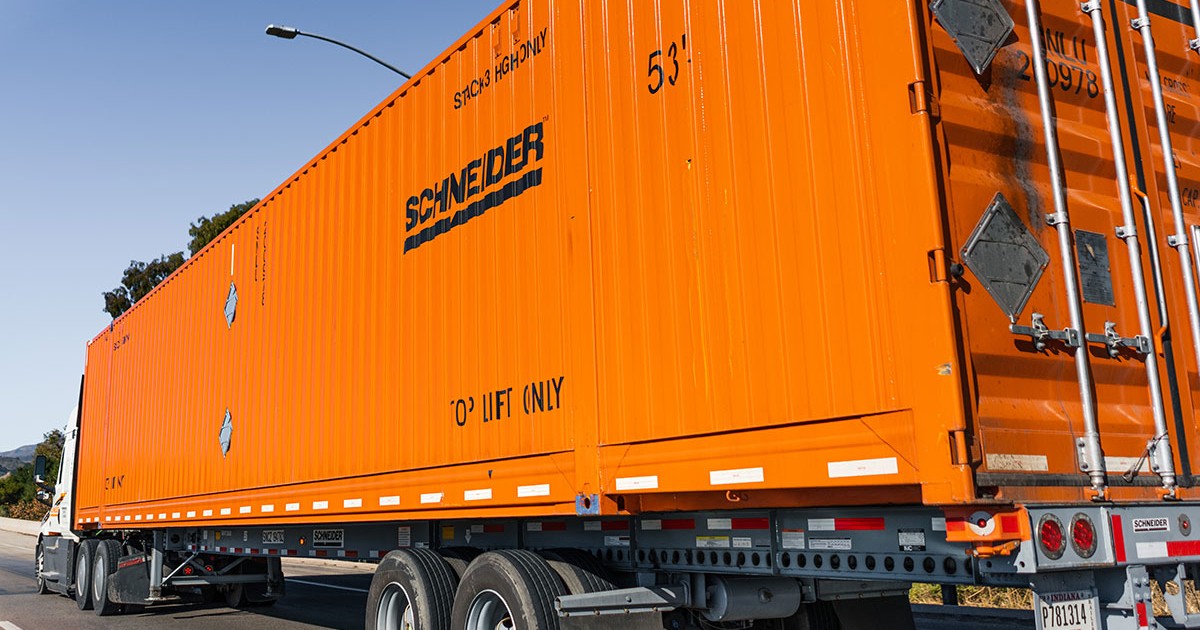
Schneider’s existing intermodal operations comprise company-owned tractors, around 23,900 chassis and 26,800 containers servicing more than 60 intermodal rail hubs across North America.
Schneider’s intermodal unit posted revenue, excluding fuel surcharges, in Q3 of $287.7 million, an increase of $6.3 million or 2%, compared with $281.4 million in the same quarter in 2025, as a result of a 3% increase in revenue
The intermodal unit’s operating profit in Q3, however, jumped 35% year over year to $22.6 million from $16.8 million on an improved freight mix and the rise in revenue Schneider’s intermodal division posted an operating ratio of 92.1 in Q3 compared with 94 in the same period 12 months earlier.
A carrier’s OR provides insight on how well a company is balancing its costs and revenue generation. The lower the ratio, the better a company’s performance.
Filter framed the eastern switch as a way to widen the carrier’s addressable freight base and pull truckload volume onto the rails.
“Norfolk Southern’s broader eastern network expands Schneider’s reach and creates additional opportunities to grow with existing customers, pursue new freight and convert truckload shipments to intermodal” — Jim Filter, CEO of Schneider
“By leveraging Schneider’s 100% company-owned containers and chassis, which are complemented by our company-operated dray fleet, we expect this agreement to strengthen service, enhance network reach and support our long-term growth strategy,” he added.
Filter’s aim is to create differentiation in Schneider’s service offering, he told TT in an exclusive interview when ascending to the post of CEO in July.
“This opens up a big chunk of the country, so we are really excited about that. In terms of the competitors that are on there, we feel really good about how we are able to differentiate the fact that we have 100%-owned containers, chassis, high percentage of our company drivers” — Jim Filter, CEO of Schneider
Competitive fallout and merger backdrop
At least one analyst agreed with the strategic logic. TD Cowen analyst Jason Seidl told investors in a research note that the Schneider-Norfolk Southern deal is likely to have negative implications for Hub Group — a direct competitor — and Jacksonville, Fla.-based railroad CSX.
Hub Group ranks No. 15 on the for-hire TT100 and No. 2 in the intermodal arena. CSX is being replaced as Schneider’s primary eastern rail partner.
An even greater competitive advantage may come should the Surface Transportation Board approve Norfolk Southern’s merger with Union Pacific. The federal agency last approved a railroad merger in 2023, when Canadian Pacific Railway bought Kansas City Southern Railway Co.; however, that was the first such approval in decades.
STB’s Norfolk Southern-Union Pacific process began in August after the first application paperwork was thrown out by the agency for being insufficient. Opposition to the deal from rival railroads, unions and farmers is fierce, and reviewing the 2023 merger took nearly two years.
Schneider, however, is happy to let the dust settle, with Filter describing the standalone agreement as sound on its own terms regardless of the regulatory outcome.
“As you think about the merger, that is really just the icing on the cake for us. This agreement on its own stands; it is economically and strategically beneficial for our organization” — Jim Filter, CEO of Schneider
Source: Transport Topics
Compiled from international media by the SCI.AI editorial team.