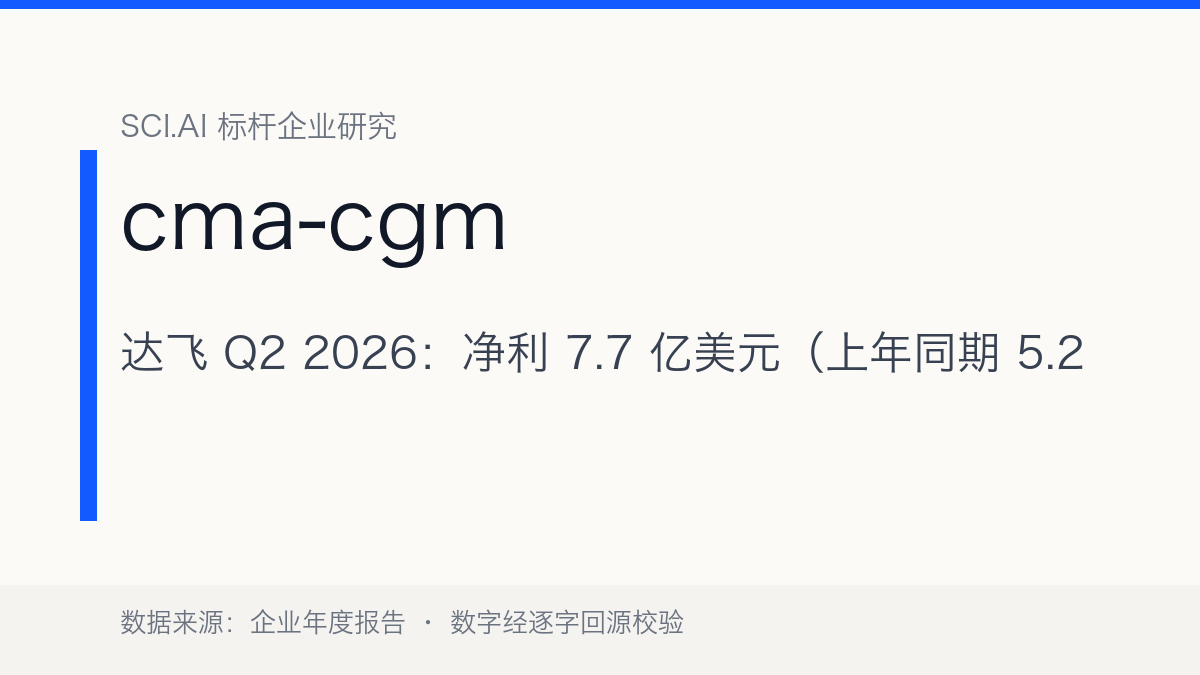
CMA CGM booked Q2 revenue of $15.7bn (+19.2% YoY), EBITDA of $3.0bn (+31%) and net income of $770m (against $520m a year earlier); the 10-terminal UNITED PORTS venture with Stonepeak closed on July 28 — after a 58% profit slide in 2025, the family carrier's V-shaped rebound and its capital spending arrived together.
Background
CMA CGM’s second quarter: revenue of $15.7bn, up 19.2% year on year; EBITDA of $3.0bn, up 31%, with margin back at 19%; net income (group share) of $770m against $520m a year earlier. By segment: Maritime carried 6.3m TEU (+6%) with revenue +22% to $10bn and maritime EBITDA of $2.3bn at a 22.7% margin (+3.3 points); Logistics (CEVA) revenue +8.5% to $5.01bn with EBITDA of $388m at a 7.8% margin; Others (terminals and air cargo) revenue +47.6% to $1.48bn with EBITDA of $338m (+44.5%).
Q1’s deep hole gives the rebound its scale: Q1 revenue was $13.23bn with net income of just $250m (against $1.12bn a year earlier) — a quarter-on-quarter jump from $250m to $770m of net income. The release quotes chairman Rodolphe Saadé: in a context of persisting global economic and geopolitical uncertainty, the Group posted strong results this quarter.
Analysis
In the five-year arc, CMA CGM is the cleanest sample of supercycle profit capitalisation. 2021 revenue was $56bn (the official release headline read “record 2021 results with $56 billion in revenue”); 2022 revenue $74.5bn (+33%) with net income at the $24.9bn record; 2023 revenue $47.0bn (-36.9%) with net income of $3.6bn (back to a quarterly loss in Q4); 2024 revenue $55.5bn (+18.0%) with net income of $5.71bn (+57%); 2025 revenue $54.4bn (-2.0%) with net income of $2.38bn (-58%). Spending through the bottom is the real storyline of this quarter.
Three capex destinations all landed in the quarter. Terminals: the UNITED PORTS joint venture with Stonepeak closed on July 28 — Stonepeak paid $2.4bn for a 25% minority stake in ten CMA CGM-operated terminals (US, Brazil, Spain); add the Santos Brasil 100% acquisition that closed in December 2025 and the portfolio now spans 66 terminals across 40 countries. Fleet and fuel: the dual-fuel orderbook runs to about $30bn (LNG plus methanol), 27 dual-fuel ships were delivered in 2025, and the group targets 200+ low-carbon ships by 2030. Air and other: CMA CGM AIR CARGO operates 8 freighters, alongside media assets and the €100m five-year Mistral AI partnership.
Two structural facts deserve to be pinned down. The OCEAN Alliance has been formally extended five years to 2032 (announced February 27, 2024) — reports of a CMA CGM exit were false; the real structural moves are in terminals and air cargo. On logistics: CEVA (including Bolloré Logistics, folded in during 2024) posted FY2025 revenue of $18.3bn, flat, at a 9.4% EBITDA margin — roughly a third of segment-sum revenue, but with margins well below maritime (23.0%) and terminals (22.5%): the stabiliser of the cycle, not its profit engine. The FY2025 segment detail frames that role: Maritime revenue of $34.3bn (-6.1%) on 24.24m TEU (+2.8%) at a 23.0% margin, CEVA at $18.3bn flat, and Others at $4.3bn (+48.4%) at a 22.5% margin — the fastest-growing bucket in the group is also its second-smallest, which is what a decade of terminal-and-air reinvestment looks like before it matures.
Implications
For shippers and forwarders: the V-shaped rebound (Q1 net income of $250m rising to $770m in Q2) and the maritime EBITDA margin back at 22.7% say carrier pricing power strengthened through mid-2026 — expect the spot-contract spread to keep narrowing in Q3, and budget models should carry a wider variance for volatility, not a single mean. With Stonepeak aboard, CMA CGM’s terminals will run on more institutional terms — US and Latin America terminal service procurement gains a new counterparty option.
For observers and investors, the transparency window on this unlisted group is quarterly releases plus the bond market — S&P BB+ and Moody’s Ba1 mean debt still prices the balance sheet as high-yield, making rating and bond sentiment the high-frequency gauges of cycle risk. The second-half tests: whether Q3 results (expected mid-November) sustain the maritime margin repair; whether 2026 group net income can rebuild toward the $5bn scale from 2025’s $2.38bn; and the pace of capital spending toward the 200-plus low-carbon ships targeted for 2030. Family control means none of those answers must accommodate quarterly shareholder pressure — that is the deepest behavioural difference between CMA CGM and its listed peers. The French-flag programme adds a political dimension to the same story: ten LNG dual-fuel ships of 24,000 TEU each under the French flag from 2026, with the French-flag fleet reaching 40 ships in the next phase — capacity, flag and national industrial policy moving as one, in a way no listed carrier can replicate.
Source: CMA CGM Q2 2026 results release (Jul 28, 2026, cmacgm-group.com); CMA CGM FY2025 results release (Mar 6, 2026); Reuters and Container News reporting