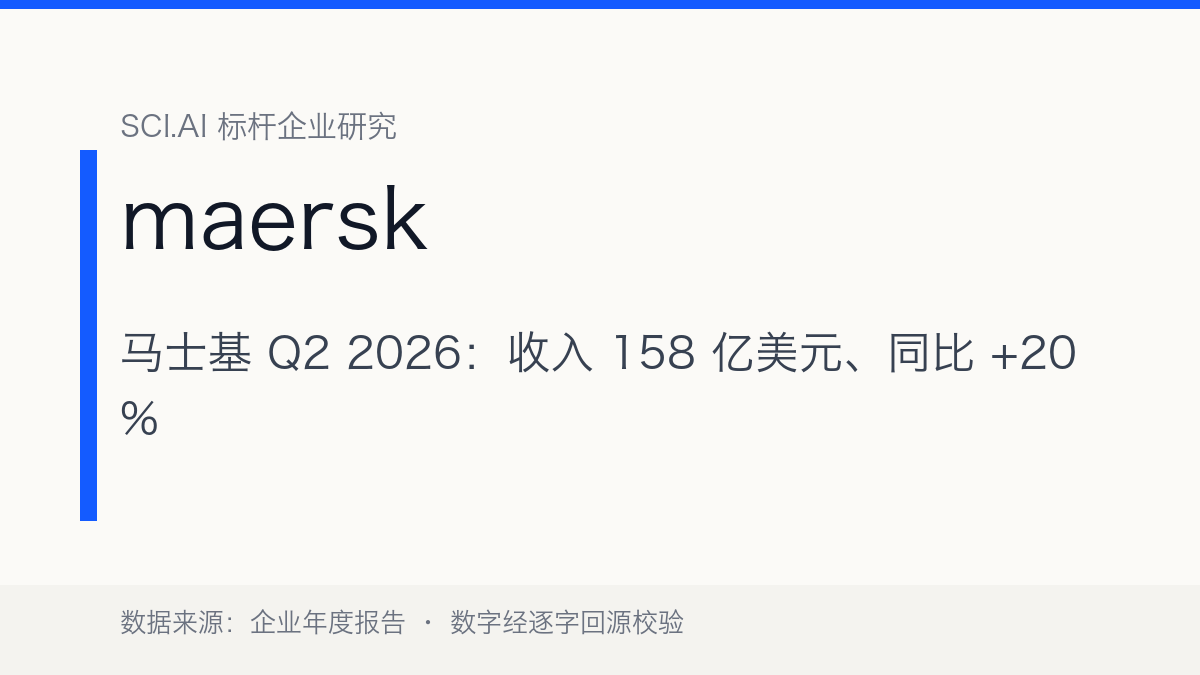
Maersk booked Q2 revenue of USD 15.8bn (+20% YoY) with EBIT of USD 1.6bn at a 10.0% margin, and lifted full-year underlying EBITDA guidance to USD 10.5-12.5bn; Ocean rates rose 22% and Terminals earned USD 458m — at the cycle bottom, volatility itself has become this integrator's earnings source.
Background
Maersk’s second quarter: “revenue increasing 20% year-on-year to USD 15.8bn from USD 13.1bn”; “EBITDA rose to USD 3.0bn from USD 2.3bn, EBIT increased to USD 1.6bn from USD 845m, and the EBIT margin reached 10.0%”. That is a sharp reversal from Q1, when group EBIT was USD -192m — and the driver was a disruption beyond the Red Sea: the release cites the Strait of Hormuz disruption, alongside Far East front-loading and port congestion in Europe and North America, pushing spot rates back up.
All three segments moved up: Ocean delivered a 23% revenue increase on loaded volumes +4.1%, average loaded freight rates +22% and vessel utilisation of 96%, with EBIT of USD 935m; Logistics & Services posted a 5.1% EBIT margin (up 0.5 points sequentially) on revenue +15% year on year, with EBIT of USD 217m; Terminals grew revenue 11% (revenue per move +7.1%, volume +2.2%) with EBIT of USD 458m.
Analysis
The two guidance raises are the hardest information in the release: full-year underlying EBITDA guidance moved to “USD 10.5-12.5bn (previously USD 8-10bn)”, underlying EBIT to “USD 4.5-6.5bn (previously USD 2-4bn)”, and free cash flow guidance improved to “greater than USD 0” — on an assumption of roughly 4% global container market volume growth for 2026. Against the年初 starting point (guidance once set at USD 2-4bn of underlying EBIT), two raises inside six months tell you where 2026 rates actually went: in management’s “new volatility normal”, disruption itself is revenue.
The five-year arc locates this volatility. In the 2022 supercycle, revenue hit USD 81,529m with EBIT of USD 30,860m. 2023 revenue collapsed to USD 51,065m, with EBIT at USD 3,934m. 2024’s Red Sea diversions lifted revenue back to USD 55,482m, with EBIT at USD 6,499m. 2025 revenue settled at USD 53,988m, with EBIT at USD 3,500m — mean reversion was delayed by the Red Sea crisis, not cancelled by it. The Hormuz disruption of H1 2026 has effectively taken the volatility-dividend baton from the Red Sea: Ocean rates +22% at 96% utilisation are the direct source of this quarter, and management is spending the windfall counter-cyclically — the USD 1.0bn share buy-back continues, the USD 350m Suape terminal (South America’s first fully electrified container terminal) was inaugurated, and the over USD 1.7bn Lien Chieu investment in Vietnam is progressing.
One quiet structural signal sits in Terminals: a Q2 EBIT of USD 458m keeps running ahead of most quarters — in FY2025 the Terminals EBIT of USD 1,747m overtook Ocean’s USD 1,386m for the first time — and quarter after quarter this year keeps confirming the shift from shipping line to terminals-plus-logistics company. The L&S margin of 5.1% edges toward the 6% target, but the second half of integration — making the Landside/Forwarding/Solutions structure profitable without an Ocean cycle underneath — is still to be proven.
Implications
For shippers and forwarders: Maersk assumes ~4% market volume growth for the year yet more than doubled its profit guidance — management is telling you that the amplitude of rates, not cargo volume, is the cost variable of 2026. Pricing strategy can hedge the disruption premium accordingly: every step of the phased Red Sea return (AE15 and AE19 have already resumed Suez routings) adds downside risk to rates, while Hormuz-style events can re-inflate them at any time. Writing indexed collars into contracts beats a one-way bet on either direction.
For observers and investors, three markers in the second half: the Q3 report on November 5 testing whether the raised range holds at its midpoint; how much a full Red Sea return compresses rates into the fourth quarter and beyond (part of that assumption already sits inside the guidance); and the pace of the methanol dual-fuel orderbook through the cycle bottom. The assumptions are worth reading too: guidance embeds around 4% volume growth for 2026, so contract indices tied to spot rates will reprice faster than fixed-rate deals through the fourth quarter. For forwarder peers, the structural signal deserves attention: when a carrier’s main profit comes from terminals and logistics, the boundary between cooperation and competition with forwarders is being redrawn. The same logic runs through the network build-out: the guidance’s free-cash-flow floor moving to greater than USD 0 funds the buy-back and the terminals pipeline at the same time, and every week the Red Sea return extends, the arbitrage between disruption premiums and normalized routings narrows for everyone in the trade.
Source: Maersk Q2 2026 results release (Aug 13, 2026, maersk.com/newsroom); Maersk FY2025 Annual Report; Maersk FY2020-FY2024 annual reports (five-year tables)