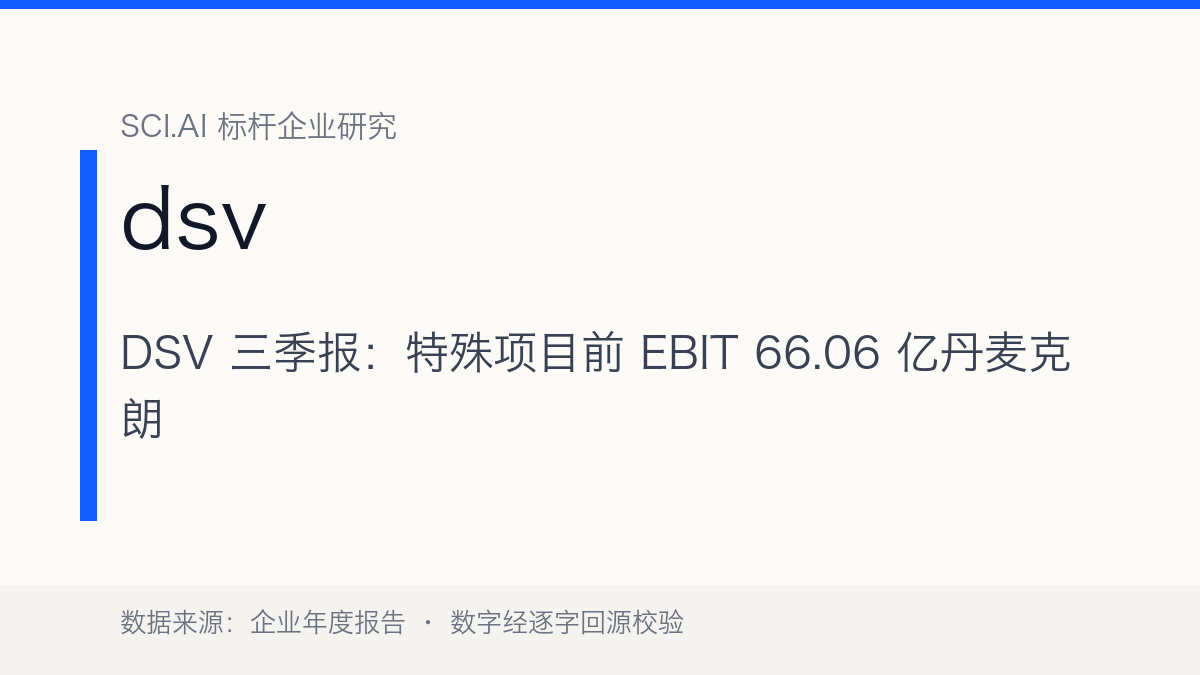
DSV booked Q3 revenue of DKK 80,702m (+10.5% YoY) and EBIT before special items of DKK 6,606m, up 19.5%; full-year guidance narrowed upward to "DKK 24,000-25,000 million" and the first post-acquisition buyback of DKK 1,500m is under way — the world's largest forwarder has entered the show-me phase of its integration.
Background
DSV’s third quarter: revenue of DKK 80,702m, up 10.5% year on year; gross profit of DKK 20,253m; EBIT before special items of DKK 6,606m, up 19.5% (including a DKK 300m property disposal gain); profit for the period of DKK 3,017m; diluted adjusted EPS (TTM) of 56.1; gearing down to 2.5x. Over the first nine months, revenue reached DKK 227,806m with gross profit of DKK 59,433m and EBIT before special items of DKK 17,716m.
Segment performance kept its air-and-sea-strong, road-recovering shape: Air & Sea EBIT of DKK 4,278m, up 18.9%, at a 45.8% gross-profit-to-EBIT conversion; Contract Logistics EBIT of DKK 1,673m, up 50.3% (including a DKK 105m property gain); Road EBIT of DKK 526m (including a DKK 195m property gain) — Road remains the segment where integration margin has not yet fully landed. The nine-month picture is consistent: Air & Sea EBIT of DKK 17,716m across the group’s first three quarters came with the Contract Logistics conversion holding up, while the group’s adjusted earnings for the nine months reached DKK 10,343m against adjusted free cash flow of DKK 6,439m in the quarter alone — a 128.6% adjusted cash conversion that funds both the buyback and the deleveraging.
Analysis
The heart of this interim report is not the single quarter — it is management moving the integration story into its pay-out phase. On guidance, the full-year EBIT-before-special-items range was narrowed upward to “DKK 24,000-25,000 million (previously DKK 23,500-25,500 million)”. On capital returns, the company announced a “share buyback programme of DKK 1,500 million” running from October 21, 2026 to February 1, 2027 — the first since the Schenker deal. On synergies, the official line stands: “Annual synergies are still expected at the level of DKK 9 billion”, with DKK 800m realised in 2025 and roughly DKK 5,000m of cumulative impact expected in 2026 — though Road and some group-function synergies have been deferred into 2027, against total deal-plus-integration costs of about DKK 11bn.
Set against the FY2025 baseline, both faces of the integration show. FY2025 revenue was DKK 247,331m, up 51.3% with Schenker consolidated for eight months, on EBIT before special items of DKK 19,611m; sea volume reached 3,695,424 TEU (+38%), air volume 2,013,127 tonnes (+44%), with 151,751 FTE — an order of magnitude lead over forwarding peers. But the gross-profit-to-EBIT conversion fell from 37.5% in 2024 to 29.3% in 2025; this quarter’s 45.8% conversion in Air & Sea is direct evidence of the synergy beginning to flow, while Road’s margin (3.5% in 2025, below the 4.6% of 2024) is the half still to be paid out.
The balance sheet underwrites the patience: net interest-bearing debt stood at DKK 86,624m at end-2025, with gearing down from 2.8x at closing to 2.5x by Q3 — deleveraging through a falling ocean-rate cycle is what makes the counter-cyclical integration narrative financeable. On volumes, media-consensus figures for the quarter show air tonnage of 560,890 tonnes (-3%) and sea TEU around -3% against air yield up about 8% — volume retreating while price holds is the standard forwarder defence in a falling-rate market, and it explains why guidance was narrowed upward rather than raised outright. For procurement teams the season matters too: the guidance range already embeds management’s caution on the second half, so contract negotiations that anchor on the top of the range are likely to be disappointed; the safer read is the floor. And the DKK 1,500m buyback, running to February 1, 2027, gives the shares a mechanical bid through the winter — a signal the board expects the free cash flow to keep funding both returns and integration.
Implications
For shippers’ logistics procurement, the quarter carries two practical signals. First, air yield rising about 8% while tonnage slips says the top forwarders are defending price and profit rather than chasing volume in a down-rate market — in peak-season negotiations, shippers should hedge with second-tier forwarders’ volume-price combinations. Second, the Schenker brand and systems are still mid-transition: customers on legacy Schenker contracts should confirm the contracting entity, system handover and service-terms succession to avoid integration-period gaps.
For observers, 2027 is the acceptance year for the largest deal in forwarding history: whether the DKK 9bn of annual synergies land in full, whether Road’s margin recovers toward its 4.6% level of 2024, and what the group reinvests at 2.5x gearing (M&A remains the stated cornerstone) will together decide whether DSV reads as the integration benchmark or the M&A trap. For rivals, Kuehne+Nagel’s organic route against DSV’s M&A route now gets its head-to-head in 2027 conversion rates — that is the second half of the crown-change story.
Source: DSV Q3 2026 interim report (Oct 21, 2026); DSV Annual Report 2025; DSV Financial Calendar 2027