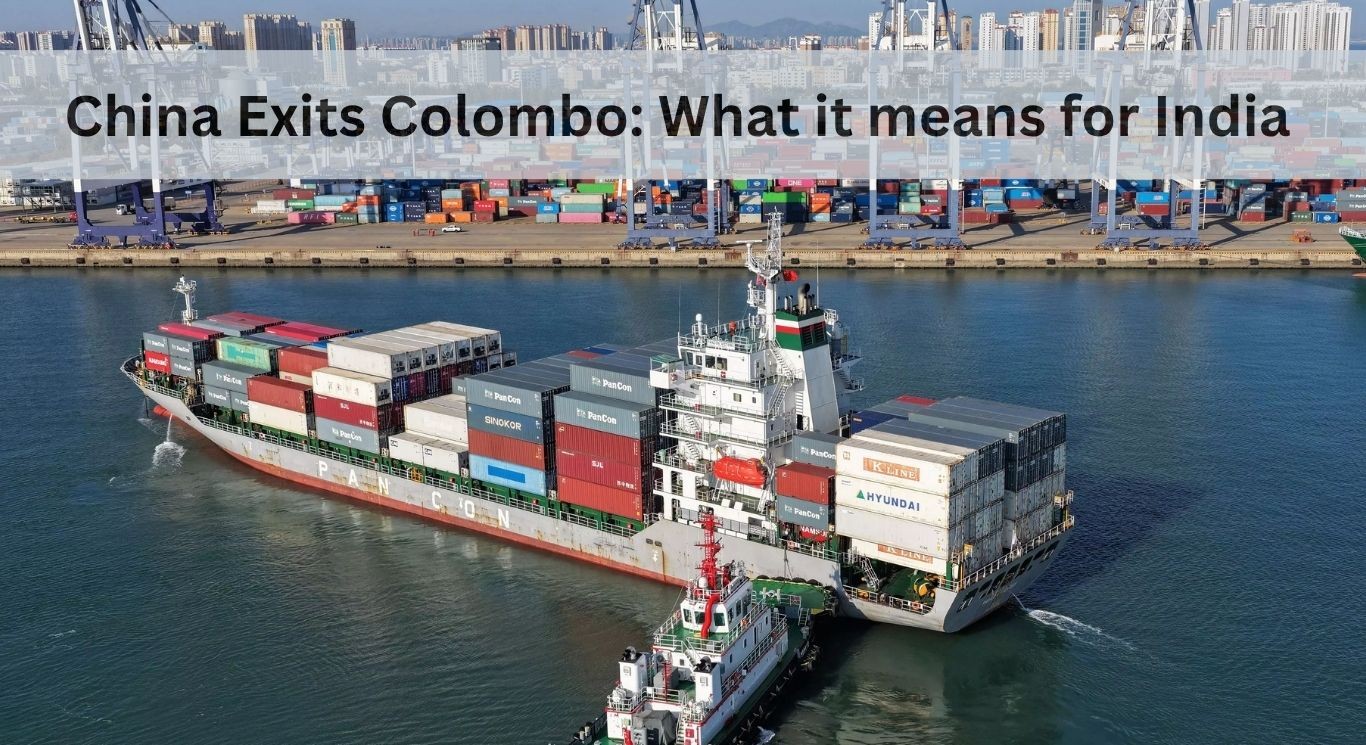
According to logisticsinsider.in, China Merchants Port Holdings has withdrawn from a planned $392 million logistics hub at Colombo Port, ending a project that was among Sri Lanka’s first major foreign investment announcements after its economic crisis. The Sri Lanka Ports Authority (SLPA) said on October 19 that the Chinese state-owned company had decided not to proceed with the collaboration agreed in April 2023.
The project will continue with a new investor, the SLPA said. The authority attributed the decision to external circumstances, commercial considerations and shareholder interests. Under the settlement, the SLPA will pay $21.905 million to the project company within 30 days — a payment to the joint venture, not to China Merchants alone.
Although the withdrawal marks a setback for the project, it does not signal a broader Chinese retreat from Sri Lanka. The exit was months in the making: in May 2026, Sri Lanka’s Board of Investment indicated that the project would not proceed and that the SLPA would invite fresh proposals for the land. Neither financing constraints nor regulatory or political factors have been established as the cause, leaving commercial considerations as the only explanation publicly cited by the authorities.
China’s wider footprint remains intact
China Merchants’ withdrawal does not affect its established presence elsewhere in Sri Lanka. At Hambantota Port, China Merchants Group holds an 85% stake in the port operator under a 99-year lease arrangement secured in 2017 for $1.12 billion.
In Colombo, China Merchants operates the Colombo International Container Terminal (CICT), which opened in 2014 and has an 85% Chinese stake. The company is also behind Port City Colombo, a $1.4 billion real-estate development adjacent to the port.
Energy is another part of China’s expanding commercial presence. In January 2025, China’s Sinopec agreed to invest $3.7 billion in a refinery at Hambantota, with a proposed capacity of 200,000 barrels per day. The project is intended to strengthen the port’s role in energy-related activities, including bunkering.
These investments underline why the logistics hub withdrawal should be viewed as a project-specific decision rather than a reversal of China’s long-term engagement with Sri Lanka.
Why India is watching closely
India’s interests in Sri Lanka converge around cargo movement, port infrastructure and maritime security. Colombo is a major transhipment hub for Indian trade, with industry estimates suggesting that around 70% of India’s container traffic passes through Sri Lanka.
India has expanded its own presence in Colombo’s port infrastructure through the West Container Terminal. Adani Group signed a deal in 2021 to develop the terminal under a 35-year build-operate-transfer arrangement. The US International Development Finance Corporation subsequently announced a $553 million investment in the project.
The terminal strengthens India-linked participation in a port where China already operates CICT. The proximity of the two terminals adds a strategic dimension to the competition, although commercial performance and operational efficiency will ultimately determine their success.
The vacated logistics site could offer another opportunity for Indian investors. However, the SLPA has only said that it will seek a new investor; no confirmed bidder has emerged. Any Indian participation will depend on the project’s commercial viability and the terms offered.
Energy and security add another dimension
The competition extends beyond container terminals. Sinopec’s proposed Hambantota refinery could strengthen China’s position in Sri Lanka’s energy sector, while India is pursuing a strategy centred on Trincomalee.
In April 2025, India, Sri Lanka and the UAE signed an agreement to develop Trincomalee as an energy hub. India and Sri Lanka also signed a defence cooperation agreement covering areas including training, information sharing and technology cooperation.
These initiatives reflect India’s interest in strengthening energy infrastructure and maritime cooperation in a strategically important part of the Indian Ocean. For New Delhi, ensuring that developments in its maritime neighbourhood do not threaten its security remains a key priority.
Colombo’s balancing act
Sri Lanka continues to balance its relationships with India and China, seeking investment while managing domestic political pressures and strategic sensitivities. In 2021, Sri Lanka withdrew from a proposed joint terminal project involving India and Japan following domestic opposition.
The episode demonstrated that even commercially significant infrastructure agreements can be vulnerable to political shifts. For India, the lesson is that strategic proximity does not guarantee project certainty. Competitive investment terms, local political support and timely execution will be crucial to securing a lasting presence.
What to watch
Three developments will indicate how the competition evolves:
- The SLPA’s search for a new investor for the Colombo logistics site
- Progress on the Sinopec refinery and the Trincomalee energy hub
- Cargo volumes and operational efficiency at CICT and the West Container Terminal
China’s exit from the Colombo logistics hub is a setback for one proposed investment, not evidence of a broader withdrawal from Sri Lanka. Its established port assets and planned energy investments remain central to its regional presence. For India, the challenge is not simply to fill the space left by a departing investor. It is to deliver competitive port and energy infrastructure, strengthen maritime cooperation and build commercial relationships that can withstand Sri Lanka’s shifting domestic priorities.
Source: logisticsinsider.in
Compiled from international media by the SCI.AI editorial team.