Skip to content

Disruptions

Analysis

Supertanker Shortage Pushes Oil Freight to $1.2M/Day

A critical shortage of supertankers has sent VLCC earnings to over US$1.2 million/day on the Persian Gulf–China route, adding US$26/barrel (US$52 million per cargo) to Houston–Asia shipments. Freight now accounts for ~25% of WTI’s value — up from a negligible share pre-conflict. European Dated Brent hit US$131 versus Brent futures at US$110, while Suezmax earnings exceeded US$300,000/day. Ship-tracking data shows U.S.–Asia flows falling as refiners pivot to shorter hauls, including a Japanese purchase of Alaskan crude. The tanker equity index reached US$70 billion this week.

Original source: Source information pending

Supertanker Shortage Pushes Oil Freight to $1.2M/Day

According to businesstimes.com.sg, a severe shortage of supertankers has driven daily earnings for very large crude carriers (VLCCs) hauling 2 million barrels from the Persian Gulf to China above US$1.2 million — a level previously deemed unimaginable by industry executives and brokers.

Soaring Costs Reshape Global Crude Flows

Moving a cargo from Houston to Asia now adds approximately US$26 a barrel — or US$52 million a cargo — to supply costs for Asia, the world’s largest crude-importing region. That premium equals roughly a quarter of the price of West Texas Intermediate futures. Before the US-Iran conflict, freight typically represented only a tiny fraction of delivered oil cost, but it now plays a much bigger role in oil markets, according to Xavier Tang, senior market analyst at analytics firm Vortexa.

Market-Wide Ripple Effects

The scarcity has pushed VLCC availability to historic lows: shipbrokers with decades of experience report virtually no vessels available for hire in certain locations within required timeframes. This tightness is cascading to smaller vessels — Suezmax tankers, each carrying 1 million barrels, are now earning on average more than US$300,000 a day, rates normally associated with war-zone operations. Asian refiners are also shifting to 700,000-barrel Aframax tankers for some U.S. purchases, deviating from standard supertanker use.

Price Divergence and Arbitrage Collapse

Freight inflation is visibly distorting physical pricing. While Brent futures topped out near US$110 a barrel this week, European Dated Brent — reflecting short-haul, immediately deliverable crude — surged above US$131. Meanwhile, diesel futures in Europe approached US$200 a barrel, underscoring persistent processor demand despite soaring logistics costs.

“It has never been this expensive to move oil around,” said Saad Rahim, chief economist at trading giant Trafigura Group, at the Bloomberg Commodity Investor Forum on Sep 17.

Self-Limiting Dynamics and Structural Shifts

Ship-tracking data from Vortexa shows U.S.-Asia crude flows have declined recently as freight costs roughly tripled. A Japanese refiner recently purchased Alaskan crude — a grade not typically well-suited for its processors — solely due to the shorter sailing distance. Similarly, Angolan oil sales to China are sluggish, and Saudi Arabia issued zero cargoes to European buyers under term contracts for October.

“Current freight levels can become self-limiting over time — they eventually close arbitrage routes and reduce demand for the most expensive long-haul barrels,” said Sumit Ritolia, senior manager of modeling at analytics firm Kpler.

Equity Rally and Market Uncertainty

The surge has minted fortunes for tanker owners: the value of the world’s largest oil tanker equities soared to a record of nearly US$70 billion this week. Yet oil traders face mounting risk — prohibitively high shipping costs threaten refinery margins and deter long-distance cargo purchases, even amid strong demand for diesel and gasoline. The key question remains how long elevated freight rates can be sustained, given that the drivers include both the US-Iran conflict and a pre-war wager by a South Korean tycoon that had already begun pushing rates upward.

Source: businesstimes.com.sg

Compiled from international media by the SCI.AI editorial team.
Ask SCI.AI Finished reading? Continue with SCI.AI. Explore the related policy, route, company and historical context. Continue asking
Record-Low Rhine Levels Choke Barge Traffic, Stress Ground Transport
Disruptions

Record-Low Rhine Levels Choke Barge Traffic, Stress Ground Transport

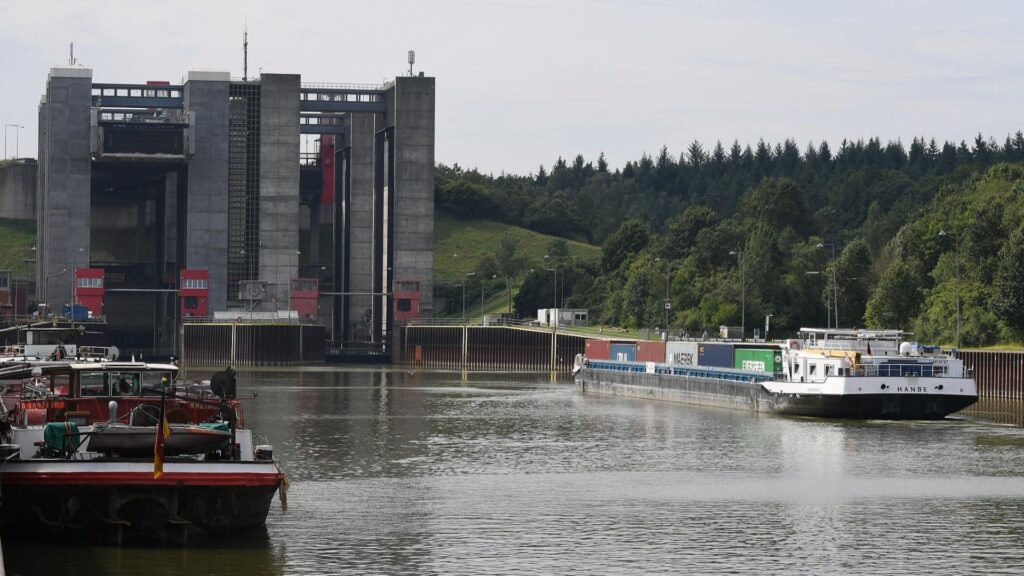
Record-low Rhine River water levels — falling to 32 cm at Kaub on September 15, 2026, the lowest since 1920 — are crippling barge traffic. Navigation restrictions took effect on September 10, 2026, forcing up to 40% load reductions and diverting 1.7 million tons of freight to roads and rails. Chemical and energy sectors report steep shipment declines: BASF cut ammonia barge deliveries by 12%, while coal deliveries dropped 31%. Rhine freight volumes fell 37% YoY in mid-September, with levels expected to stay below 50 cm through October 2026.

Bangkokmax Charter Rates Rise 18% to $32,000/Day Amid Vessel Shortage
Disruptions

Bangkokmax Charter Rates Rise 18% to $32,000/Day Amid Vessel Shortage

Bangkokmax charter rates have surged 18% year-on-year to nearly $32,000 per day amid a severe vessel shortage, with only three new ships delivered in 2026 following minimal newbuilding orders since 2023. Resale prices range from $35m to $45m, and recent charters include CMA CGM’s $34,000/day fixture for the 1,740 TEU Elbella. Linerlytica reports the Bangkokmax orderbook now totals 252 vessels, including eight 1,900 TEU ships ordered by Hong Kong’s Moon Keung Shipping for 2028–2029 delivery. The shortage is projected to continue through the first half of 2027, with just 12 additional vessels scheduled for delivery this year.

Asia-Pacific Data Centres Face 40% Power Demand, $772B Investment
Disruptions

Asia-Pacific Data Centres Face 40% Power Demand, $772B Investment

Asia-Pacific data centre growth is accelerating, with McKinsey forecasting the region will capture 34% of global demand by 2030 and JLL estimating US$772 billion in capital needs through 2030. Singapore’s strict sustainability standards have shifted investment to Johor, where data centres may consume 40% of local electricity by 2035. Australia’s live capacity is projected to grow from 1.4 GW in 2025 to 1.8 GW by 2028, though a supply gap looms. Environmental liability and contingent business interruption — driven by utility dependencies and infrastructure strain — are now central insurance concerns.

Welcome Back!

Login to your account below

Create New Account!

Fill the forms below to register

Retrieve your password

Please enter your username or email address to reset your password.

Scan to share via WeChat

Open WeChat and scan the QR code to share

QR Code

Add New Playlist