Skip to content

Last Mile · Supply Chain

Analysis

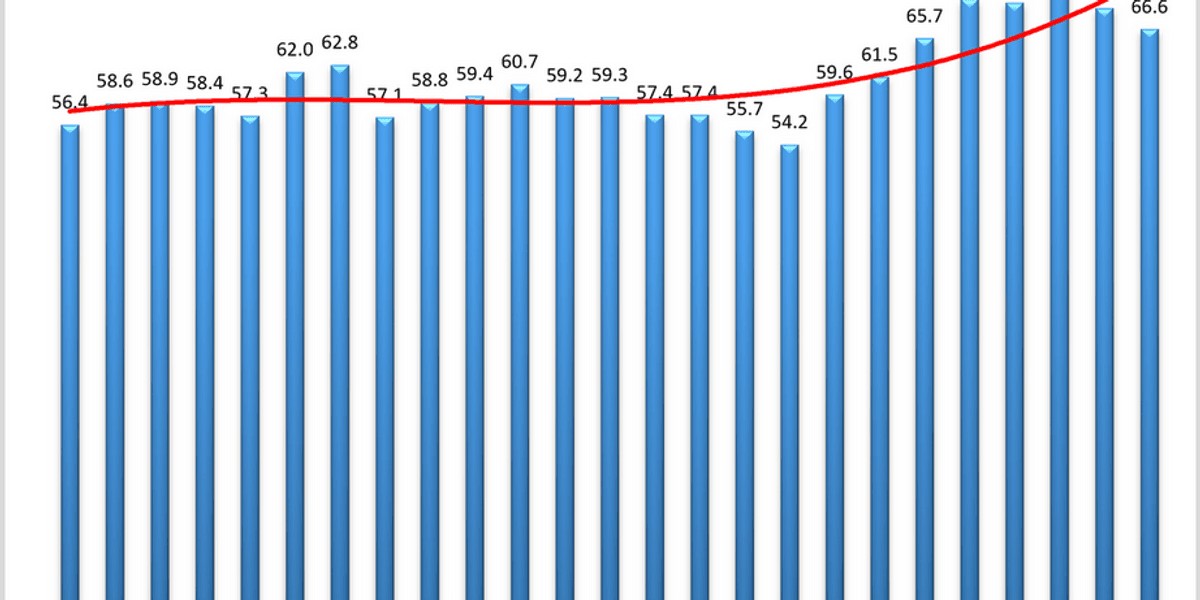
Logistics Managers’ Index falls to 66.6 in August

The Logistics Managers’ Index (LMI) fell to 66.6 in August 2026 — down from 68.9 in July and 71.1 in June — marking the second consecutive monthly decline. Inventory levels cooled to 52.8, with upstream firms slipping into contraction at 49.0. The LMI, a U.S.-based survey of logistics managers, remains above the 50 expansion threshold but signals slowing growth. The report was released on Sep 02, 2026. This follows GE Appliances’ $1 billion Kentucky factory expansion announced on Sep 03, 2026.

Original source: Source information pending

Logistics Managers’ Index falls to 66.6 in August

According to www.thescxchange.com, the Logistics Managers’ Index (LMI) declined to 66.6 in August — down more than two points from July’s 68.9 and more than four points from June’s four-year peak of 71.1.

Slowing expansion amid cooling inventories

The LMI, a monthly survey-based measure of U.S. warehousing and transportation activity, registered 66.6 in August — its second consecutive monthly decline. A reading above 50 indicates industry-wide expansion; below 50 signals contraction. Inventory levels fell more than two points to 52.8, marking the second straight month of cooling.

The slowdown reflects reduced stockpiling across the supply chain, with upstream firms reporting a mild contraction in inventory at 49.0. This shift follows aggressive inventory buildup in June and aligns with intensifying cost pressures cited in the report.

Researchers noted that the August reading continues a broader trend of deceleration after the index hit its highest level since 2022 in June. The report was released on Sep 02, 2026, and covers data collected during the month of August 2026.

Data-driven context for logistics performance

The LMI is compiled by logistics managers across the United States and serves as a leading indicator for freight volumes, warehousing demand, and transportation capacity utilization. Its August value of 66.6 remains well above the 50 expansion threshold but signals diminishing momentum compared to recent highs.

Inventory readings dropped sequentially for two months: from 55.0 in July to 52.8 in August. Upstream firms’ inventory index fell further — to 49.0 — indicating actual contraction in that segment.

While no specific dollar figures or investment amounts are tied directly to the LMI result itself, the broader editorial context on the same domain includes a $1 billion factory expansion plan announced by GE Appliances on Sep 03, 2026, underscoring continued capital deployment despite moderating logistics growth.

Source: thescxchange.com

Compiled from international media by the SCI.AI editorial team.

Ask SCI.AI Finished reading? Continue with SCI.AI. Explore the related policy, route, company and historical context. Continue asking
U.S. Last-Mile Costs Rise Faster Than Revenue for 45% of Operators
Last Mile

U.S. Last-Mile Costs Rise Faster Than Revenue for 45% of Operators

A FarEye report reveals intensifying financial strain on U.S. last-mile delivery: 45% of operators say costs are outpacing revenue in 2026, while fuel, driver availability, and vehicle operations rank as top cost pressures. Organizations with greater network control achieve 95% on-time performance and 8.3% median cost inflation—well below the 14.5% seen among low-control peers. Hybrid networks now span 57% of respondents, with 47% planning deeper outsourcing. Predictability trumps speed for 55.7%, and AI adoption has jumped to 66.3% from 46.2% in 2025.

U.S. Firms Seek Greater Last-Mile Control Amid 64% AI-Adopting Shoppers
Last Mile

U.S. Firms Seek Greater Last-Mile Control Amid 64% AI-Adopting Shoppers

A FarEye study cited by Supply Chain Xchange finds U.S. enterprises with greater control over last-mile delivery infrastructure and data better withstand delivery cost inflation, complex fulfillment networks, and changing customer expectations. The report links this advantage to rising adoption of AI by shoppers — 64% of whom now use AI tools — as documented in a related report dated Aug 27, 2026. Released on Aug 28, 2026, the analysis focuses exclusively on U.S. operations and identifies data ownership as a critical lever for operational resilience.

Korean Air upgrades Incheon cargo hub, completes automation in September
Procurement

Korean Air upgrades Incheon cargo hub, completes automation in September

Korean Air is reshaping its cargo operations ahead of its 17 December merger with Asiana Airlines, prioritising expanded passenger belly capacity, freighter specialisation, and infrastructure upgrades. Automation at Incheon Airport — developed with Lödige Industries — is scheduled for completion next month, while a major cargo terminal upgrade at JFK is planned for next year. The airline targets transpacific tech cargo, including AI server racks and semiconductor equipment, and is building an AI-enabled operational ecosystem with smart tracking and API integration.

Welcome Back!

Login to your account below

Create New Account!

Fill the forms below to register

Retrieve your password

Please enter your username or email address to reset your password.

Scan to share via WeChat

Open WeChat and scan the QR code to share

QR Code

Add New Playlist