Nuevo León Governor Samuel García unveiled a $135 billion foreign direct investment surge, a tenfold jump in daily freight crossings—from 800 to over 10,000—at the Colombia-Solidarity Bridge since 2022, and $17 billion in planned border infrastructure including Green Corridors. The state is expanding security with 10 helicopters and 200–300 highway officers, launching a 40-hectare border industrial zone and a 988-acre zone in Pesquería hosting 400 auto suppliers. NADBank pledged $164 million for water resilience in the Texas-Mexico border region during its 2026 San Antonio summit.
Borderlands Mexico is a weekly rundown of developments in the world of United States-Mexico cross-border trucking and trade. This week in Borderlands Mexico: Nuevo León governor pitches border boom as Texas-Mexico freight surges; NADBank plans nearly $164 million in water projects; and Otay Business Park completes first phase near US-Mexico border.
Gold Triangle integration and infrastructure push
Nuevo León Gov. Samuel García is betting billions of dollars in infrastructure, industrial development and security investments can help transform the Mexican state into an increasingly important gateway for U.S.-Mexico freight.
Speaking Thursday at the 2026 North American Development Bank (NADBank) Summit in San Antonio, García laid out an ambitious vision for tightening Nuevo León’s economic ties with Texas, particularly along a trade corridor connecting Monterrey with Laredo, San Antonio, Houston and Dallas.
García said Nuevo León wants to further integrate what he called the “Gold Triangle” between Monterrey, Houston and Dallas as the state seeks to capitalize on growing nearshoring and cross-border trade.
“That is the goal.” — Samuel García, Governor of Nuevo León
Surging border traffic and $17 billion in new crossings
García pointed to Nuevo León’s relatively small border with Texas as one of the state’s biggest opportunities for future trade growth.
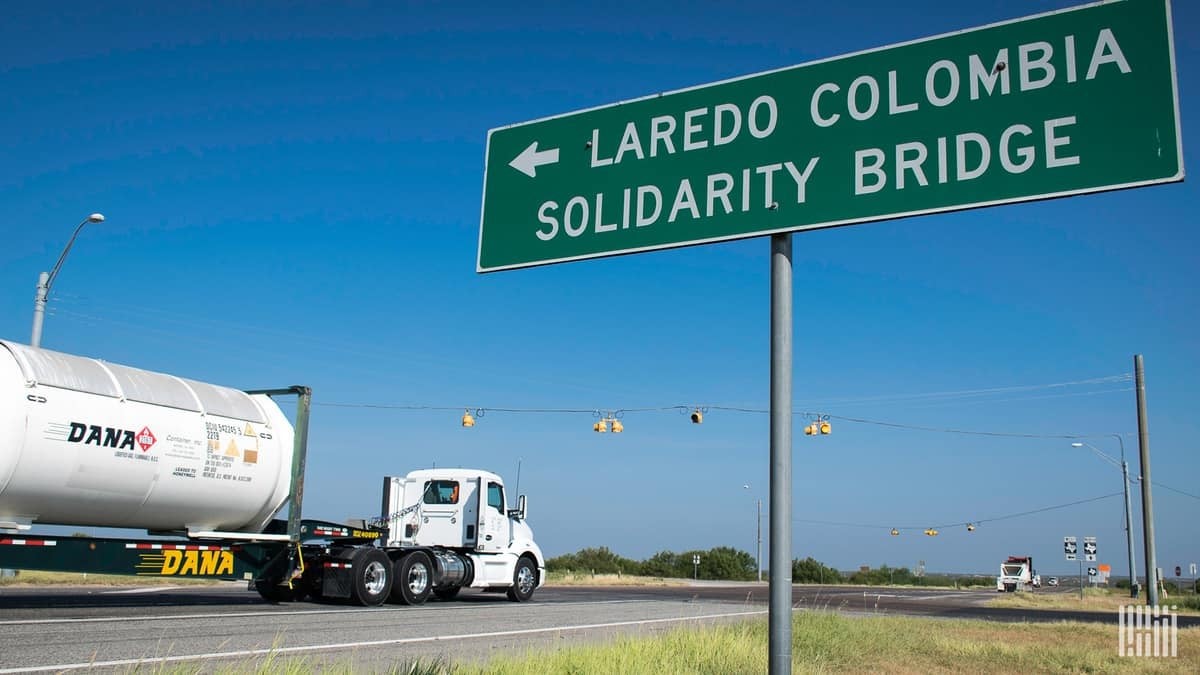
Commercial traffic through the state’s Colombia-Solidarity International Bridge has surged from roughly 800 freight movements in 2022 to more than 10,000 daily.
“Imagine the amount of commerce, revenue, money.” — Samuel García, Governor of Nuevo León
He said plans for two additional border crossings — including a freight crossing and the proposed Green Corridors project — could further expand capacity between Nuevo León and Texas. García described the projects as representing $17 billion in investment.
Security as a nearshoring enabler
García also emphasized security as a critical component of Nuevo León’s strategy for attracting foreign manufacturers and logistics companies.
“Every company we invite to Nuevo León, the first thing they ask is, what about safety?” — Samuel García, Governor of Nuevo León
The state has expanded its police capabilities with an aviation division containing 10 helicopters and a heavy-duty division with 100 trucks, He said Nuevo León also stations law enforcement personnel near border crossings and deploys roughly 200 to 300 officers to patrol major highways.
Industrial zones and logistics targeting
One of the most freight-focused initiatives García outlined Thursday involves a new industrial development zone near the Colombia border crossing.
The project is part of the Mexican federal government’s Plan México industrial development initiative, which García said offers significant tax incentives for companies establishing operations in designated industrial zones.
Nuevo León plans to open a roughly 40-hectare industrial zone near the Colombia crossing and new highway infrastructure. García pitched the location directly to U.S. manufacturers and logistics companies whose primary business involves assembling products in Mexico and shipping them back across the border.
Nuevo León is also developing a larger, roughly 988-acre industrial zone in Pesquería, near automotive manufacturing operations including Kia and Ternium. García said approximately 400 Tier 1, Tier 2 and Tier 3 suppliers from the U.S. and Asia are already clustered around the area’s automotive industry.
$135 billion FDI and deep Texas-Mexico integration
García framed the infrastructure push against what he described as an unprecedented wave of investment into Nuevo León.
The governor said the state has attracted $135 billion in foreign direct investment during roughly four years of his administration, compared with $11 billion during the previous governor’s six-year term. García said about 65% of the components used in Tesla’s Model Y produced in Austin come from Monterrey-area suppliers.
“That’s how deep we are connected with Texas. If both winners share technology, share companies, share this cooperation, I think that the best is yet to come.” — Samuel García, Governor of Nuevo León
NADBank commits $164M to border water resilience
The North American Development Bank recently announced $164 million in water conservation investments in Texas’ Lower Rio Grande Valley, while advancing additional water reliability projects across northern Mexico.
The investments, announced Thursday during the NADBank Summit 2026 in San Antonio, are part of the bank’s Water Resiliency Fund, which aims to improve water conservation, efficiency and supply reliability in drought-stricken communities along the U.S.-Mexico border.
Source: FreightWaves
Compiled from international media by the SCI.AI editorial team.