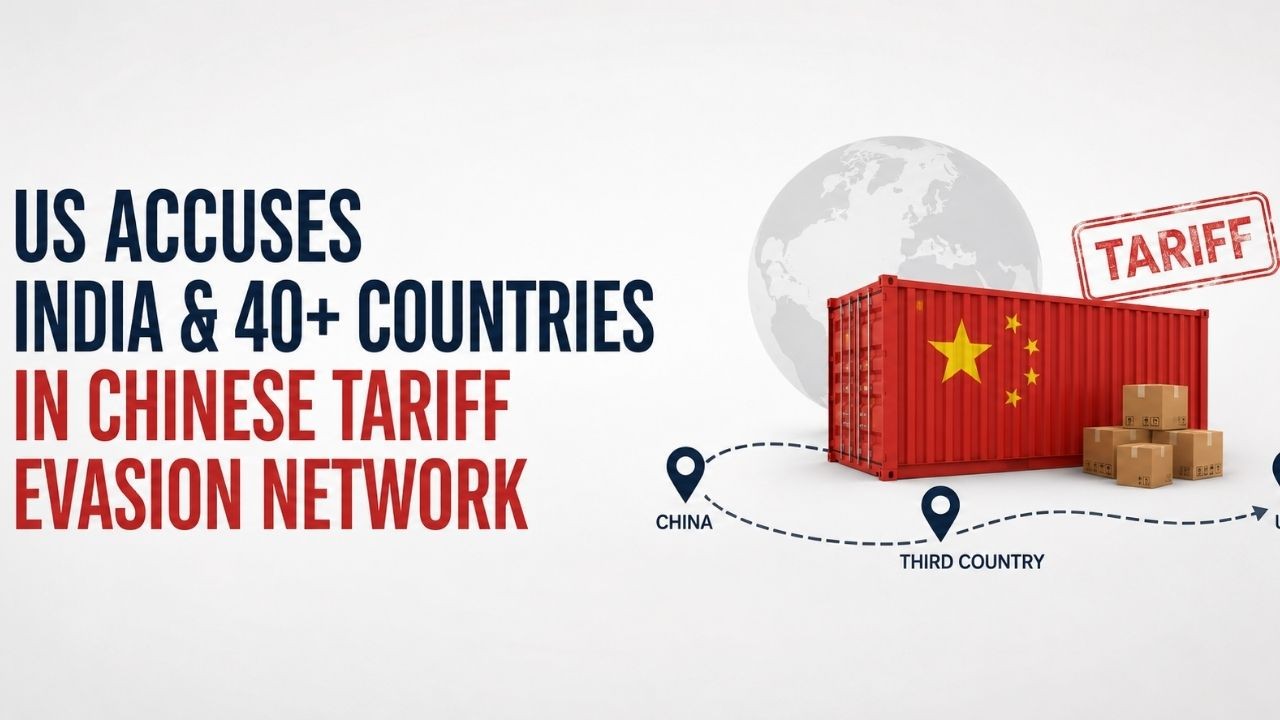
According to Logistics Insider, the United States government has launched a comprehensive investigation into a global network of countries accused of facilitating the evasion of American tariffs on Chinese goods. The allegations, which impact more than 40 countries including India, Mexico, Canada, and the European Union, allege the existence of a “shadow transshipment network” designed to circumvent steep duties imposed on Chinese exports.
The core of the accusations stems from a report titled “The Great Transshipment Scam,” released by Peter Navarro, the senior trade adviser to President Donald Trump. The document outlines how Chinese manufacturers allegedly utilize third-party nations to bypass the 2018 Section 301 tariffs, which were originally implemented in response to what the US administration described as unfair trade practices by Beijing.
Scale of Alleged Trade Diversion
The report presents a wide range of financial estimates regarding the impact of these transshipment activities. It suggests that the annual value of goods being rerouted through third countries could range between $40 billion and $303 billion, depending on the specific methodology used to calculate the scale of the trade. These figures underscore the significant potential revenue impact on US customs collections if the allegations are substantiated.
Navarro highlighted that the practice of using intermediary countries became increasingly prevalent following the imposition of the initial tariffs in 2018. The report identifies several major US trading partners as key nodes in this network, including Mexico, Canada, the European Union, India, Japan, and South Korea.
Scrutiny of Indian Manufacturing Hubs
India has been specifically highlighted in the allegations, with the report pointing to the Pune-Gujarat-Chennai manufacturing belt as a primary area of concern. The document alleges that this region is involved in absorbing Chinese-origin pumps and compressors, which are then processed, relabeled, or repackaged before entering the US market.
The US authorities claim that these supply chains exploit countries with lower labor costs, lighter customs oversight, free-trade zones, or favorable access to the American market. The report further alleges that these networks could impact established supply chains serving major US industrial centers, specifically naming Cincinnati, Dayton, and Columbus as affected hubs.
However, the report clarifies that being named in the document does not definitively prove that Indian companies or shipments have violated US customs or tariff rules. Legitimate manufacturing, processing, and investment activities frequently involve the use of imported Chinese components before final products are exported, which can create ambiguity in origin determination.
Deployment of AI Surveillance Tools
To combat these alleged evasion tactics, the United States plans to deploy a new artificial intelligence system dubbed “Detective Border.” This system is designed to analyze multiple data points to identify goods that may have been routed through third countries to circumvent tariffs. The system is expected to evaluate shipment records, routing histories, product classifications, ownership connections, declared production capacity, and other trade patterns.
The “Detective Border” system will utilize anomaly detection and computer vision technologies to flag potentially high-risk shipments. The primary objective is to distinguish between legitimate nearshoring and foreign investment activities, which are encouraged by US policy, and illegal transshipment networks that undermine tariff structures.
US authorities indicated that the findings generated by the AI system could lead to various enforcement measures, including the collection of additional duties, the imposition of penalties, and the issuance of exclusion orders. For global supply chains, this development signals a significant increase in scrutiny regarding country-of-origin declarations, customs documentation, routing patterns, and supplier networks.
The move represents a broader shift in US trade enforcement, with customs authorities increasingly relying on supply-chain data and advanced technology to trace the origin and movement of goods, rather than relying solely on the declarations made at the point of entry.
Source: logisticsinsider.in
Compiled from international media by the SCI.AI editorial team.