Skip to content

Last Mile · Supply Chain

Analysis

O’Neill Logistics deploys 24 Robust.AI Carter robots in Q4

O’Neill Logistics will deploy 24 Robust.AI Carter mobile robots across its New Jersey and Georgia facilities in Q4 2026. The robots will support retail, DTC, and omnichannel fulfillment at a 1 million square-foot Savannah site and a Monroe, NJ hub. Designed for human collaboration, Carter enables system-directed picking and light-directed putting without new hardware. O’Neill Logistics operates ~2 million square feet nationally. Stephen Reilly, director of industrial engineering, emphasized productivity gains without floor complexity. Robust.AI CEO Anthony Jules stressed automation built "for people, not just around them."

Original source: digitalcommerce360.com

O’Neill Logistics deploys 24 Robust.AI Carter robots in Q4

Ask SCI.AI about this story

📋 本文要点

O’Neill Logistics will deploy 24 Robust.AI Carter mobile robots across its New Jersey and Georgia facilities in Q4 2026. The robots will support retail, DTC, and omnichannel fulfillment at a 1 million square-foot Savannah site and a Monroe, NJ hub. Designed for human collaboration, Carter enables system-directed picking and light-directed putting without new hardware. O’Neill Logistics operates ~2 million square feet nationally. Stephen Reilly, director of industrial engineering, emphasized productivity gains without floor complexity. Robust.AI CEO Anthony Jules stressed automation built "for people, not just around them."

According to www.digitalcommerce360.com, third-party logistics provider O’Neill Logistics will deploy 24 mobile robots from Robust.AI across its facilities in New Jersey and Georgia, with the rollout scheduled to go live in Q4 2026.

Deployment scope and facility footprint

The Carter robots will operate in two key U.S. distribution hubs: a facility in Monroe, New Jersey, supporting retail and direct-to-consumer (DTC) fulfillment, and a 1 million square-foot site in Savannah, Georgia, dedicated to omnichannel order fulfillment. Collectively, O’Neill Logistics operates approximately 2 million square feet of national distribution space — a scale that underscores the strategic importance of automation in maintaining throughput and labor efficiency.

Technology integration and operational goals

Robust.AI describes the Carter model as a collaborative mobile robot designed to integrate seamlessly into existing workflows without requiring infrastructure overhauls. Its software-defined functionality enables order fulfillment picking, point-to-point transport, and mobile sorting — all without additional hardware investment. According to the source, the system automates repetitive material handling tasks, reduces unproductive walking by warehouse associates, and enables faster, more flexible order fulfillment. The deployment directly supports O’Neill Logistics’s objective to improve order fulfillment efficiency for both retail and DTC clients.

Human-centered automation design

Stephen Reilly, director of industrial engineering at O’Neill Logistics, emphasized workforce alignment in the announcement:

“We needed automation that would make our associates more productive without adding complexity to the floor. Robust.AI’s system-directed picking, light-directed putting, and the ability to run a lean fleet gave us everything we were looking for. We’re confident this is the right platform to grow with as our business scales across both sites.” — Stephen Reilly, director of industrial engineering, O’Neill Logistics

Strategic rationale and leadership perspective

Anthony Jules, co-founder and CEO of Robust.AI, framed the partnership around human augmentation rather than replacement. He stated that his company builds automation “that works for people, not just around them.” The source notes that O’Neill Logistics has built its reputation on engineering smarter supply chains — a context in which Carter was specifically designed to deliver productivity gains from day one while empowering frontline workers. This philosophy aligns with broader industry trends: recent moves by Nestlé (opening an automated distribution center in California in June 2026) and Home Depot (acquiring Simpl Automation in April 2026) reflect accelerating adoption of AI-driven fulfillment tools among major U.S. logistics and retail operators.

Source: digitalcommerce360.com

Compiled from international media by the SCI.AI editorial team.
Ask SCI.AI Finished reading? Continue with SCI.AI. Explore the related policy, route, company and historical context. Continue asking
Stay ahead of supply chain shifts

One email a week: the stories that matter and new risk events — in English, free.

Prefer RSS? Articles Risk events

M&S backs £340M warehouse automation with TGW
Last Mile

M&S backs £340M warehouse automation with TGW

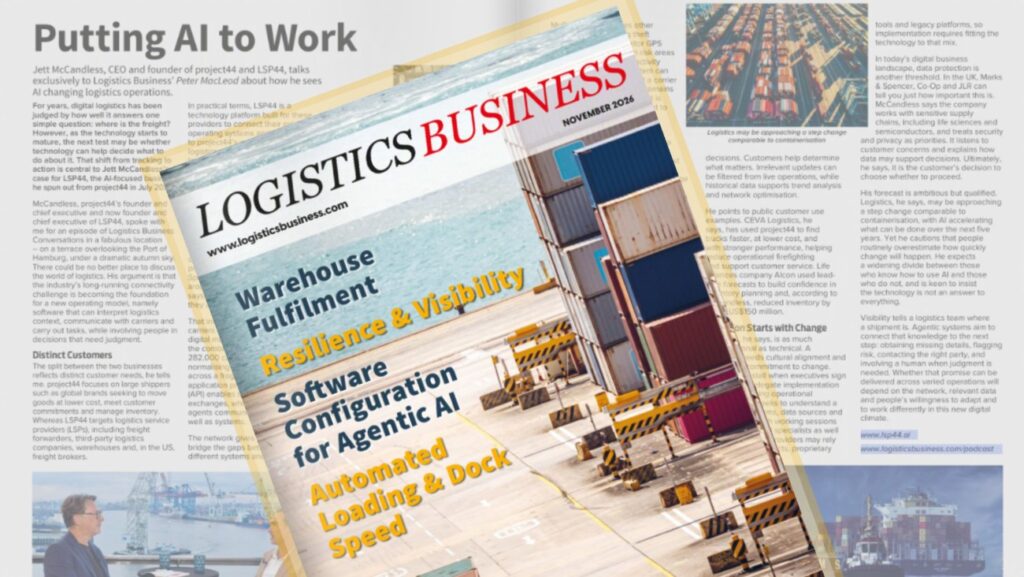
The November 2026 issue of Logistics Business Magazine, published on November 6, 2026, leads with an interview with project44 and LSP44 founder Jett McCandless on the shift from shipment visibility to AI-powered decision-making. TGW Logistics details its £340 million automation project for Marks & Spencer's new Daventry grocery fulfilment centre, while a THG Fulfil and Footasylum project has introduced 85 robots and 96,000 storage locations. Joloda Hydraroll discusses automated trailer loading in under 10 minutes, and UPS Europe, Middle East and Africa President Daniel Carrera explains why resilience now matters as much as efficiency.

Amazon lifts 2026 capex to $220B as warehouse automation hits $30B
Last Mile

Amazon lifts 2026 capex to $220B as warehouse automation hits $30B

Apparel supply chain investment is pivoting from volume growth to yield and efficiency, with warehouse automation spending reaching an estimated $30 billion this year. Amazon raised its 2026 capex forecast to about $220 billion from $131 billion in 2025, UPS has automated 63 percent of hub volume and invested over $100 million in RFID, and FedEx is pushing capex down toward 4 percent of revenue while returning $4.1 billion in spin-off proceeds to debt reduction. Maersk has earmarked $10 billion to $11 billion for ports and integrated logistics, and Gartner sees global IT spending rising 14.2 percent to $6.37 trillion.

India quick commerce to need 75M sq ft logistics space by 2030
Last Mile

India quick commerce to need 75M sq ft logistics space by 2030

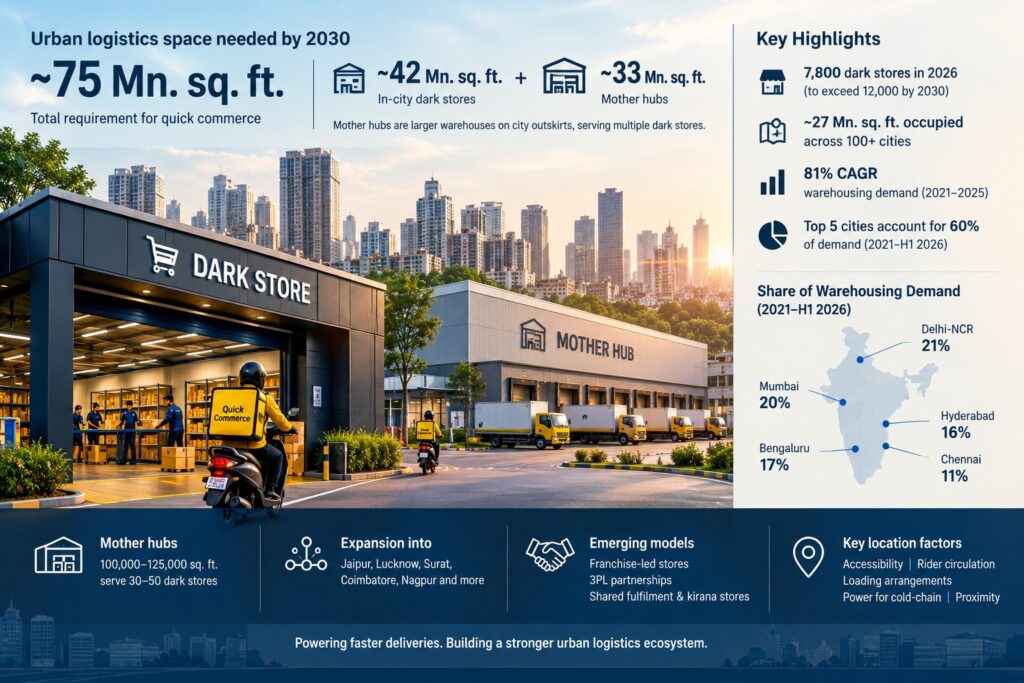
India's quick commerce sector is projected to require about 75 million sq. ft. of urban logistics space by 2030, including 42 million sq. ft. of in-city dark stores and 33 million sq. ft. of mother hubs, according to a CBRE South Asia report. The ecosystem has scaled to 7,800 dark stores in 2026 across more than 100 cities and is expected to exceed 12,000 stores by 2030. Quick-commerce warehousing demand grew at an 81% CAGR between 2021 and 2025, with annual take-up rising from 3.1 million sq. ft. in 2024 to 4.3 million sq. ft. in 2025. Delhi-NCR, Mumbai and Bengaluru accounted for nearly 60% of demand.

Welcome Back!

Login to your account below

Create New Account!

Fill the forms below to register

Retrieve your password

Please enter your username or email address to reset your password.

Scan to share via WeChat

Open WeChat and scan the QR code to share

QR Code

Add New Playlist