According to www.seatrade-maritime.com, Europe’s air conditioning market — valued at $26.5 billion in 2025 — is projected to reach $46 billion by 2034, growing at a 6.4% CAGR, as rising temperatures accelerate household adoption across the EU.
A climate-driven market shift
Northern Europe has warmed by roughly 2.5°C over the past century, turning extreme heat events — such as Paris’s 40.9°C in June 2026, Berlin’s 39.9°C, and Vienna’s 40°C — from anomalies into annual occurrences. This climatic shift underpins a structural change in residential infrastructure: only 5% of UK households and 3% of German households have air conditioning, compared with a global average near 37%. Eurostat data shows EU household cooling energy use doubled between 2018 and 2024, while the UK Climate Change Committee estimates 22% of British buildings will require active cooling under 2°C of warming.
Policy accelerates deployment
The EU’s revised Energy Performance of Buildings Directive (EPBD IV), transposed by member states by May 2026, formally reclassifies cooling as essential building infrastructure rather than a discretionary purchase. As noted in yesterday’s Financial Times editorial titled “It’s time for Europe to embrace air conditioning,” the debate has moved beyond ideology: “A technology capable of easing record heat has become oddly entangled in culture wars — a rekindled German dispute over heat pumps, French objections that large-scale cooling plans carry emissions risks — even though Europe’s low AC penetration was climatic, not ideological, and that climate no longer exists.” The editorial advocates prioritising vulnerable facilities like hospitals and schools, easing retrofit rules, and favouring refrigerant-light systems.
Supply chain dominance: China fills the gap
Europe lacks domestic manufacturing capacity to meet surging demand. Volume growth — particularly in portable and mini-split residential units — is supplied almost entirely by Midea, Gree, Haier, and TCL. China exported an estimated $27.2 billion worth of air conditioners globally in 2025, accounting for nearly 40% of world exports. EU imports of Chinese units hit a record $3.76 billion in H1 2026, up 43.2% year-on-year; Midea’s shipments to Spain and France reportedly surged 108%. A standout product is Midea’s PortaSplit — a portable unit designed specifically for European constraints (no wall drilling, no facade permits) — developed after the 2022 heatwave and named to Time’s Best Inventions list. Chinese exports of AC components — compressors and control boards — reached $1.04 billion in the first five months of 2026 alone.
Container shipping impacts intensify
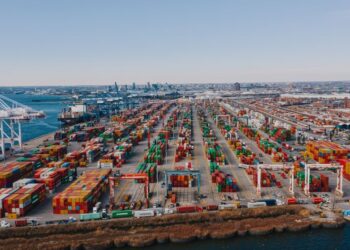
Three measurable effects are now visible. First, port congestion has shifted westward: Rotterdam import dwell times stretched toward four days, while export dwell approached seven days; Antwerp emerged as a more resilient alternative, and Hamburg-to-central-Europe rail outperformed trucking. Second, freight rates absorbed a real demand shock: Shanghai–North Europe spot rates rose 6% to $3,342 per TEU in a mid-2026 reporting period, with 40ft rates up 12% to $5,766. Third, modal shift accelerated — manufacturers increasingly route via the China–Europe Railway Express, cutting delivery from 30–40 days to roughly 10 days to meet heatwave-triggered demand windows.
Strategic implications for logistics
Unlike friction around EVs or solar, this dynamic involves no domestic industry being undercut — only an urgent, apolitical household need met by the sole supply chain capable of rapid scale. Yet geopolitics intrude: the EU and China entered three months of bilateral trade talks in mid-2026 to address a large goods deficit, with AC exports now a visible line item. For shippers, seasonality is intensifying rather than smoothing; parts trade extends demand well beyond initial unit sales; European port and inland-rail resilience has become a live routing variable; and any full Red Sea/Suez return will collide with — not relieve — existing congestion, a critical consideration for 2026–27 capacity planning.
Source: Seatrade Maritime
Compiled from international media by the SCI.AI editorial team.