According to www.scmp.com, the US-China AI competition has shifted from model superiority to raw electricity economics — with solar power now priced at $0.02 per kWh in China and data center siting decisions increasingly driven by energy cost arbitrage.
The Commoditization of AI Models
Dr Andy Xie, a Shanghai-based independent economist specializing in China and Asia, argues that large language models are rapidly losing their differentiation edge. As open-source AI models proliferate across China — notably from DeepSeek and Zhipu AI — performance gaps with U.S. closed-source models have effectively vanished. According to the report, this convergence signals that AI is transitioning from proprietary technology to a commodity, much like steel or aluminium. The implication is structural: value no longer resides in model ownership but in service delivery efficiency.
“As AI models become interchangeable commodities, the contest is down to service prices — which are driven by electricity output and cost,”
“As AI models become interchangeable commodities, the contest is down to service prices — which are driven by electricity output and cost.” — Andy Xie, independent economist
This reframing upends the U.S. strategy of positioning its AI as a premium, globally dependent infrastructure — a goal the source describes as now appearing “like a pipe dream.”
Electricity as the New Battleground
With compute-intensive AI inference and training consuming vast amounts of power, electricity has become the dominant cost component for AI services — accounting for an estimated 60–70% of operational expenses in hyperscale data centers, according to industry benchmarks cited in related analyses. The U.S.-China contest thus pivots to two divergent energy pathways: America’s continued reliance on hydrocarbons versus China’s state-directed push toward renewable self-reliance and carbon neutrality. The outcome hinges not on algorithmic novelty but on which nation delivers cheaper, more reliable electrons at scale.
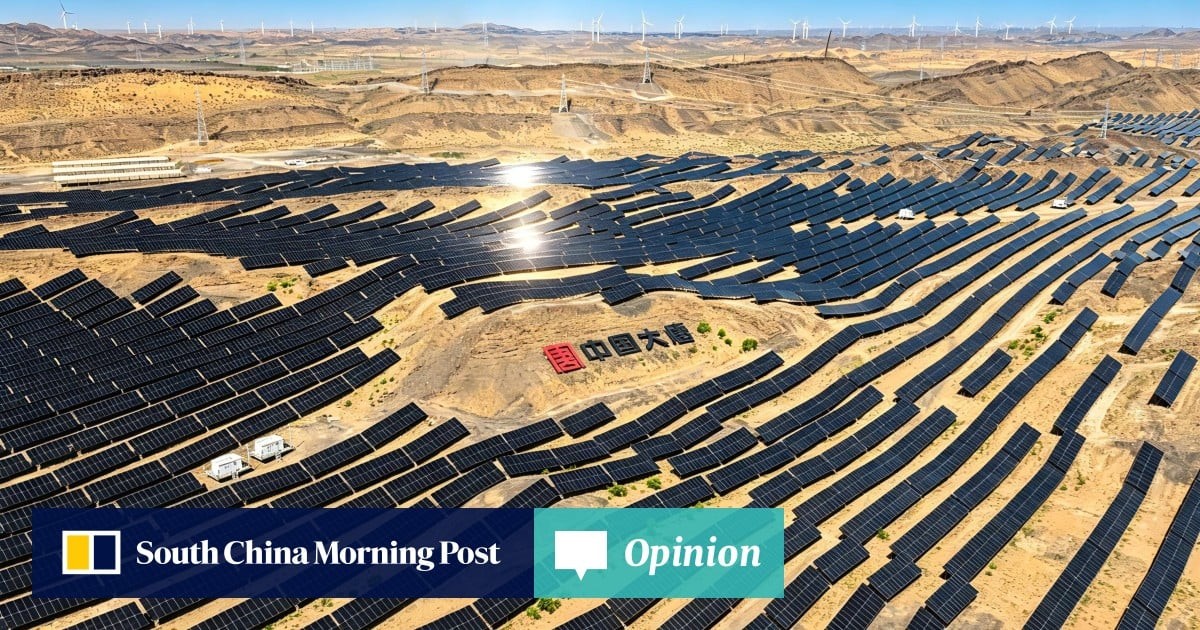
China’s renewable buildout has accelerated dramatically: solar and wind now supply over 35% of the country’s total electricity generation, up from just 12% in 2020. Crucially, the levelised cost of solar power fell to approximately $0.02 per kWh last year — a figure confirmed by multiple international energy agencies tracking Chinese utility-scale photovoltaic auctions. However, transmission losses and grid congestion mean delivering that power from western deserts to eastern industrial hubs can double end-user costs. Hence, the rational economic response — highlighted in the source — is co-locating AI infrastructure with generation: building data centers adjacent to solar farms in remote, high-irradiance zones like Gansu province’s Gobi Desert.
Strategic Siting and Infrastructure Realities
The Hongliuwa Photovoltaic Industrial Park in Jinta County, Gansu Province — located in China’s northwestern Gobi Desert — exemplifies this integrated strategy. Operational since early 2026, the park hosts over 2.8 gigawatts of installed solar capacity and is already powering adjacent AI compute clusters under pilot agreements with provincial data authorities. This geographic logic directly challenges U.S. assumptions about AI infrastructure centralization: whereas American cloud providers concentrate servers near fiber hubs and urban talent pools, China’s approach prioritizes proximity to low-cost electrons — even if it means deploying in sparsely populated, logistically complex regions.
Such siting decisions carry concrete supply chain implications. According to the source, cooling, power conditioning, and high-voltage direct current (HVDC) interconnection represent 42% of total capital expenditure for desert-based AI data centers — significantly higher than conventional builds. Yet these upfront costs are offset within 3.2 years due to electricity savings alone. For supply chain professionals, this signals a fundamental shift: procurement criteria now include kilowatt-hour cost curves, grid stability metrics, and land-use permits for remote energy zones — not just latency or bandwidth specs.
Global Implications and Industry Precedent
This electricity-first paradigm is not isolated to AI. Similar dynamics are reshaping semiconductor manufacturing, where TSMC’s Arizona fab faces $0.08/kWh average electricity costs versus $0.035/kWh at its Kaohsiung cluster — a differential driving renewed investment in on-site solar and battery storage. Meanwhile, European regulators are drafting binding requirements for AI providers to disclose energy sourcing, with enforcement scheduled for Q4 2027. These moves confirm that energy intensity is becoming a core KPI — one that cuts across chip design, model architecture, and infrastructure planning.
For global supply chain teams, the takeaway is operational: AI deployment decisions must now involve energy procurement officers, regional grid analysts, and land-use strategists — not just IT architects. As Dr Xie concludes, the race isn’t for smarter algorithms but for smarter electrons — and the winner will be the nation that most efficiently converts photons and wind into tokens.
Source: South China Morning Post
Compiled from international media by the SCI.AI editorial team.