According to erp.today, Agility Robotics — a Salem, Oregon-based robotics company — has announced plans to go public through a merger with Churchill Capital Corp XI, a special-purpose acquisition company (SPAC), in a deal valuing the firm at $2.5 billion.
First US-listed pure-play humanoid robotics company
If completed, the transaction would make Agility the first US-listed pure-play humanoid robotics company. The deal is expected to generate more than $620 million in gross proceeds, including cash held by Churchill Capital Corp XI and a private investment led by Foxconn. Agility intends to use the capital to expand commercial deployments, scale production of its next-generation Digit v5 robot, and advance product development.
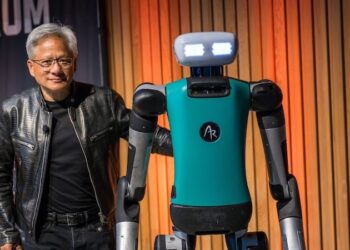
The company’s flagship platform, Digit, is designed for repetitive material-handling tasks — specifically moving totes and bins in warehouses and industrial facilities built for human workers. Unlike anthropomorphic prototypes developed elsewhere, Digit features birdlike legs and gripper-style hands optimized for function over form. As Jonathan Hurst, co-founder and Chief Robot Officer of Agility, explained to investors:
“We did not set out to build a machine that looks like a person. Digit has birdlike legs and gripper-style hands because the design is meant to fit the work.” — Jonathan Hurst, Co-founder and Chief Robot Officer, Agility Robotics
Commercial validation beyond demos
Agility’s Wall Street pitch rests on real-world operational evidence — not lab demonstrations. The company reports having logged 65,000 hours of real-world operations across customer sites. It has secured more than $300 million in multi-year contracted orders for Digit v5, subject to contractual milestones, from a pipeline of 30+ customers. These include major logistics and manufacturing firms: GXO, Schaeffler, Toyota, and Mercado Libre.
This demand-side traction differentiates Agility from competitors still operating in prototype or pre-commercial stages. Its commercial deployments are tied directly to industrial pain points: labor shortages, rising warehouse throughput pressure, reshoring initiatives, and supply chain resilience requirements. As Peggy Johnson, CEO of Agility, told investors, demand is being driven by three converging forces: companies reshoring production, an aging workforce retiring, and younger workers increasingly avoiding physically demanding, repetitive manual jobs.
ERP and WMS integration as the real test
For supply chain and operations leaders, the viability of humanoid robotics hinges less on mobility or appearance and more on interoperability. As the source states, the critical question is whether robots like Digit can integrate seamlessly into existing enterprise systems — specifically ERP and warehouse management systems (WMS), labor planning protocols, and safety governance frameworks. Agility’s public-market debut thus represents one of the first audited benchmarks for physical AI in enterprise operations.
Forbes noted that Agility’s listing will provide investors with transparent, publicly reported data on revenue, deployment costs, gross margins, production scalability, and customer adoption — metrics previously unavailable in the opaque private funding environment. This scrutiny aligns humanoid robotics with other supply chain technologies subject to rigorous ROI analysis. In a recent Q&A with SAP Labs, SAP’s AI roadmap explicitly extended into the longer-term integration of AI with physical operations — including robotics and industrial environments coordinated by enterprise software.
Operational finance replaces demo theater
The shift signaled by Agility’s SPAC move is fundamental: humanoid robotics is transitioning from “demo theater” to operational finance. Investors — and customers — are no longer evaluating robots based on spectacle or novelty. Instead, they’re assessing concrete performance indicators: deployment cost per unit, system uptime, throughput per shift, labor-cost savings per facility, and integration fidelity with core ERP and WMS workflows.
This financial and functional accountability elevates the conversation beyond hardware specs. As the source states, Agility’s pitch centers on solving tangible labor gaps in environments already optimized for people — not retrofitting facilities for robots. Digit v5 is described as an AI-enabled, cooperatively safe humanoid robot engineered to work alongside humans, not replace them outright. Its design philosophy reflects a pragmatic response to warehouse realities rather than speculative futurism.
Source: erp.today
Compiled from international media by the SCI.AI editorial team.