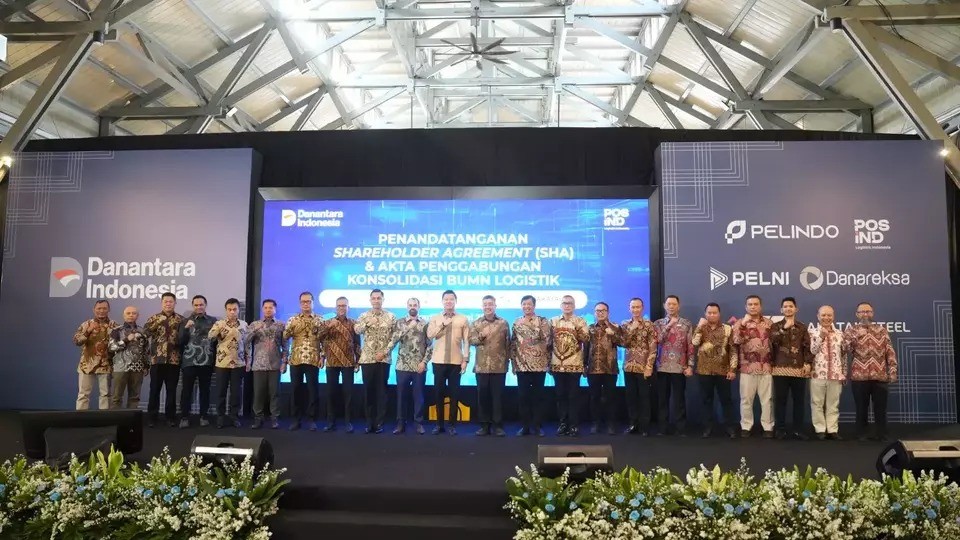
According to most1058fm.com, Indonesia has formally consolidated seven state-owned logistics enterprises into a single national holding structure, with PT Pelabuhan Indonesia (Persero) — known as Pelindo — taking majority control at 74.47%.
Consolidation Framework and Shareholding Structure
The consolidation was formalized through the signing of a Shareholder Agreement (SHA) and an Act of Merger for National Logistics BUMN, executed by Pelindo via its subsidiary PT Pelindo Sinergi Lokaseva (PSL). The move is part of the Indonesian government’s broader strategy, coordinated through BPI Danantara, to transform the national logistics sector.
The initial ownership structure of the merged entity comprises 74.47% held by the Pelindo Group, 9.24% by PT Pos Indonesia (Persero), 9.37% by PT Krakatau Bandar Samudera, and 6.92% distributed among other participating entities. As the majority shareholder, Pelindo will oversee the full integration process in line with the government’s established roadmap.
Seven Entities Unified Under One Surviving Company
The consolidation brings together seven logistics-focused state-owned enterprises: PT Multi Terminal Indonesia (MTI), PT Prima Indonesia Logistik (PIL), PT Pos Logistik Indonesia (POSLOG), PT Sarana Bandar Logistik (SBL), PT KBN Prima Logistik (KPL), PT Varia Usaha Dharma Segara (VUDS), and PT Krakatau Jasa Logistik (KJL). PT Multi Terminal Indonesia has been designated the surviving legal entity in the merger.
This structural unification aims to eliminate operational redundancies, optimize asset utilization across ports, industrial zones, and hinterland regions, and establish a unified service architecture for end-to-end logistics solutions. According to Aurelius Altius Rosimin, Senior Director of Corporate Strategy at PT Danantara Aset Manajemen, the integration “will strengthen synergy through the consolidation of capabilities, assets, and networks across companies.”
Strategic Rationale and Expected Outcomes
Achmad Muchtasyar, Director General of Pelindo, described the consolidation as a strategic step to enhance Indonesia’s global logistics competitiveness through tighter collaboration among state-owned enterprises. He emphasized that stronger synergy will support the creation of a more integrated logistics ecosystem, reduce national logistics costs, and improve service quality for customers.
“This consolidation is a strategic step to increase national logistics competitiveness through closer collaboration among state-owned enterprises.” — Achmad Muchtasyar, Director General of Pelindo
The initiative aligns with Indonesia’s national logistics efficiency targets, including reductions in logistics cost-to-GDP ratio — currently estimated at 23.5% — and aims to accelerate infrastructure connectivity across the archipelago’s 17,000 islands. Faruq Hidayat, Director General of PT Pelindo Sinergi Lokaseva, underscored the importance of port-related logistics integration, stating the merger represents “a critical momentum to deliver more integrated and efficient logistics services.”
The government expects measurable improvements within three years of full integration, including faster cargo dwell times at major ports such as Tanjung Priok and Belawan, improved inter-island multimodal coordination, and enhanced digital visibility across supply chain nodes. Pelindo has committed to reinforcing port logistics services and strengthening physical and digital linkages between ports, industrial estates, and hinterland distribution centers.
Implementation Timeline and Governance Oversight
The consolidation process began in earnest following the SHA and merger act signing on 5 July 2026, with implementation scheduled to proceed in phases over the next 24 months. The government has assigned BPI Danantara — the state-owned investment holding company managing strategic national assets — to supervise governance, performance metrics, and regulatory compliance throughout the transition.
Under the current plan, the final national logistics holding entity is expected to be fully operational by Q3 2028. This timeline includes harmonizing IT systems, standardizing service-level agreements, integrating human resources policies, and consolidating financial reporting under International Financial Reporting Standards (IFRS). The effort reflects Indonesia’s broader push to improve its Logistics Performance Index (LPI) ranking, where it currently stands at 3.17 out of 5 — below regional peers like Vietnam (3.42) and Malaysia (3.68).
Source: most1058fm.com
Compiled from international media by the SCI.AI editorial team.