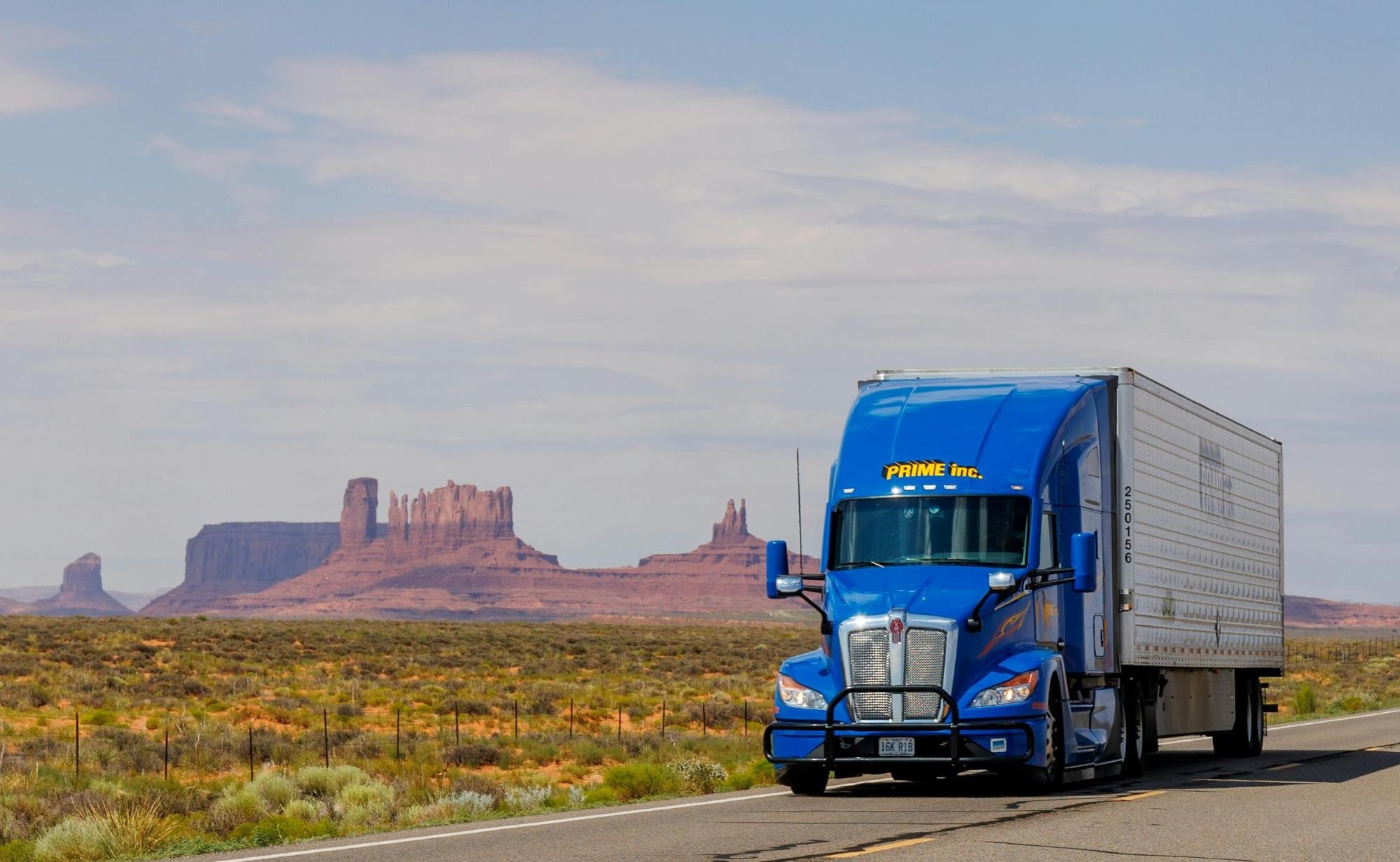
Prime Inc. has taken the IRS to federal court to recover more than $11 million in excise tax it paid on the diesel that ran its refrigeration units, arguing that fuel never propelled a truck down the highway and should never have been taxed as if it did.
The legal claim
The diesel that runs the reefer unit is burned to keep freight cold, not to move the truck, and the federal excise tax on that fuel is refundable as a nontaxable off-highway use, a credit available to large carriers and owner-operators alike.
A reefer unit burns its own diesel. Anyone who runs refrigerated freight knows this, because they are paying for two fuel burns on every load: the diesel that moves the truck down the road, and the separate diesel that runs the refrigeration unit on the trailer keeping the freight cold. Both come out of the same pocket. Only one of them is actually pushing the truck down the highway.
Prime Inc., the Springfield, Missouri carrier that runs roughly 9,000 trucks and is one of the largest refrigerated carriers in the country, has decided that the distinction is worth more than $11 million, and it is now making that case in federal court against the Internal Revenue Service.
The case, New Prime, Inc. v. United States, was filed June 16, 2026 in the U.S. District Court for the Western District of Missouri. In a complaint filed June 16, 2026, Prime petitioned the IRS for a refund of $11,016,644 in federal fuel excise tax that it paid between 2018 and 2021. The basis for the claim is specific and, on its face, straightforward. Prime argues that the diesel used exclusively to power the refrigeration units on its trailers, fuel that never propelled a vehicle, constitutes an off-highway, nontaxable business use, and that taxing it as standard highway fuel was improper.
The logic rests on what the federal fuel excise tax is actually for. That tax, currently 24.3 cents on undyed diesel, exists to fund “highway infrastructure”. It is, in effect, a user fee for the roads. Fuel that runs a refrigeration unit on a trailer does not use the highway in that sense. It is burned to spin a compressor and keep a box cold, whether the truck is rolling down the interstate or parked at a dock overnight. Prime’s position is that fuel doing that work was never highway fuel and should never have carried the highway tax. This is where technically, the point is very valid.
This is not Prime’s first attempt to recover the money. complaint, Prime previously filed for refunds covering the periods ending March 31, 2018 through December 31, 2020, and the IRS denied all of those claims. Prime then filed an additional claim on September 12, 2025 covering 2021, and as of the complaint, it had received neither a refund nor a denial notice for that year. Having exhausted the administrative route without success, Prime has moved the fight to federal court. In addition to the $11 million, it is seeking litigation costs, attorney fees, and prejudgment and post-judgment interest.
The part that actually matters for small carriers
Here is what makes this more than a story about a big carrier and a big number. The tax credit Prime is fighting over is not some exotic provision available only to fleets with 9,000 trucks and a legal department. It is a standard, established federal fuel tax credit, and it is available to any business burning taxed fuel for a nontaxable off-highway use, including the owner-operator pulling a single reefer.
The IRS Fuel Tax Credit covers the federal excise tax paid on undyed diesel that is used for a qualifying nontaxable purpose. Reefer fuel is one of the textbook examples. So is fuel burned by auxiliary equipment that does not propel the truck, generators/APUs, certain power take-off (PTO) applications, and similar equipment that runs off diesel but never turns a drive wheel. The credit refunds the federal excise tax on that fuel, which is 24.3 cents on undyed diesel and 18.3 cents on gasoline. Those rates are exactly the federal excise tax paid at the pump.
Run the numbers on what that means for a reefer operation. A refrigeration unit can burn somewhere in the range of a half-gallon to a gallon of diesel depending on the unit, the load, the ambient temperature, and how hard it is working. An operator running a reefer hard across a year can easily burn well over a thousand gallons of diesel just in the refrigeration unit. At 24.3 cents a gallon, the recoverable excise tax on that fuel runs into real hundreds of dollars money that most owner-operators simply never claim because they did not know the reefer fuel was separable from the highway fuel for tax purposes.
How the credit actually gets claimed
For a small carrier who wants to capture this, the mechanics are worth knowing in plain terms, with the strong caveat that this is a conversation to have with a qualified tax professional before filing anything.
The most common route is IRS Form 4136, Credit for Federal Tax Paid on Fuels, which is filed with the annual income tax return. You report the gallons used for the nontaxable purpose, multiply by the per-gallon credit rate, and claim the credit against your income tax. For operators who would rather not wait until they file their annual return, there are two other paths: Form 8849, which is used to claim a periodic refund during the year, and Form 720 Schedule C, for those who already file the quarterly federal excise tax return. There is a threshold worth noting on the periodic refund route: you generally need at least $750 in claimable credit accumulated before you can file a periodic Form 8849 claim, and if you do not reach that in a quarter, it carries forward.
There is also a newer wrinkle that matters. Starting with the 2024 tax year, the IRS requires claimants to attach a “Statement Supporting Fuel Tax Credit Computation” to the return, documenting how the claim was calculated. This is part of a broader and very real IRS crackdown, which leads directly to the most important point.
Why documentation is everything here
The fuel tax credit has been one of the most abused credits on the books, and the IRS knows it. The agency has assessed more than $162 million in penalties on improtax credit claims since 2022, and it imposes a $5,000 civil penalty under tax code section 6702(a) for frivolous claims. The IRS cross-checks claims against EIA fuel price data to verify that the numbers are realistic, and a claim that looks disproportionate to the size of the operation will draw scrutiny.
None of that should scare a legitimate reefer operator away from a credit they are genuinely entitled to. But it does mean the credit lives or dies on documentation. The operator who can cleanly show how many gallons went into the reefer unit, separate from the gallons that went into the tractor, is in a strong position. The operator who estimates a number with nothing behind it is asking for trouble.
The cleanest way to build that record is to separate the fuel purchase at the point of sale. Some operators use a dedicated fuel card or a separate transaction specifically for reefer fuel, which creates a clean, automatic pashowing exactly how much diesel went into the refrigeration unit. Reefer fuel is often purchased separately at the pump anyway, which makes this more practical than it sounds. That clean separation is the difference between a credit you can defend and a number you are guessing at.
What the lawsuit tells us
Prime’s case is a reminder that even the largest, most sophisticated carriers are scrutinizing every line of their cost structure in the current environment, and that the federal fuel excise tax on non-propulsion fuel is real money worth fighting for. The fact that the IRS denied Prime’s earlier administrative claims, and that Prime felt strongly enough to take the dispute into federal court, signals this is a genuinely contested question at the dollar amounts a large fleet generates. How the court rules could clarify the treatment of reefer fuel for the entire industry.
But an owner-operator does not need to wait for the outcome of Prime’s lawsuit to act on the underlying principle, because the Fuel Tax Credit for reefer and auxiliary fuel is already established and already claimable through the normal process. What Prime is litigating is a denied claim at a large scale. What a small carrier faces is simply whether they are filing the routine credit at all. Most are not.
The takeaway is not complicated. If you run refrigerated freight, or you burn diesel in auxiliary equipment that does not move your truck, the federal excise tax on that fuel is very likely refundable, and it is money you are entitled to keep. Track the gallons cleanly, keep the documentation airtight, talk to a tax professional who handles trucking, and stop leaving that money with the IRS. Prime is going to court for its share. Yours is sitting in a form most owner-operators have never filed.
Source: FreightWaves
Compiled from international media by the SCI.AI editorial team.